
M2 High Speed Tool Steel Chemical Analysis
Common M2 Tool Steel Related Specifications and Equivalents
| Country | USA | German | Japan |
| Standard | ASTM A600 | DIN EN ISO 4957 | JIS G4403 |
| Grades | M2 | 1.3343 | SKH51 |
other Known Names: HS 6-5-2, S600 Steel, E M2, REX M2®, P6M5, 6-6
ASTM M2 Tool Steel Chemical Composition Properties
| ASTM A600 | C | Mn | P | S | Si | Cr | V | Mo | W | |||||||
| M2 regular C | 0.78 | 0.88 | 0.15 | 0.40 | 0.03 | 0.03 | 0.20 | 0.45 | 3.75 | 4.50 | 1.75 | 2.20 | 4.50 | 5.50 | 5.50 | 6.75 |
| DIN ISO 4957 | C | Mn | P | S | Si | Cr | V | Mo | W | |||||||
| 1.3343 | 0.86 | 0.94 | … | … | … | … | … | 0.45 | 3.80 | 4.50 | 1.70 | 2.10 | 4.70 | 5.20 | 5.90 | 6.70 |
| JIS G4403 | C | Mn | P | S | Si | Cr | V | Mo | W | |||||||
| SKH51 | 0.80 | 0.88 | … | 0.40 | 0.03 | 0.03 | … | 0.45 | 3.80 | 4.50 | 1.70 | 2.10 | 4.70 | 5.20 | 5.90 | 6.70 |
M2 Tool Steel Chemical composition
0.85% Carbon improves the steel hardness, tensile strength, and improves wear resistance. As the amount of carbon in a steel alloy increases, the ductility trends downward.
4.15% Chromium increases tensile strength, hardness, and toughness. Since the chromium appears in low amounts, M2 is highly vulnerable to rusting and not a good steel knife for use in humid or saltwater conditions.
5.00% Molybdenum increases the hardness, strength, and toughness of this steel.
1.85% Vanadium boosts the steel toughness while increasing its strength and wear resistance.
0.280% Manganese increases the hardenability and wear resistance of this steel.
0.30% Nickel adds to the steel toughness.
0.45% Silicon improves the steel strength.
0.25% Copper helps prevent surface oxidization, thereby promoting corrosion resistance.
0.030% Phosphorous improves the machinability, strength, and hardness of M2 steel.
0.030% Sulfur boosts machinability. This element has to be used in small amounts since too much of it can increase impurity level in the steel alloy and affect its strength.
The M2 tool has a combination of high Tungsten, Nickel and Chromium, which makes hard steel with great toughness and corrosion resistance.
M2 Tool Steel Equivalent And Comparison
M2 Tool Steel Vs D2
AISI D2 is close steel to M2 and is at times considered its equivalent. Not to forget, D2 is also popular in the knife manufacturing industry. When these two steels are treated to the same hardness level, M2 will offer better wear resistance and toughness. But D2 offers better corrosion resistance and is more difficult to sharpen than M2 tool steel.
M2 Vs M4 Tool Steel
As we have mentioned earlier, M4 tool steel replaced M2 around 2005. As the upgraded version of the famous M2 steel, the M4 steel delivers higher toughness at the same hardness as M2. Because of the higher carbide volume in M4 than in M2, it’s less challenging to grind, offers increases wear resistance and has better edge retention than M2 at the same hardness. However, anti-corrosion performance is still wanting for both steels.
Fushun Special Steel LTD CO
Fushun Metal is a large special steel manufacuter and supplie. We are metal experts and have been providing quality customer service and products since 1998.
At Fushun Metal, we supply a wide range of metals for a variety of applications. Our products/stock includes: stainless steel, alloy steel, spring steel, tool steel, high speed steel, mould steel, nickel alloy.
Our hot rolled and cold rolled steel is available in a wide range of shapes including: bars, tubes, sheets and plates. We can cut metal to your exact specifications.
Send your inquiry information to us and get a free quotation today!
Reading the analysis like a toolmaker
M2 is defined by balance, not by any single element. The carbon sets the hardness ceiling; tungsten and molybdenum deliver red hardness; vanadium delivers wear resistance; chromium delivers hardenability. Move one and the others have to follow.
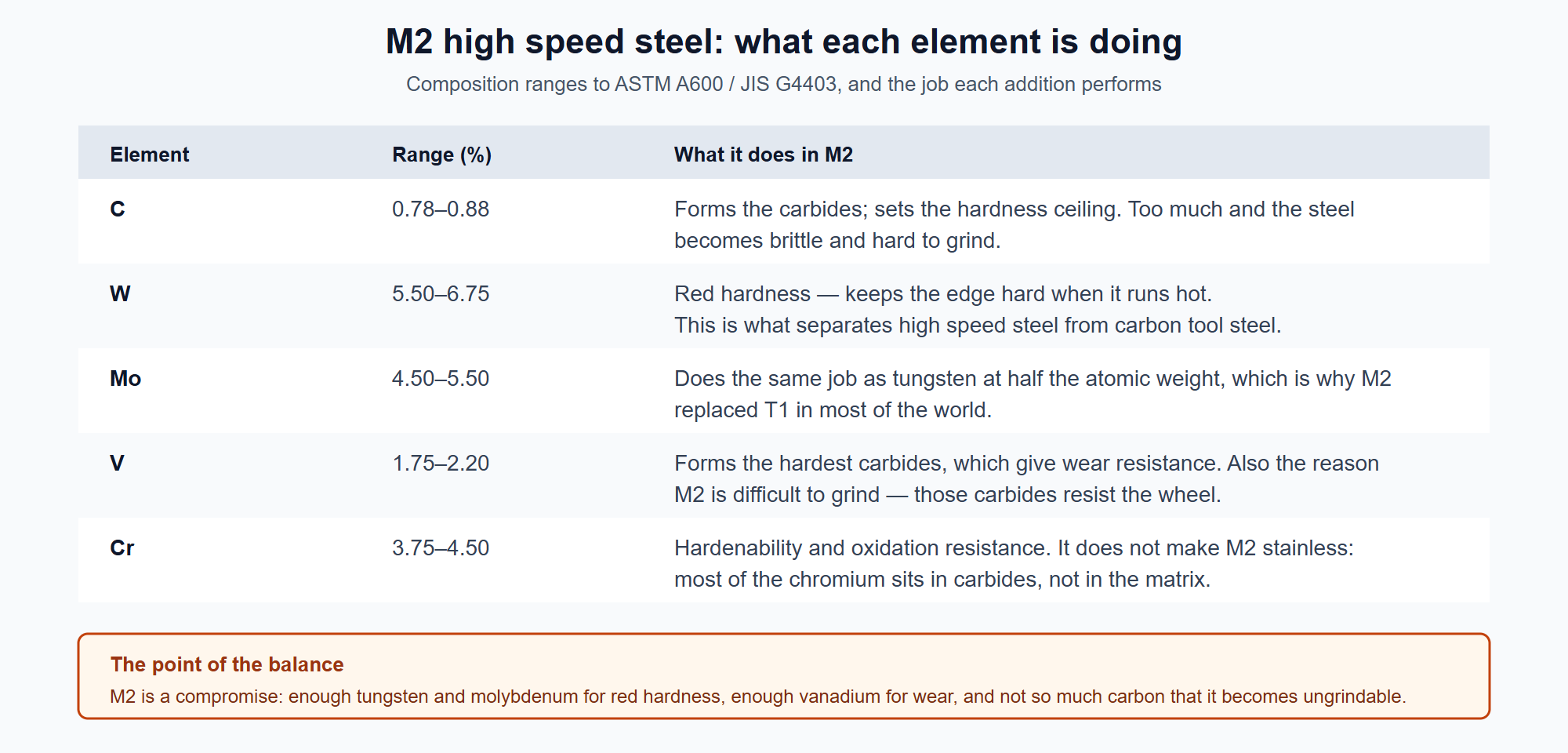
That is why the specification gives ranges rather than single values, and why two heats at opposite ends of the carbon range machine differently even though both are “M2”.
What an out-of-range element does on the floor
| Element | Too low | Too high |
|---|---|---|
| Carbon | Will not reach 64 HRC | Brittle, difficult to grind, cracking in heat treatment |
| Tungsten | Loses red hardness — the edge softens in a hot cut | Segregation, poor toughness |
| Vanadium | Wear resistance drops | Very hard carbides that resist grinding |
| Chromium | Shallow hardening, soft core | Retained austenite after quenching |
What to check on the certificate
Three things beyond the chemistry: the annealing hardness (should be around 235 HB max for machinability), the decarburisation depth (a soft skin will not hold an edge), and the carbide banding rating if the bar is going into a critical tool. A certificate that gives only the analysis is telling you half the story.