
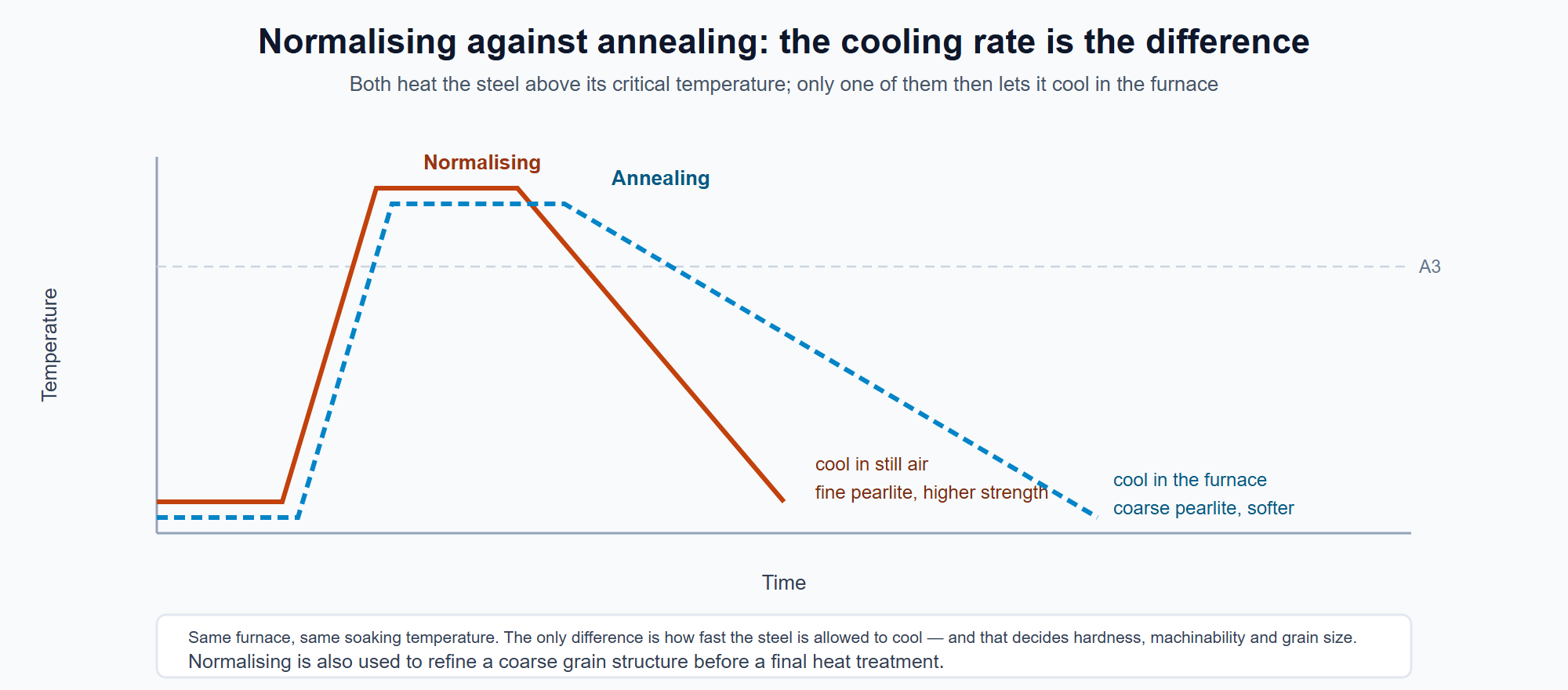
normalizing p1
normalizing p2
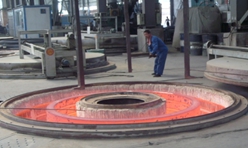
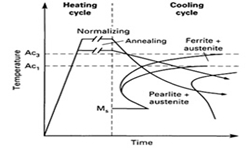
normalizing p3
Normalizing
Normalizing is a heat treatment process for making material softer but does not produce the uniform material properties of annealing.A material can be normalized by heating it to a specific temperature and then letting the material cool to room temperature outside of the oven. This treatment refines the grain size and improves the uniformity of microstructure and properties of hot rolled steel.
We can supply follows heat treatment services:
Normalizing, Annealing, Quenching, Tempering, Carburizing, Nitriding, High-frequency surface hardening and other processing services.
And we can strictly enforce the national standards.
And we have follows heating equipment:
Pit furnace: Dia1300mm max, Length9500mm max.
Salt bath furnace: Length1900mm max, Width1600mm max, Height900mm max.
Trolley furnace: Legth15000mm max, Width6000mm max, Height6000mm max.
Tunnel type continuous reheating furnace:dia30mm-dia250mm
Induction quenching line: dia15mm-dia120mm
Normalizing cooling fan can be used in combination of wind capacity air-cooled systems.
One step apart
Both treatments heat the steel above its critical temperature and hold it there. The difference is cooling: normalising cools in still air, annealing cools in the furnace or in a medium that slows it further.
That single difference decides the microstructure. Air cooling gives fine pearlite and a higher strength; furnace cooling gives coarse pearlite and the softest condition the steel can reach.
When normalising is the right call
- After forging or casting — to refine a coarse, uneven grain structure before machining or final heat treatment.
- To restore consistency after welding or hot working has left a mixed structure along the part.
- As a pre-treatment before quenching, so the austenitising step starts from a uniform structure.
When annealing is the right call
When the part has to be machined or cold formed and hardness is the obstacle. Full annealing gives the lowest hardness, but it is slow and ties up the furnace — which is why process annealing and spheroidising are often used instead for specific purposes.
What to put on the drawing
Name the treatment and the target hardness, not just “heat treat”. “Normalise, 180–220 HB” and “anneal, 160–190 HB” produce different structures and different machining behaviour, and a supplier given only “heat treat” will choose whichever is cheaper.
What normalising does to the grain
Heating above the critical temperature makes the steel re-form austenite, and the grain size that results depends on temperature and time. Cool it in air and the transformation happens quickly enough that the new ferrite–pearlite structure is fine and uniform.
That is the real value of normalising after forging: it does not just soften the steel, it erases the uneven, elongated structure that hot working leaves behind. A forged shaft normalised before quenching will harden more evenly than one that went straight to the furnace.
Normalising against quenching
Both heat above the critical range. Quenching cools fast enough to form martensite, which is hard and brittle; normalising cools in air, which forms fine pearlite, which is strong but machinable.
That is why normalising is often the step before quenching rather than a substitute for it: it gives the austenitising step a uniform starting structure, so the quench produces consistent results along the part.
Where it goes wrong
- Large sections cool slowly in the centre — a big forging may be normalised at the surface and still coarse in the core.
- Fan or forced cooling is sometimes used for large parts, but it moves the result toward a quench and the procedure has to be written down.
- Not a stress relief — normalising relieves some stress but its purpose is structural; a part that needs stress relief gets a separate low-temperature treatment.
