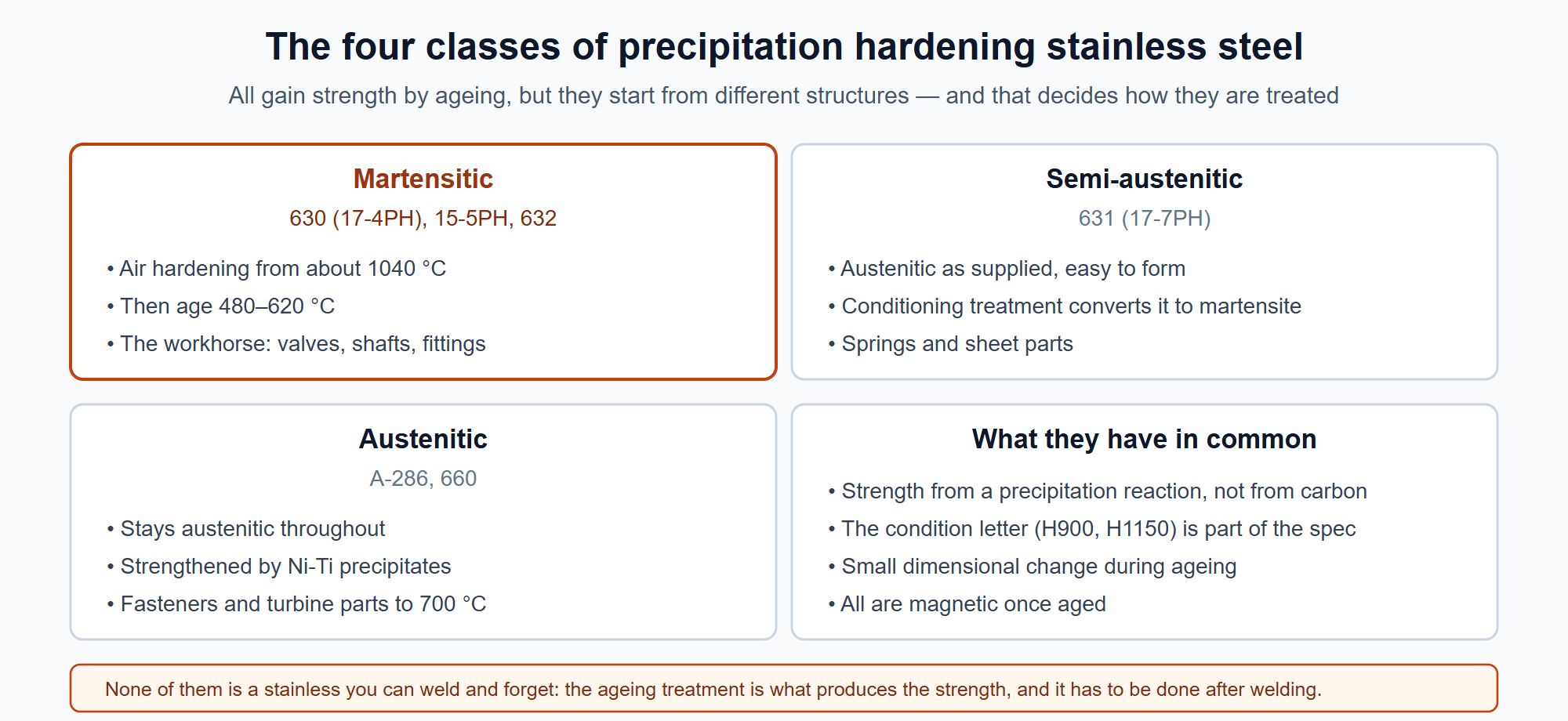
Figure 1: The four classes of precipitation hardening stainless steel.
Precipitation Hardening (PH) stainless steels are classified as martensitic or semi-austenitic. They develop their high strength and hardness through a variety of heat treatments resulting in a very high strength-to-weight ratio. Semi-austenitic grades are 17-7 PH® and PH 15-7 Mo®. They are austenitic in the annealed state, and martensitic in the hardened condition. Martensitic grades include 17-4 PH® and 15-5 PH®. The PH grades achieve high tensile properties in heat treated conditions.
Applications for PH steels include aerospace components, flat springs, and retaining rings.
Corrosion Resistance
Corrosion resistance of precipitation hardening stainless steels is generally superior to that of the standard hardenable martensitic stainless steels, but is not quite as good as chromium-nickel Type 304. Corrosion resistance of the PH stainless steels depends, to some extent, on the heat treated condition.
Accelerated laboratory corrosion tests have been conducted on the precipitation hardening stainless steels since their development, as well as extensive in-service use in a variety of corrosive conditions.
Formability
The semi-austenitic precipitation hardening stainless steels in Condition A can be readily formed prior to heat treatment. Work hardening and springback in these steels is similar to that of Type 301. Semi-austenitic PH stainless steels in Condition C and the martensitic PH stainless steels are extremely hard and strong and as such are limited to mild forming operations.
Heat Treatment
Standard heat treatments have been developed to achieve a variety of strength levels in the PH stainless steels. Heat treatment for the martensitic PH grades (17-4 PH® and 15-5 PH) are based on one- or two-step aging treatments. The semi-austenitic PH grades require a multi-step heat treatment to achieve their full strength potential.
Weldability
The precipitation hardening class of stainless steels is generally considered to be weldable by common fusion and resistance techniques. Special consideration is required to achieve optimum mechanical properties by considering the best heat-treated conditions in which to weld and which heat treatments should follow welding.
Four routes to the same end
All precipitation hardening stainless steels gain strength from a reaction during ageing, not from carbon. But they start from different structures, and that decides how they are formed, welded and heat treated.
The martensitic grades (630, 15-5PH) are the workhorses; the semi-austenitic grades (631) are chosen for formability before hardening; the austenitic grade (A-286) for high-temperature fasteners.
Why the class matters more than the number
Class
Supplied as
Implication
Martensitic
Hardened and aged, or annealed for machining
Simple, predictable, the default choice
Semi-austenitic
Austenitic, soft and formable
Form first, then condition and age
Austenitic
Solution treated
No martensite at all; strengthening by Ni-Ti
Two things that surprise buyers
First, all of them are magnetic once aged — the precipitation reaction leaves a ferromagnetic structure, so “non-magnetic stainless” and “PH stainless” are not the same requirement.
Second, the ageing treatment produces the strength, so it has to be done after welding. A welded assembly in 17-4PH that is not aged after welding will have a soft, weak heat-affected zone.
Founded in 1998, FuShun covers an area of 3000 square meters, annual sales volume of 20000 tons. We are engaged in the manufacture and export of Tool Steel, Nickel Alloy, Stainless Steel and other special steel products…,View more content About Me.
We use cookies to ensure that we give you the best experience on our website. If you continue to use this site we will assume that you are happy with it.