
SK5 / SK85 Carbon Tool Steel: Strip, Hardness and Heat Treatment
JIS G4401, 0.80–0.90 % carbon, no chromium worth counting. That is the whole specification — and it explains both why SK5 reaches 63 HRC for the price of a carbon steel and why it rusts the first time it is left wet.
SK5 is the older JIS designation; SK85 is the same grade written in the two-digit carbon notation. Both refer to a plain high-carbon tool steel, supplied annealed for machining or hardened and tempered as strip. It is the steel that a hand saw, a chisel, a plane iron or a utility-knife blade is made from when the buyer wants hardness and a sharp edge rather than corrosion resistance.
Because there is no chromium in the analysis, there is no passive film. The material is cheap, it hardens in water, and it will hold an edge that a stainless grade at the same carbon level cannot match. Everything else about working with it follows from those three facts.
Chemical composition
Table 1. Chemical composition of SK5 / SK85 to JIS G4401, mass fraction in percent.
| C | Si | Mn | P | S | Cr | Ni | Cu |
|---|---|---|---|---|---|---|---|
| 0.80–0.90 | 0.15–0.35 | 0.15–0.50 | ≤0.03 | ≤0.03 | ≤0.30 | ≤0.25 | ≤0.25 |
The manganese range is there for hardenability rather than strength: it lets a 1 mm section harden in water without the cracking that a pure carbon steel of the same carbon content would suffer. Silicon is a deoxidation remnant. Nothing in the analysis is there to resist corrosion.
Hardening and tempering
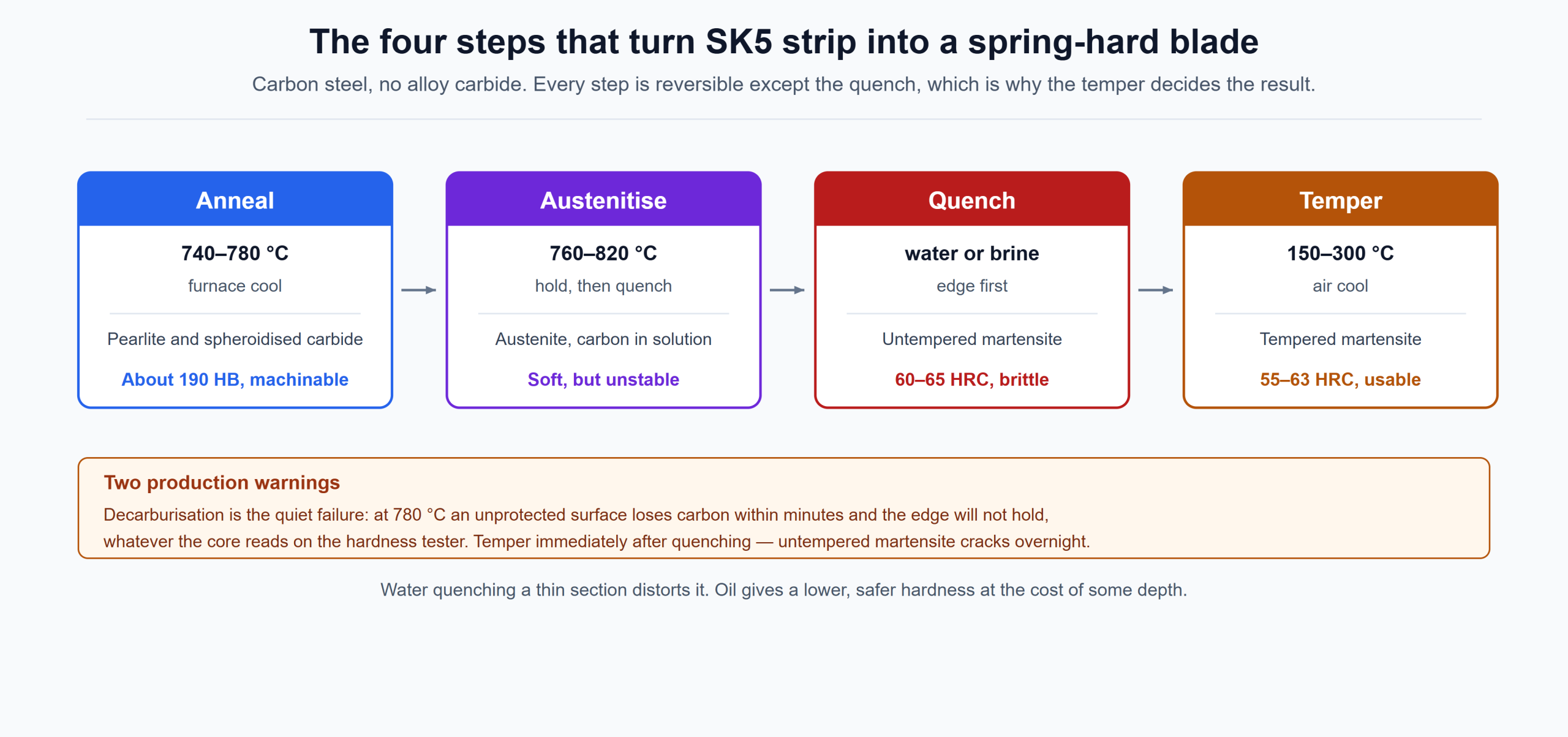
SK5 is a water-hardening steel. That is its advantage — water is cheap and the quench is fast enough to harden thin sections fully — and also its main risk, because a fast quench in a thin section distorts and can crack. A blade is normally quenched edge-first so that the edge sees the fastest cooling and the spine lags.
Table 2. Typical heat treatment for SK5 / SK85.
| Step | Temperature | What it does |
|---|---|---|
| Annealing | 740–780 °C, furnace cool | Softens to about 190 HB for machining and grinding |
| Austenitising | 760–820 °C | Water or brine quench; oil gives lower, safer hardness |
| Tempering, low | 150–200 °C | 60–63 HRC with the quench brittleness taken out |
| Tempering, higher | 250–300 °C | About 55–57 HRC where a tougher edge is wanted |
Two warnings are worth repeating because both are common in production. The first is decarburisation: at 780 °C in an uncontrolled atmosphere the surface loses carbon within minutes, and a soft skin will not hold an edge no matter what the core hardness reads on the tester. The second is the tempering range itself — 250–300 °C is where tempered martensite embrittlement is most likely, so a part tempered there should be checked for impact toughness rather than hardness alone.
Why SK5 gets hard — and why it rusts
The carbon is what allows martensite to form. At 0.85 % the steel is fully pearlitic in the annealed condition and, once austenitised, the whole structure can transform to martensite on quenching, which is why the hardness reaches 60–63 HRC rather than the 40s. There is no alloy carbide to do the job, so the hardness is entirely a function of carbon content and cooling rate.
The same absence of chromium explains the corrosion behaviour. A stainless steel protects itself with a chromium oxide film a few nanometres thick; SK5 has roughly 0.1 % chromium, which is not enough to form a continuous film. Moisture reaches the steel directly, and rust starts at any scratch or fingerprint. For a tool that is oiled and kept dry this is an acceptable trade. For anything washed, left wet or used outdoors it is the wrong material.
How SK5 compares with the alternatives
Table 3. SK5 against the grades it is usually weighed against.
| Grade | Carbon | Hardness | Against SK5 |
|---|---|---|---|
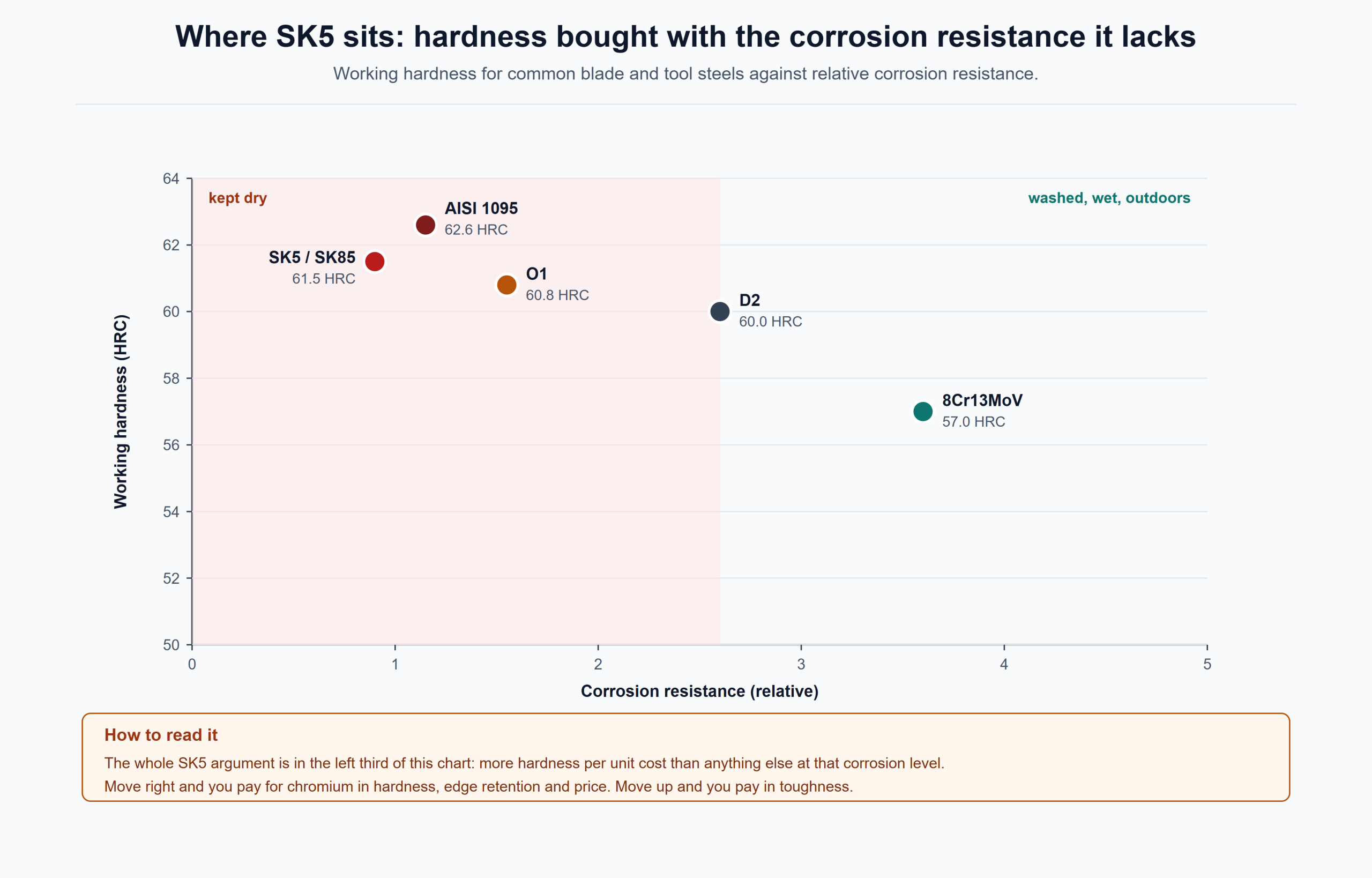
| SK5 / SK85 | 0.80–0.90 % | 60–63 HRC | The baseline: hard, cheap, rusts |
| AISI 1095 | 0.90–1.03 % | 60–64 HRC | Slightly more carbon, similar behaviour, also non-stainless |
| O1 tool steel | 0.90 % + Cr, W | 60–62 HRC | Oil-hardening, less distortion, better wear resistance, dearer |
| 8Cr13MoV | about 0.8 % + 13 % Cr | 56–58 HRC | Stainless, softer, far easier to sharpen |
The choice usually comes down to one question: will the tool be kept dry? If yes, SK5 delivers more hardness per unit cost than anything else in its class. If no, a stainless grade wins by default, even though it holds a lesser edge. O1 sits between the two on cost and is the better answer when distortion matters more than price.
Where SK5 is specified
- Hand tools: saws, chisels, axes, plane irons, scissors.
- Blades: kitchen and utility knives, razor and scalpel blades, long edged tools.
- Light tooling: simple punches, small moulds and dies where hardness matters more than toughness.
- Spring washers and flat springs that are not exposed to moisture.
The common thread is a part that needs a hard, keen edge, is used dry, and is cheap enough to be replaced rather than repaired. Where any of those three fails — wet service, high impact, or a part that has to last — the specification should move to a stainless or an oil-hardening grade.
Supply range and condition
Table 4. Supply range for SK5 / SK85 strip and coil.
| Item | Range |
|---|---|
| Standard | JIS G4401 carbon tool steel |
| Delivery condition | Annealed, or hardened and tempered to 29–55 HRC |
| Form | Strip, coil or sheet |
| Thickness | 0.15–2.5 mm |
| Width | 8–300 mm |
| Edge | Slit, both edges rounded, one round and one slit, or square |
| Finish | Polished in blue, yellow, white, grey-blue, black or bright; or natural |
| Tolerance | Thickness ±0.03 mm, width ±0.3 mm |
| Comparable DIN grades | CK50, CK55, CK60, CK67, CK70, CK75 — the same carbon range under EN 10132 |
| Tensile strength | 1200–1850 N/mm² in the hardened and tempered condition |
Table 5. Physical properties of SK5 / SK85 at room temperature.
| Property | Value |
|---|---|
| Density | 7.84 g/cm³ |
| Specific heat | 490 J/(kg·K) |
| Thermal expansion, 0–100 °C | 11.0 × 10⁻⁶/K |
| Thermal conductivity | 50.2 W/(m·K) |
| Electrical resistivity | 18 µΩ·cm |
| Young’s modulus | 208,000 N/mm² |
Inspection, certification and services
Each lot is issued with a certificate to EN 10204 3.1 covering chemical analysis and hardness, with tensile testing on request. Where the strip is bought for a cutting edge, the certificate should also state the decarburisation depth, because a soft skin is the defect that ruins an otherwise correct heat.
Table 6. Workshop and commercial services offered with SK5 strip.
| Service | Detail |
|---|---|
| Cutting | Slit coil to width, cut lengths, or laser-cut blanks to drawing |
| Machining | CNC grinding and turning of hardened strip to drawing |
| Packing | Coil on pallet, wooden case, or oiled and interleaved for export |
| Payment | T/T, L/C at sight, or O/A against approved credit |
| Delivery terms | FOB, CFR, CIF, DDU or DDP by sea, rail, air or road |
What to put on the enquiry
- Grade as SK5 or SK85, and the standard — JIS G4401 is the usual reference.
- Delivery condition: annealed for forming, or hardened and tempered to a hardness range.
- Thickness, width, edge type and finish, since these decide the price more than the chemistry does.
- Whether the part is to be welded. SK5 is not a welding steel, and a welded joint will crack in service.
Related reading
- AISI 1095 — the closest American equivalent, a little more carbon and the same rust behaviour
- O1 oil-hardening tool steel — when distortion matters more than the price of the strip
- D2 against 8Cr13MoV — the stainless option for blades, and what it gives up in hardness
- SKD11 cold-work tool steel — the step up when a blade has to survive production volumes
- Hardness conversion chart — HRC against HB and HV for the hardness values quoted here
You get chemical composition, mechanical properties and a price — with inspection certificates to EN 10204 3.1 issued against the heat number.