
Spring Steel Strip and Plate
Cold rolled strip from 0.1 to 6.0 mm thick and up to 1650 mm wide, in seven spring grades. Supplied annealed for forming, or hardened and tempered to final hardness so the part needs no heat treatment after it is stamped. The grade, the edge and the delivery condition decide whether the spring survives — not the tensile figure on the certificate.
At a glance
| Item | Detail |
|---|---|
| Grades | 55 / 65 / 70 / 75 / 85, 65Mn, 60Si2Mn, 50CrVA — see the cross-reference below |
| Standards | DIN 17222; EN 10132; GB/T 1222 |
| Delivery condition | Cold rolled, annealed (G), annealed and re-rolled (G+K), or hardened and tempered (H+A) |
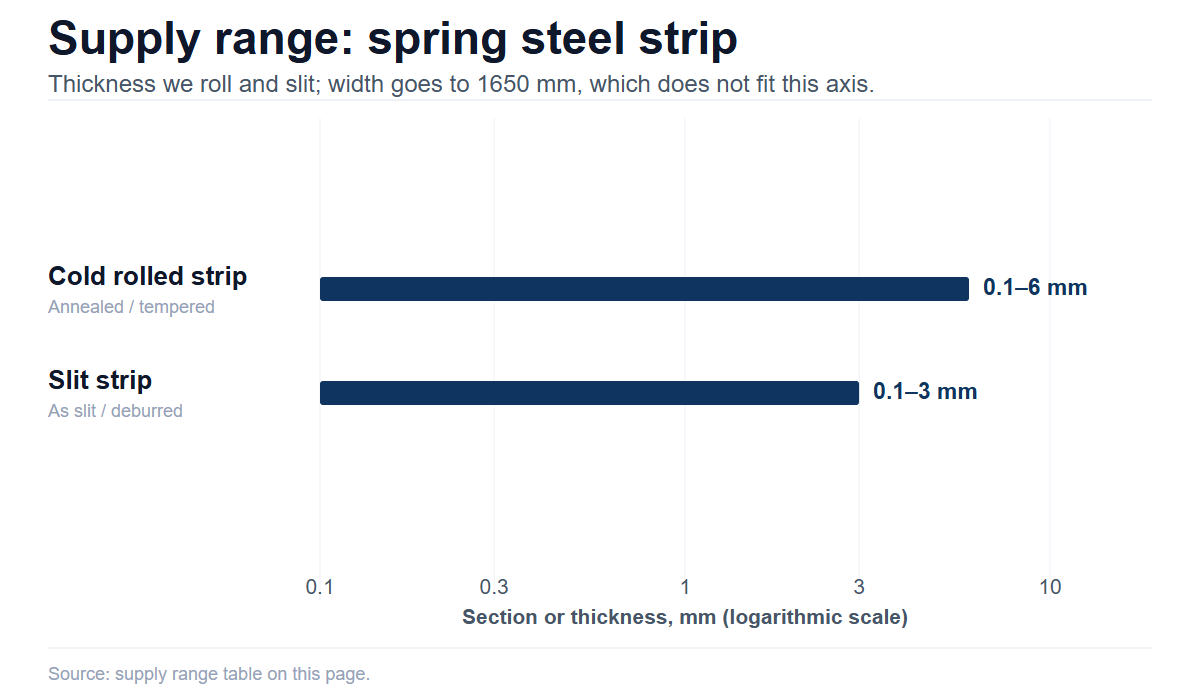
| Supply range | Thickness 0.1–6.0 mm × width up to 1650 mm |
| Surface | Grey blue (GR), bright (BK), polished (P), polished and colour tempered (P+AF) |
| Certificate | EN 10204 3.1 with chemistry, mechanical properties and hardness |
Supply range and delivery condition
| Form | Size range | Condition |
|---|---|---|
| Cold rolled strip | Thickness 0.1–6.0 mm × width up to 1650 mm | Annealed / tempered |
| Slit strip | Thickness 0.1–3.0 mm × width from 8 mm | As slit, deburred on request |
| Cold rolled plate | Thickness 3.0–6.0 mm × width up to 1250 mm | Annealed |
Widths above 1250 mm are rolled to order. Slit edges are sheared unless a dressed or rounded edge is specified — see the note on edge condition below.
Grade cross-reference
| GB | ASTM | JIS | EN | DIN |
|---|---|---|---|---|
| 55 | 1055 | / | CK55 | 1.1204 |
| 60 | 1060 | / | CK60 | 1.1211 |
| 70 | 1070 | / | CK67 | 1.1231 |
| 75 | 1075 | / | CK75 | 1.1248 |
| 85 | 1086 | SUP3 | CK85 | 1.1269 |
| 65Mn | 1066 | / | / | / |
| 60Si2Mn | 9260 | SUP6 / SUP7 | 61SiCr7 | 60SiCr7 |
| 50CrVA | 6150 | SUP10A | 51CrV4 | 1.8159 |
The same strip is bought and sold under all five systems. Put the designation you need on the purchase order; the 3.1 certificate carries it.
Chemical composition
| Grade | C | Mn | Si | P | S | Cr | V |
|---|---|---|---|---|---|---|---|
| 55 | 0.52–0.60 | 0.50–0.80 | 0.17–0.37 | ≤0.035 | ≤0.035 | ≤0.25 | / |
| 65 | 0.62–0.70 | 0.50–0.80 | 0.17–0.37 | ≤0.035 | ≤0.035 | ≤0.25 | / |
| 70 | 0.62–0.75 | 0.50–0.80 | 0.17–0.37 | ≤0.035 | ≤0.035 | ≤0.25 | / |
| 75 | 0.72–0.80 | 0.50–0.80 | 0.17–0.37 | ≤0.035 | ≤0.035 | ≤0.25 | / |
| 85 | 0.95–1.04 | ≤0.40 | ≤0.35 | ≤0.025 | ≤0.025 | / | / |
| 65Mn | 0.62–0.70 | 0.90–1.20 | 0.17–0.37 | ≤0.035 | ≤0.035 | ≤0.25 | / |
| 60Si2Mn | 0.56–0.64 | 0.70–1.00 | 1.50–2.00 | ≤0.035 | ≤0.035 | ≤0.35 | / |
| 50CrVA | 0.46–0.54 | 0.50–0.80 | 0.17–0.37 | ≤0.025 | ≤0.025 | 0.80–1.10 | 0.10–0.20 |
Heat analysis per the grade table on this page; product analysis tolerances apply.
Mechanical properties
| Grade | Tensile Rm | 0.2 % proof | Elongation A5 | Reduction of area |
|---|---|---|---|---|
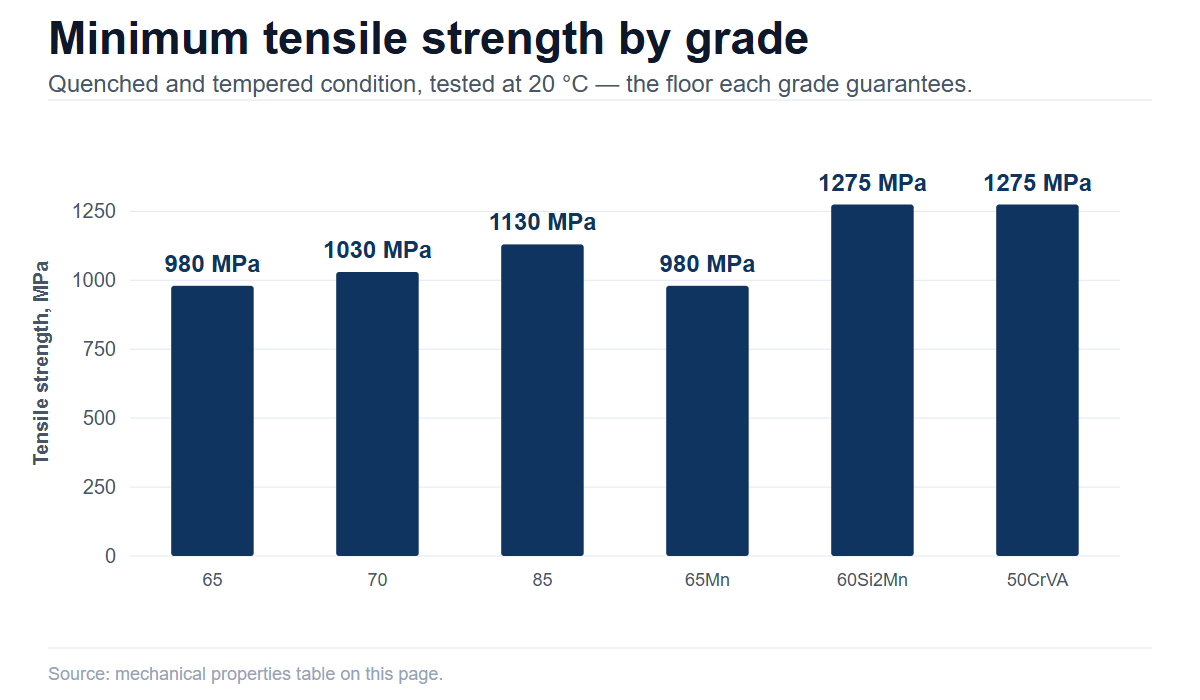
| 65 | ≥980 MPa | ≥785 MPa | ≥9 % | ≥35 % |
| 70 | ≥1030 MPa | ≥835 MPa | ≥8 % | ≥30 % |
| 85 | ≥1130 MPa | ≥980 MPa | ≥6 % | ≥30 % |
| 65Mn | ≥980 MPa | ≥785 MPa | ≥8 % | ≥30 % |
| 60Si2Mn | ≥1275 MPa | ≥1180 MPa | ≥5 % | ≥25 % |
| 50CrVA | ≥1275 MPa | ≥1130 MPa | ≥10 % | ≥40 % |
Quenched and tempered condition, tested at 20 °C. These are minimums for the grade, not a promise for every thickness.
Heat treatment
| Grade | Quenching °C | Medium | Tempering °C |
|---|---|---|---|
| 65 | 840 | Oil | 500 |
| 70 | 830 | Oil | 480 |
| 85 | 820 | Oil | 480 |
| 65Mn | 830 | Oil | 540 |
| 60Si2Mn | 870 | Oil | 480 |
| 50CrVA | 850 | Oil | 500 |
Tempering temperature is set by the hardness the part needs, not by the grade alone; every 40 °C roughly halves the retained strength. Oil quench throughout — these grades crack in water at strip thickness.
How to choose a grade, instead of listing them
The grade table tells you what is available. It does not tell you which one the spring needs. Three questions decide it: the stress level, the environment, and whether the part is formed before or after hardening.
| Duty | Grade | Why |
|---|---|---|
| General purpose, low cost | 65Mn / 1065 | Cheap and adequate for static or lightly loaded springs |
| Higher stress, good fatigue | 60Si2Mn / 9260 | Silicon raises the elastic limit and the fatigue resistance |
| Valve springs, elevated temperature | 50CrVA / 6150 | Chromium and vanadium resist softening where plain silicon grades sag |
| Severe fatigue, shock loading | 50CrVA / 6150 | Vanadium refines the grain and widens the tempering window |
| Corrosion or food contact | 301 / 302 stainless | Sacrifices strength for corrosion resistance |
Annealed or hardened and tempered strip
This is the specification decision that causes the most rework. Annealed strip is soft, formable, and must be hardened after the spring is wound or stamped — which means distortion and an extra heat treatment step. Hardened and tempered strip arrives at final hardness (typically 42–48 HRC for clock-type springs), can be formed and used without further treatment, but will crack if bent sharply.
If the design has tight radii, buy annealed and harden after forming. If the design is a simple profile and the volume is high, buy tempered strip and accept the forming limits.
Edge condition matters more than grade
A spring strip slit from wide coil has a sheared edge with micro-cracks running into the section. Under fatigue those edges are where the crack starts. Dressed or rounded edges cost more per kilogram and routinely double the fatigue life of a stamped spring. Buyers who change grade to fix a fatigue problem, without changing the edge, usually see no improvement.
Residual stress and shot peening
A spring is a component that lives on surface stress. Shot peening puts the surface into compression and is the single most effective fatigue treatment available for springs; it is also the one most often omitted to save cost. If a spring is failing early in service, check the peening specification before changing the steel.
What ships with every lot
- EN 10204 3.1 mill certificate — chemistry, tensile, proof stress, elongation and hardness, against the heat number
- Thickness and width report; crown and flatness measured across the coil
- Hardness traverse across the width on tempered strip, on request
- Decarburisation depth check on hardened and tempered strip
- Edge condition declaration — sheared, dressed or rounded
Packing and delivery
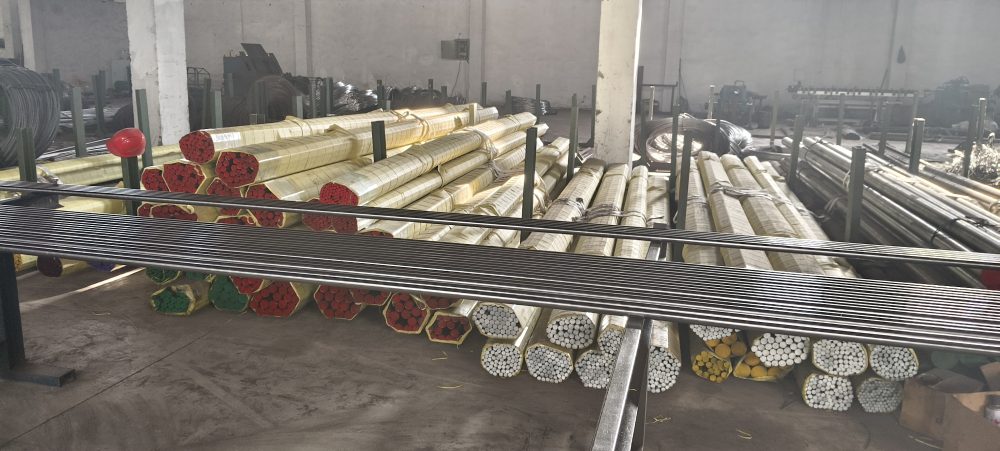
Strip travels on wooden pallets or in crates, coil eye vertical, wrapped in VCI paper and strapped. Each coil is labelled with grade, heat number, thickness, width, weight and delivery condition, matching the 3.1 certificate inside the crate.
Typical lead time is 20–30 days for stock thicknesses, 30–45 days for tempered strip or non-standard widths. Loading from Shanghai, Qingdao or Shenzhen.
Trade terms and how an order runs
The terms below apply unless the enquiry states otherwise, and they can be adjusted in the quotation.
| Item | Standard terms |
|---|---|
| Incoterms 2020 | FOB Shanghai, Qingdao or Shenzhen; CIF and CFR quoted against the destination port |
| Payment | T/T 30 % advance, 70 % against the bill of lading copy; irrevocable L/C at sight above 20 t |
| Minimum quantity | One coil for stock sizes; mill runs from 3 t per width |
| Lead time | 20–30 days for stock; 30–45 days where tempering, slitting or edge dressing is included |
| Documents | 3.1 certificate, packing list, invoice, bill of lading, certificate of origin |
| Inspection | Third-party inspection (SGS, BV, TUV) arranged before dispatch on request |
Request a quote
- Grade — 65Mn, 60Si2Mn or 50CrVA, or the performance you need and we will pick
- Thickness × width, and coil weight or cut length
- Delivery condition — annealed, annealed and re-rolled, or hardened and tempered with the hardness window
- Edge — sheared, dressed or rounded
- Certificate and inspection — 3.1 as standard, hardness traverse on request
Email [email protected] or use the form below. Drawings in DXF, STEP or PDF are all fine.
Related grades
One heat-treatment route, one certification route — grades can be combined in a single shipment.
- SUP7 / 56Si7 / 9260H — the silicon grades behind 60Si2Mn
- 51CrV4 / 6150 — chromium-vanadium for valve springs
- Cold drawn spring steel wire — when the part is wire, not strip
- 65Mn — the low-cost grade for general purpose springs
Browse all spring steel grades →
Governing standard: JIS G4801 (PDF)
Frequently asked questions
Annealed strip is soft and formable but has to be hardened after the spring is made. Tempered strip arrives at 42–48 HRC, needs no further treatment, and will crack if it is bent sharply. Tight radii point to annealed; simple profiles and high volume point to tempered.
50CrVA / 51CrV4 / 6150. Chromium and vanadium hold hardness where the plain silicon grades sag, and the wider tempering window gives the springmaker room to tune the load without losing fatigue life.
1650 mm at 0.1–6.0 mm thickness. Above 1250 mm the strip is rolled to order rather than cut from stock coil.
Yes. A sheared edge carries micro-cracks into the section and that is where fatigue cracks start. Dressed or rounded edges cost more per kilogram and commonly double the life of a stamped spring — cheaper than moving to a higher grade.
Cold rolled and annealed as standard, or hardened and tempered to your hardness window. Every lot ships with an EN 10204 3.1 certificate; hardness traverses and decarburisation checks are added on request.
