
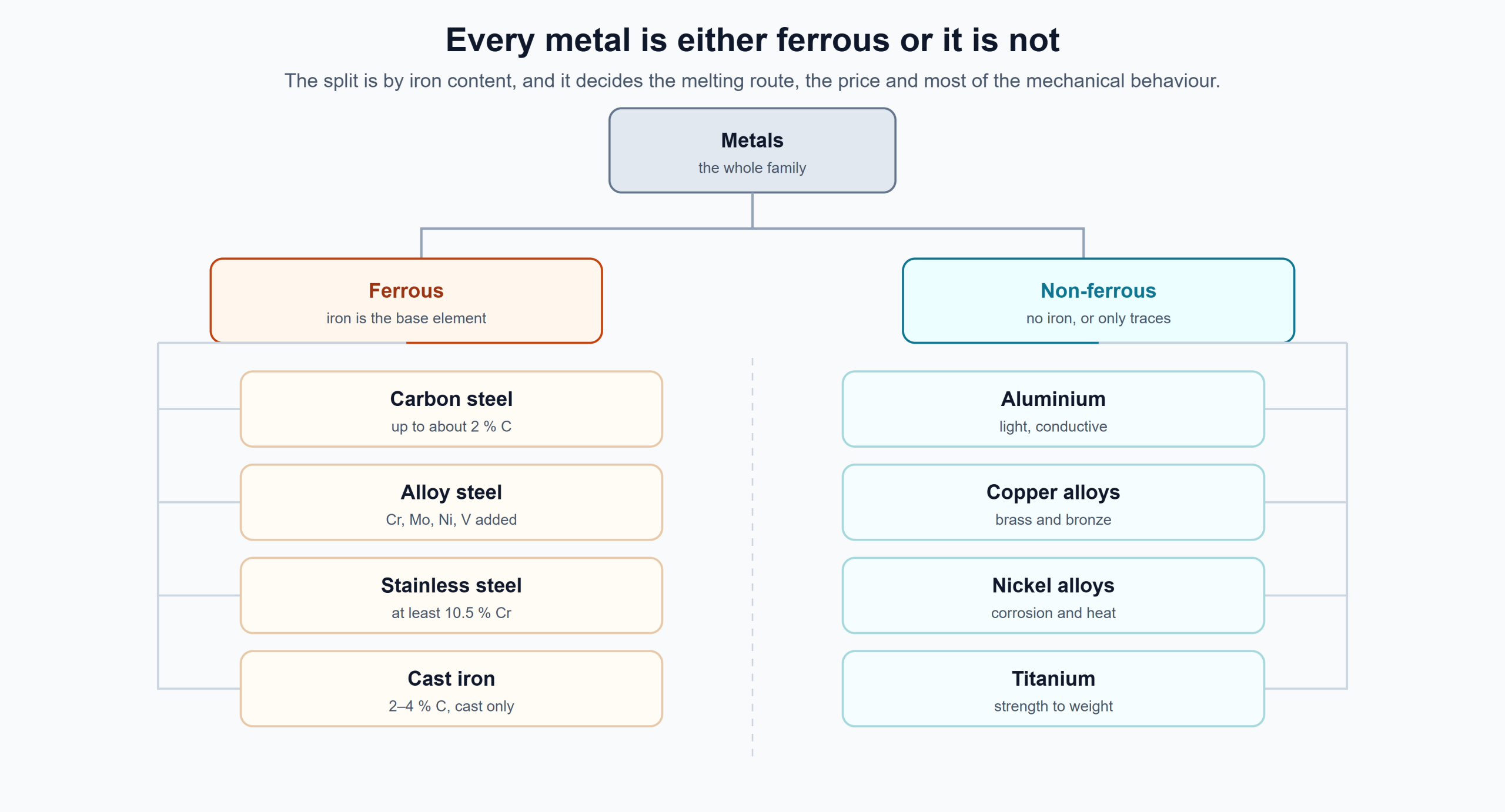
Short answer: a ferrous metal is one in which iron is the base element — not a trace, but the largest single constituent. Everything else, from aluminium to titanium, is non-ferrous. The split matters because it decides the melting route, the recycling stream, the price, and most of the mechanical behaviour.
What “ferrous” actually means
Ferrous comes from ferrum, the Latin for iron. In practice the label is applied when iron dominates by weight — over 50 %, and usually over 85 %. A copper alloy with 0.5 % iron added as a grain refiner is still non-ferrous: the iron is there to control structure, not to define the metal.
The distinction is not academic. Ferrous metals are magnetic (with one important exception), they rust, they are produced in far greater tonnage than every other metal combined, and they are melted from scrap in an electric arc furnace. Non-ferrous metals are not magnetic, do not rust in the same way, and typically cost three to thirty times more per kilogram.
The properties that hold across the family
It is difficult to assign common properties to ferrous metals, because the alloying elements change the behaviour so much. Many are magnetic, but not all: austenitic stainless steel — the whole 300 series — contains iron and is not magnetic at room temperature, because the nickel holds the crystal structure in the austenitic form. Some ferrous metals are extremely strong and brittle, such as white cast iron; others are soft and ductile, such as low-carbon sheet.
Three statements are safe. Ferrous metals are dense — about 7.8 g/cm³ against 2.7 for aluminium. They are stronger per unit volume than the copper, tin and lead alloys. And unless the chromium content passes roughly 10.5 %, they rust in wet air, which is why so much of the processing effort goes into coating, painting or alloying them.
Carbon is the axis that matters
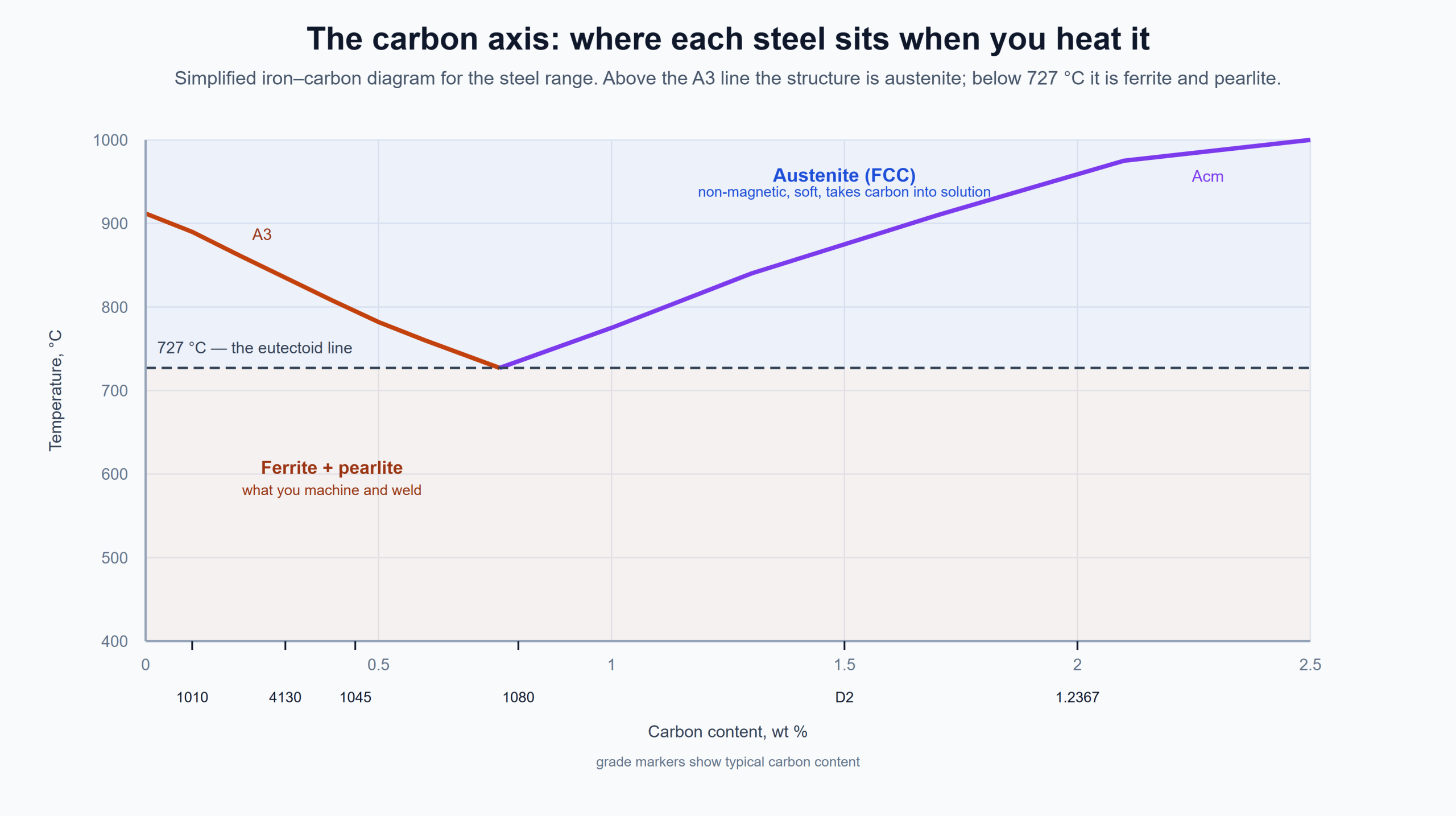
Inside the ferrous family, carbon sets almost everything else. It is the cheapest alloying element and the one with the largest effect: a few tenths of a percent separate a bendable sheet from a file-hard cutting edge.
Up to about 0.25 % carbon the steel is soft, weldable and formable — structural sections, tube, fasteners. Between 0.3 and 0.5 % it responds to quenching and tempering, which is the range that carries shafts, gears and crankshafts. Above 0.6 % it takes and holds an edge, and past 1.2 % it becomes a tool steel. Beyond 2 % carbon the alloy is no longer steel but cast iron, and it is cast rather than wrought.
The four families you will actually be quoted
Carbon steel
Iron with carbon and only trace amounts of everything else. It accounts for the largest tonnage of any metal, and it is the baseline against which the others are priced. A typical structural grade such as AISI 1045 carries about 0.45 % carbon and is supplied normalised or quenched and tempered.
Stainless steel
Iron with at least 10.5 % chromium. The chromium forms a passive oxide film that is a few nanometres thick and self-healing, and that film — not the iron — is what resists corrosion. The family splits into austenitic (300 series), ferritic and martensitic (400 series) and duplex. Only the austenitic grades are non-magnetic, which is why a magnet is a rough grade check rather than an acceptance test — the reason is set out in which stainless grades are magnetic.
Cast iron
Two to four percent carbon, cast rather than rolled. It is cheap, it damps vibration, and it machines well, which is why machine tool bases and pump housings are still made from it. It is also brittle: cast iron does not bend, it breaks, and it cannot be welded reliably.
Alloy steel
Iron with deliberate additions of chromium, molybdenum, nickel, vanadium or manganese to buy hardenability, toughness or wear resistance. Alloy steel is the family that covers everything from 4130 tubing to 4340 forgings, and the additions are what make a large section harden through rather than only at the surface.
How to tell them apart on the shop floor
A magnet, a grinder and a density check will separate the four families in under a minute. The magnet holds firmly to carbon steel, cast iron and the 400-series stainless grades, and falls away from annealed 304 and 316. The grinder gives a spark stream: carbon steel throws long yellow sparks with a burst at the end, stainless gives short red sparks with almost no burst, and cast iron gives dull red sparks close to the wheel.
What none of these tests can do is identify the grade. For that you need a chemical analysis or a positive material identification check — and on a purchase order, the grade is the only thing that is contractual.
Related reading
- What is alloy steel — the family that sits between carbon steel and stainless.
- Which stainless grades are magnetic — the exception to the iron rule.
- AISI 1045 carbon steel — a medium-carbon grade in detail.
- The 400 series — martensitic and ferritic stainless in one place.
- AISI 4130 — what the alloying additions actually buy.
You get chemical composition, mechanical properties and a price — with inspection certificates to EN 10204 3.1 issued against the heat number.
