
What is HSLA Steel?
HSLA means High strength low alloy steel. HSLA has a limited proportion of alloy incorporated in the chemical properties. These alloy components are required to improve the intensity of the material. HSLA steel can be made to have higher hardness and be more resistant to heat treatment than carbon steel, in addition to providing improved strength over carbon steel. Alloying components may also be used to improve steel corrosion resistance.
How high strength low alloy is steel made?
HSLA steel is formed in the same technique, as different types of materials made. Iron ore and coal are mixed together in a fire, which heats the minerals and burns out some of the impurities. Based on the grade of HSLA steel, different quantities and forms of alloys are then applied to the molten mixture. If the correct chemical composition has obtained, many other measures ensure that pollutants in the HSLA steel are kept to a minimum. After that, the steel is enabled to consolidate into a wide rectangle alloy. After that, the HSLA steel ingot is made it down to its appropriate size.
What Is the Process of high-strength low alloy Steel?
HSLA steel has a number of benefits over normal carbon steel. Since the atoms of the elements tend to block the deformation of motion in the microstructure of carbon steel, the presence of alloying components improves strength and hardness. Carbon steel’s strength and hardness can be increased by alloying components such as tungsten, vanadium, silicon, copper, molybdenum, and manganese. Nickel is particularly useful for increasing hardness.
Corrosion tolerance in HSLA steels can also be improved. Components of Alloys such as copper, nickel, and chromium can improve steel’s corrosion resistance. This is possible because the copper, nickel, and chromium in HSLA steel oxidize faster with the iron. It prevents iron oxide, or rust, from settling mostly on iron.
Common High Strength Low Alloy or HSLA Steel Grades
Because of the many alloying material variations that can be used, High Strength Low Alloy steel is available in a wide range of grades. The chemical composition and grade of High Strength Low Alloy steel should be determined by the expected use.
ASTM A36 steel is a common form of HSLA steel. ASTM A36 is an HSLA steel that can be used for a variety of purposes. It is widely used in the construction of steel structures. It is inexpensive, weldable, and machinable. This adaptability, along with its outstanding mechanical properties is what makes it such a popular choice for structural uses.
Weathering steel is a form of HSLA steel as well. It is widely used in structural applications that do not need a coating or coats of paint, such as bridge construction. ASTM A242 and ASTM A588 are two standard weathering steel classes.
HSLA steel is used for more than just structural purposes. It is most commonly found in oil and gas delivery pipelines. Among the most popular materials being used in modern piping is API 5L Grade X70. The number “70” in the name refers to the 70,000 psi minimum yield strength needed by the American Petroleum Institute. ASTM A573 is another standard used in the oil and gas industry. ASTM A573 is a standard that is commonly used in the manufacturing of storage tanks.
Of course, there are a variety of other HSLA steel grades available. Such grades are designed to be weldable rather than machinable, and others are designed to be abrasion-resistant or precipitation resistant.
Strength without carbon
HSLA steels reach 355–690 MPa yield with carbon below 0.12 %. They do it by keeping the grain size small: niobium, vanadium and titanium form fine carbonitrides that pin grain boundaries during hot rolling, and fine grains give both strength and toughness at the same time.
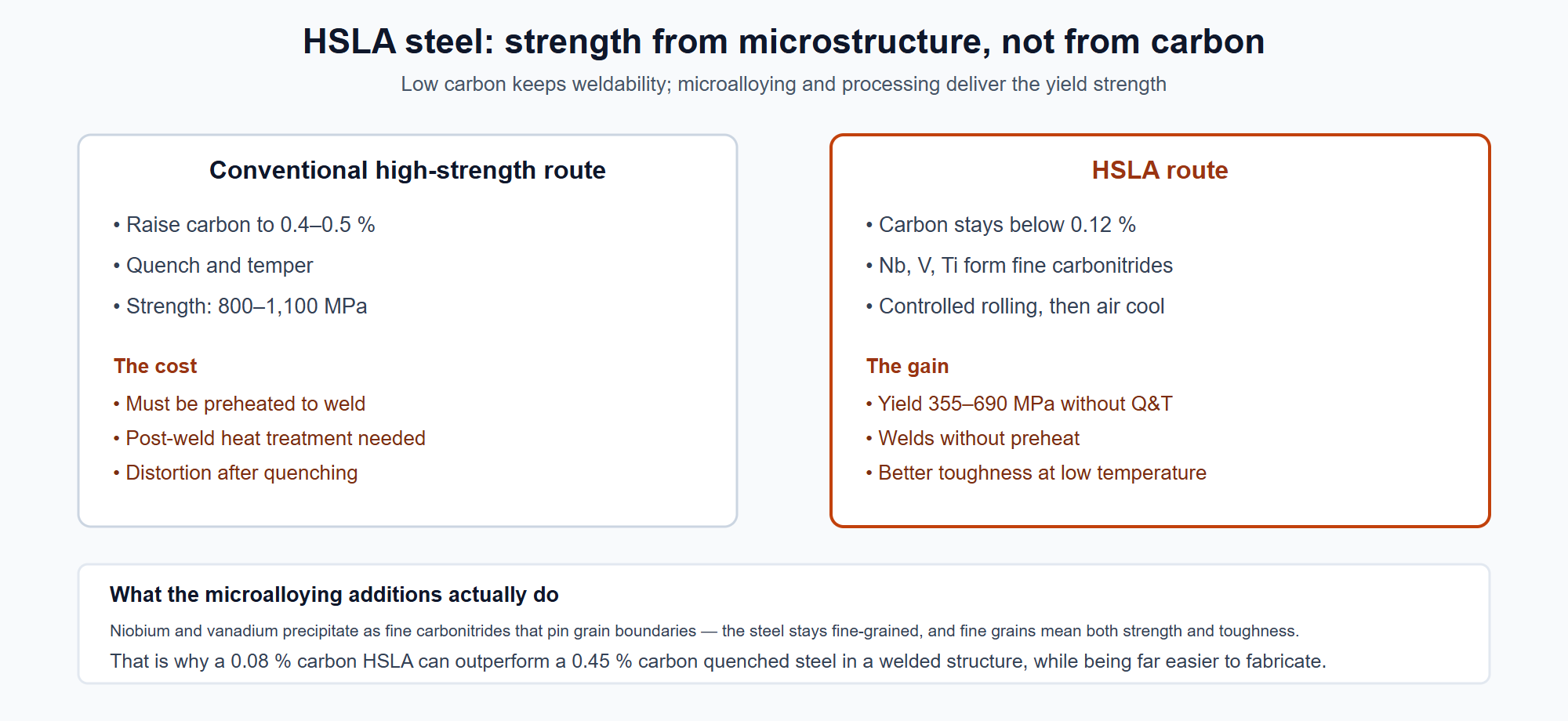
Because the carbon is low, the steel welds without preheat and without post-weld heat treatment — which is the real commercial advantage, not the strength figure.
Where HSLA replaces quenched and tempered steel
| Structure | Usual choice | Why |
|---|---|---|
| Bridges, cranes, heavy fabrication | HSLA (S355, S460, A572) | Weldable at full strength, no PWHT |
| Line pipe | HSLA (API 5L X65, X70) | Toughness at low temperature plus weldability |
| Shafts, gears, bolts | Q&T alloy steel | Needs through-hardening, not weldability |
| Wear parts | Q&T or surface hardened | HSLA is not a wear grade |
What to watch
HSLA strength depends on the rolling schedule, not just the chemistry. Two plates with the same analysis from different mills can differ by 50 MPa if one was controlled-rolled and the other was not. When the design is at the limit, ask for the rolling process, not only the certificate values.
