
X2CrTi12, designated as EN 1.4512, UNS S40900, and JIS SUH409L (trade name AISI 409), is a titanium-stabilized ferritic stainless steel and the most cost-effective chromium stainless grade in industrial-scale production. FUSHUN METAL supplies this volume-grade material under ISO 9001:2015 and AS9120B certified quality systems. Unlike all preceding grades in the heat-resistant series—which are nickel-bearing austenitic steels with body-centered-cubic (BCC) ferrite matrices—X2CrTi12 contains zero nickel, making it fundamentally more economical and giving it a completely different set of physical properties: it is ferromagnetic, has approximately 60% higher thermal conductivity (~25 vs ~16 W/m·K for austenitics), and exhibits a markedly lower coefficient of thermal expansion, which translates into superior dimensional stability under thermal cycling. The titanium addition—typically 6×(C+N) to 0.65%—scavenges interstitial carbon and nitrogen to form stable Ti(C,N) particles, suppressing the chromium carbide precipitation that would otherwise cause intergranular corrosion at grain boundaries after welding or thermal exposure. With only 10.5–12.5% chromium and no nickel, molybdenum, or other costly alloying elements, X2CrTi12 achieves an exceptional cost-to-performance ratio that has made it the global standard material for automotive exhaust systems: over 70% of the world’s passenger-vehicle exhaust tubing, muffler shells, and catalytic converter housings are manufactured from this grade or its direct equivalents. Its continuous oxidation resistance is rated up to approximately 675°C, and it operates reliably in the −20°C to 600°C range for long-term service.
X2CrTi12 (1.4512 / S40900) Overview
X2CrTi12 belongs to the ferritic class of stainless steels—a category fundamentally distinct from the austenitic grades (304H, 321H, 347H, etc.) in both metallurgy and application philosophy. The body-centered-cubic (BCC) ferrite crystal structure, stabilized by ~11–12% chromium, cannot dissolve as much carbon or nitrogen as the face-centered-cubic austenite matrix can, which is why the titanium addition is metallurgically mandatory: it locks up the limited carbon and nitrogen that the ferrite matrix rejects, preventing them from combining with chromium at grain boundaries and causing intergranular attack. At FUSHUN METAL, every heat of X2CrTi12 is verified by optical emission spectroscopy with independent titanium quantification, then annealed at 770–830°C followed by air cooling—a far simpler and more energy-efficient heat treatment cycle than the 1040–1250°C solution annealing required by austenitic grades. The annealed microstructure consists of equiaxed ferrite grains with finely dispersed Ti(C,N) particles; the absence of a phase transformation during heating and cooling means that grain size cannot be refined through heat treatment alone, so careful control of hot-rolling temperature (800–1100°C) and reduction ratio is essential to prevent excessive grain coarsening. In service, X2CrTi12 offers good resistance to atmospheric corrosion, mild chemical environments, and condensation-induced attack from automotive exhaust condensates—but it is not suitable for marine atmospheres, strong acids, or high-chloride environments, where austenitic grades (304/316) or duplex steels are required. The grade’s defining economic advantage is its raw-material cost: containing zero nickel and only half the chromium of 304, it is typically 40–60% less expensive per ton than the cheapest austenitic grade, enabling its use in cost-sensitive, high-volume applications where corrosion requirements are moderate but thermal cycling and oxidation resistance are essential.
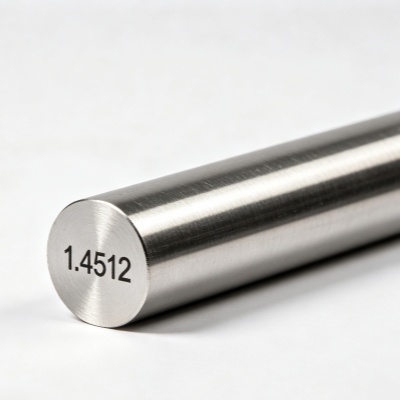
Typical Applications by Industry
Automotive Exhaust
- Muffler shells & internals
- Exhaust pipes & tailpipes
- Catalytic converter housings
- Exhaust manifold heat shields
- Flexible coupling bellows
- Diesel particulate filter cans
Home Appliances
- Washing machine drums & tubs
- Dishwasher inner cabinets
- Tumble dryer drums
- Water heater burner tubes
- Microwave oven cavities
Building & Construction
- Window & door frames
- Decorative cladding panels
- Roof flashing & gutters
- Ventilation ducting
- Chimney liners & flues
- Structural brackets (light-duty)
Industrial Equipment
- Heat exchanger tubing (mild media)
- Furnace casing & panels
- Kiln outer shells
- Conveyor belt covers
- Storage tanks (non-corrosive)
Commercial Kitchen
- Oven inner liners & trays
- Range hood bodies
- Fryer tanks & baskets
- Warming cabinet panels
- Worktable surfaces (dry use)
Agricultural Machinery
- Harvester exhaust & shields
- Grain dryer ducting
- Fertilizer spreader bodies
- Irrigation system fittings
- Livestock feeder panels
Automotive (Non-Exhaust)
- Fuel tank straps & brackets
- Underbody heat shields
- Battery tray supports
- EGR cooler housings
Power Generation (Balance-of-Plant)
- Cooling tower drift eliminators
- Duct burner casings
- Air preheater baskets
- Ash hopper liners
X2CrTi12 Supply Range — FUSHUN METAL
FUSHUN METAL stocks and processes X2CrTi12 (1.4512 / 409) in high-volume form, manufactured under ISO 9001:2015 quality management and AS9120B distribution protocols. Every shipment includes MTC 3.1 documentation with heat number, full optical emission spectroscopy (with Ti verification), mechanical test results, and dimensional conformance. Third-party inspection and PMI are available on request. As a volume-grade ferritic stainless, lead times are typically shorter and minimum order quantities are flexible compared to specialized heat-resistant austenitic grades.
| Product Form | Process | Thickness / Diameter Range | Width / Length & Surface |
|---|---|---|---|
| Cold-Rolled Sheet | Cold-Rolled, Annealed | T: 0.3 – 3.0mm | W: 1000 – 2000mm; L: coil or cut-to-length; finish: 2B, BA, No.4 |
| Hot-Rolled Plate | Hot-Rolled, Annealed | T: 3.0 – 12.0mm | W: 1000 – 2000mm; L: up to 12000mm; finish: No.1 |
| Round Bar | Hot-Rolled | Φ5mm – Φ200mm | L: 3000 – 6000mm |
| Flat Bar | Hot-Rolled | T: 3 – 40mm; W: 10 – 150mm | L: 3000 – 6000mm |
| Welded Tube | Welded (HF / TIG), Annealed | OD: 8 – 168mm; WT: 0.5 – 6.0mm | L: up to 6000mm; per ASTM A268 TP409; pickled or polished |
| Seamless Tube | Cold-Drawn / Hot-Finished | OD: 6 – 89mm; WT: 0.5 – 10mm | L: up to 12000mm; upon inquiry |
Chemical Composition — X2CrTi12 per EN 10088-2 / ASTM A240
At FUSHUN METAL, each incoming heat is verified by optical emission spectroscopy, with titanium content independently confirmed against the stabilization requirement. The composition below conforms to EN 10088-2 for 1.4512 and ASTM A240 for UNS S40900. The Ti:C+N ratio is the critical quality control gate: titanium must be present at a minimum of 6 times the combined carbon-plus-nitrogen content to ensure complete stabilization of the ferritic structure.
| Element | C | Si | Mn | P | S | Cr | Ti | N |
|---|---|---|---|---|---|---|---|---|
| Value | ≤0.03 | ≤1.00 | ≤1.00 | ≤0.040 | ≤0.015 | 10.5–12.5 | 6×(C+N)–0.65 | ≤0.03 |
Iron (Fe) balance. Zero nickel, zero molybdenum—this is the leanest stainless steel chemistry in common industrial use, and the source of its cost advantage. The titanium stabilization mechanism is metallurgically identical to that of 321 (X7CrNiTi18-10) but deployed in a ferritic matrix: Ti preferentially combines with C and N to form stable carbonitrides, preventing chromium depletion at grain boundaries. Some specifications also permit niobium or zirconium as alternative stabilizers at proportional mass fractions relative to titanium.
Mechanical Properties — X2CrTi12 in Annealed Condition
Values below represent room-temperature properties after annealing at 770–830°C with air cooling, per EN 10088-2 and ASTM A240. Note the fundamentally different mechanical profile compared to austenitic grades: lower strength (particularly yield), lower elongation, and lower work-hardening rate—but higher thermal conductivity and lower thermal expansion, which are the physical properties that matter most in exhaust and thermal-cycling applications.
| Property | Metric Value | Imperial Value | Remarks |
|---|---|---|---|
| Tensile Strength (Rm) | 380–560 MPa | 55–81 ksi | Annealed; cold work can raise UTS significantly |
| Yield Strength (Rp0.2) | ≥170–220 MPa | ≥25–32 ksi | Varies by standard; EN: ≥210 MPa; some specs: ≥170 MPa |
| Elongation (A) | ≥20–25% | ≥20–25% | Lower than austenitic grades (35–40%); adequate for forming |
| Hardness | ≤180–200 HBW | ≤88–95 HRB | Annealed condition |
| Density | ~7.7 g/cm³ | ~0.278 lb/in³ | Slightly lower than austenitic (7.93–8.0) |
| Thermal Conductivity | ~25 W/m·K | ~173 BTU/h·ft·°F | ~55% higher than austenitics (~16 W/m·K) |
| Thermal Expansion | ~10.5 × 10⁻⁶/K | ~5.8 × 10⁻⁶/°F | ~35% lower than austenitics; better dimensional stability |
| Melting Range | 1425–1510°C | 2600–2750°F | Solidus–Liquidus |
| Magnetic? | YES | — | All ferritic grades are ferromagnetic |
| Max. Service Temp | ~675°C (oxidation) | ~1250°F | Long-term service: 600°C; avoid sustained use above 675°C |
Frequently Asked Questions on X2CrTi12 / 409
What is the fundamental difference between ferritic 409 and austenitic 304?
They differ in crystal structure, chemistry, cost, and application philosophy. 409 (X2CrTi12) has a body-centered-cubic (BCC) ferrite structure containing ~11% Cr and zero nickel; 304 has a face-centered-cubic (FCC) austenite structure containing ~18% Cr and ~8% Ni. The practical consequences: 409 costs 40–60% less, is magnetic, has 55% higher thermal conductivity, 35% lower thermal expansion, and is immune to chloride stress-corrosion cracking—but its corrosion resistance is substantially lower, especially in acidic or marine environments. 409 cannot be deep-drawn or stretch-formed as aggressively as 304. The grade selection depends entirely on the environment: for automotive exhaust condensates and mild atmospheric exposure, 409 is the economic winner; for chemical plants, food processing, and marine atmospheres, 304 or higher is required.
Why is titanium added to 409 stainless steel?
Titanium serves the same stabilization function in 409 as it does in 321 (austenitic) and niobium does in 347. The ferrite BCC lattice has extremely low solubility for carbon and nitrogen—far lower than the austenite FCC lattice. During welding or high-temperature exposure, the excess interstitial C and N atoms would rapidly diffuse to grain boundaries and combine with chromium to form chromium carbides/nitrides, depleting the adjacent matrix of chromium and creating a pathway for intergranular corrosion. Titanium has a far stronger chemical affinity for carbon and nitrogen than chromium does, so it captures them as stable Ti(C,N) particles dispersed throughout the grains, leaving the chromium untouched to maintain the passive oxide film. Without titanium stabilization, welded 409 would suffer intergranular attack within hours of entering high-temperature service.
What are the welding limitations of X2CrTi12?
Ferritic stainless steels present fundamentally different welding challenges compared to austenitics. Because ferrite does not undergo a phase transformation during heating and cooling, grain growth in the heat-affected zone (HAZ) is irreversible—coarse HAZ grains cannot be refined by post-weld heat treatment, and excessive grain growth causes embrittlement. Best practice is to weld with low heat input (<1 kJ/mm), use small-diameter filler wire, maintain interpass temperature below 150°C, and avoid preheating above 200–300°C. TIG (GTAW) is preferred; MIG (GMAW) is acceptable with controlled parameters. Recommended filler metal is AWS ER409Nb (niobium-stabilized) or ER430 for matching corrosion resistance. The titanium-stabilized base metal is sensitive to hydrogen and nitrogen pickup during welding—argon shielding gas purity must be high, and any nitrogen-containing shielding mixtures must be strictly avoided. Despite these cautions, millions of 409 exhaust systems are successfully welded every year in automated production lines using optimized procedures.
Can X2CrTi12 replace 304 in my application?
The answer depends on the corrosion environment, not the operating temperature alone. If your application involves: exposure to road salt or marine atmospheres, contact with acidic or alkaline chemicals, use in food-contact or hygienic environments, or any condition where surface staining is unacceptable—then 409 cannot replace 304. However, if your application is primarily thermal (exhaust gas, dry heat, mild atmospheric exposure), operates below 600°C, and the economic benefit of a 40–60% material cost saving is attractive, then 409 is an excellent candidate. Many automotive manufacturers successfully use 409 for mufflers, tailpipes, and catalytic converter shells while reserving 304 or 316 for the hotter, more corrosive sections closer to the engine. FUSHUN METAL can provide comparative corrosion data and application guidance for specific environments—we supply both grades and will recommend the cost-optimal choice.
What certifications accompany FUSHUN METAL shipments of X2CrTi12?
Every shipment of X2CrTi12 (1.4512 / S40900) from FUSHUN METAL is supplied with an EN 10204 Type 3.1 Mill Test Certificate bearing heat number, full chemical analysis by optical emission spectroscopy (with independent titanium verification), mechanical property results (tensile, yield, elongation, hardness), and dimensional conformance report. The material is produced and verified under our ISO 9001:2015 registered quality management system, with AS9120B protocols governing traceability, storage, handling, and documentation retention. For automotive and industrial volume orders, FUSHUN METAL offers the supplementary testing commonly required by Tier-1 exhaust system manufacturers: intergranular corrosion testing per ISO 3651-2 (or ASTM A763 Practice Z for ferritic grades), weld qualification coupons with macro/micro examination, Erichsen cupping test for formability assessment, surface roughness measurement, and custom test protocols defined at the time of order placement. All test equipment is calibrated to national standards.