
X30Cr13 / 1.4028 Stainless Steel: Properties and Supply
The 0.3 % carbon member of the 12 % chromium family — 50–55 HRC and better edge retention than 2Cr13 at the same corrosion resistance. Bought for blades, mould inserts and wear parts where a harder surface matters more than impact strength.
At a glance
| Item | Detail |
|---|---|
| Designations | X30Cr13 / 1.4028 / 3Cr13 / SUS420J2 (near equivalent) |
| Standards | EN 10088-3; GB/T 1220; ASTM A276 |
| Delivery condition | Annealed max 235 HB, or hardened and tempered |
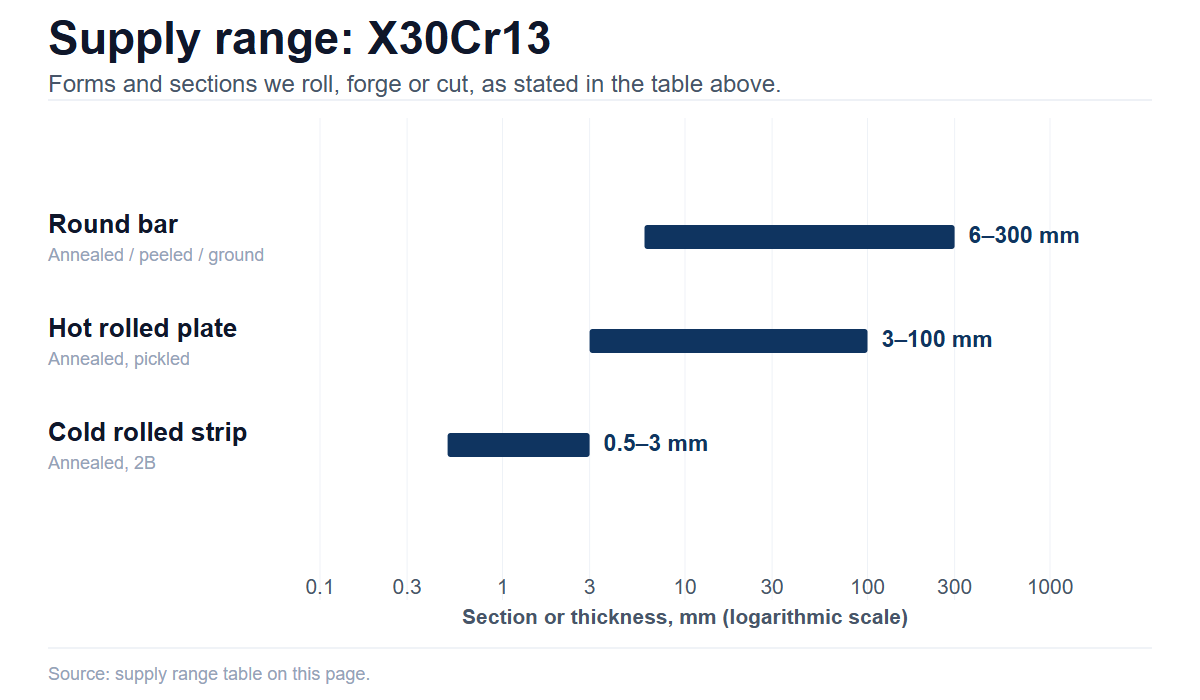
| Supply range | Round bar Ø6–300 mm, plate 3–100 mm, strip 0.5–3.0 mm |
| Typical use | Knives and scissors, surgical instruments, mould inserts, valve trim, wear plates |
| Certificate | EN 10204 3.1 with chemistry, hardness and mechanical properties |
Where the extra carbon buys something
X30Cr13 carries roughly 0.1 % more carbon than 2Cr13 and that is the whole difference. After hardening at 980–1050 °C it reaches 50–55 HRC instead of 48–52, and the extra carbide volume is what keeps an edge from rolling over.
The cost is toughness. The same carbon that raises hardness lowers impact strength, so the grade belongs on parts that see abrasion and cutting — blades, trim, inserts — rather than on shafts that see torque or shock.
Where it stops: chlorides, welded assemblies that cannot be re-hardened, and service above about 400 °C. For those, a duplex or a PH stainless is the honest answer.
Supply range and delivery condition
| Form | Size range | Condition |
|---|---|---|
| Round bar | Ø6–300 mm | Annealed / peeled / ground |
| Hot rolled plate | Thickness 3–100 mm × width up to 2000 mm | Annealed, pickled |
| Cold rolled strip | Thickness 0.5–3.0 mm × width up to 600 mm | Annealed, 2B |
Sawn or slit within these ranges; above Ø300 mm the bar is quoted as a forging.
Chemical composition
| C | Si | Mn | P | S | Cr |
|---|---|---|---|---|---|
| 0.26–0.35 | ≤1.00 | ≤1.00 | ≤0.040 | ≤0.030 | 12.0–14.0 |
EN 10088-3 and GB/T 1220 ranges agree for this grade. The certificate reports the actual heat.
Mechanical properties
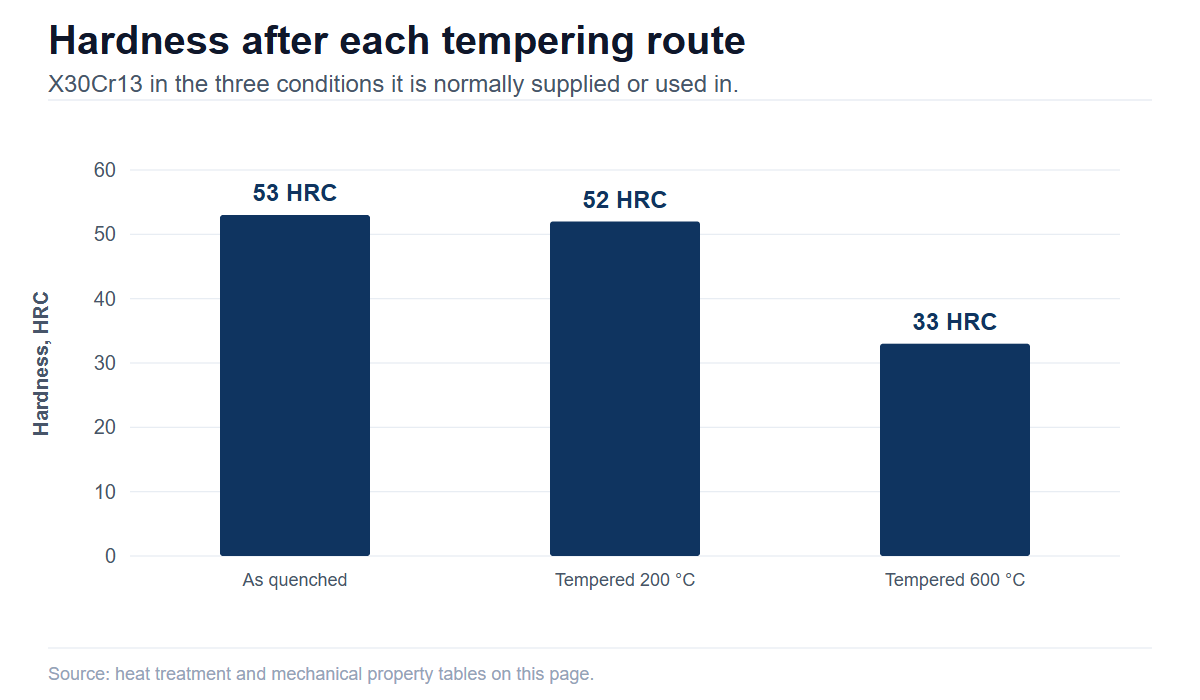
| Condition | Hardness | Tensile Rm | Note |
|---|---|---|---|
| Annealed | ≤235 HB | ≤740 MPa | Machinable, magnetic |
| Hardened 1000 °C, oil | 50–55 HRC | — | Temper immediately |
| Tempered 180–250 °C | 50–54 HRC | — | Blade and wear parts |
| Tempered 600 °C | 30–36 HRC | — | Where some toughness is needed |
Room temperature. The grade is normally used in the low-tempered condition; the high-temper route exists for parts that must survive shock.
Heat treatment
| Step | Temperature | Medium | Result |
|---|---|---|---|
| Annealing | 840–900 °C, furnace cool | — | ≤235 HB |
| Hardening | 980–1050 °C | Oil or air | 50–55 HRC |
| Tempering | 180–250 °C | Air | 50–54 HRC |
| Tempering | 550–650 °C | Air | 30–36 HRC |
Two tempers are normal on thin sections: the first converts retained austenite, the second stabilises the dimension.
Where orders go wrong
- Using 1.4028 where 1.4021 was specified. The higher carbon is not interchangeable: it hardens 3–5 HRC higher and machines differently. Read the drawing, not the family name.
- Grinding after hardening without coolant. The surface can re-austenitise and form untempered martensite, which is where blade edges spall.
- Expecting a mirror polish. The carbide volume makes a true mirror difficult; 1.2083 or 1.2316 is the mould grade for optical surfaces.
What ships with every lot
- EN 10204 3.1 mill certificate with chemistry, hardness and mechanical properties
- Hardness traverse across the section on request
- Decarburisation depth check on annealed bar
- Grain size and inclusion rating on request
- Surface inspection for 2B and pickled finishes
Cutting, machining and surface
| Operation | What we hold |
|---|---|
| Saw cutting | Section up to 300 mm; length tolerance ±2 mm |
| Surface grinding | Thickness tolerance −0 to +0.1 mm; flatness 0.01/100 mm |
| Polishing | Satin to bright; not a mirror-finish grade |
| CNC machining | From drawing — DXF, STEP or PDF |
Anneal before machining if the part needs a lot of stock removed; hardened material is ground.
Trade terms and how an order runs
The terms below apply unless the enquiry states otherwise, and they can be adjusted in the quotation.
| Item | Standard terms |
|---|---|
| Incoterms 2020 | FOB Shanghai, Qingdao or Shenzhen; CIF and CFR quoted against the destination port |
| Payment | T/T 30 % advance, 70 % against the bill of lading copy; irrevocable L/C at sight above 20 t |
| Minimum quantity | One bundle or one plate for stock sizes; mill runs quoted individually |
| Lead time | The 0.3 % carbon member of the 12 % chromium family — 50–55 HRC and better edge retention than 2Cr13 at the same corrosion resistance. Bought for blades, mould inserts and wear parts where a harder surface matters more than impact strength. |
| Documents | 3.1 certificate, packing list, invoice, bill of lading, certificate of origin |
| Inspection | Third-party inspection (SGS, BV, TUV) arranged before dispatch on request |
Packing and delivery
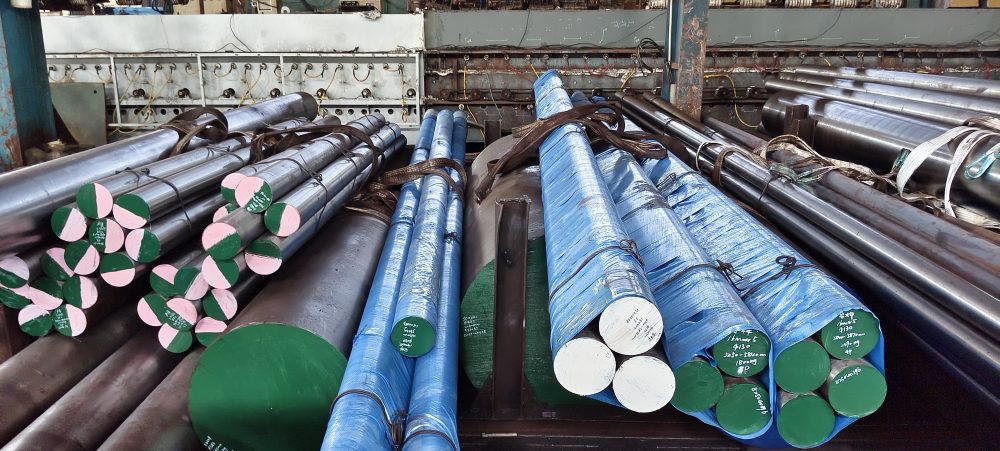
Bar is bundled by heat number with colour-marked ends; plate is separated with timber and strapped to skids. Every package carries grade, heat number, size and net weight matching the certificate.
Typical lead time is 20–30 days for stock sizes, 30–45 days where grinding or heat treatment is included.
Request a quote
- Grade and standard — X30Cr13 / 1.4028 unless 2Cr13 is enough
- Form and size — diameter and length, or plate thickness × width
- Quantity in pieces or kilograms
- Condition — annealed, peeled, ground, or hardened and tempered with the hardness window
- Certificate and inspection — 3.1 as standard, hardness traverse on request
Email [email protected] or use the form below. Drawings in DXF, STEP or PDF are all fine.
Related grades
One heat-treatment route, one certification route — grades can be combined in a single shipment.
- 2Cr13 / 20Cr13 — the tougher, lower-carbon member
- SUS420J2 — the JIS near-equivalent
- 1.2083 / S136 — 420 modified for mirror-polished moulds
Browse all stainless steel grades →
Governing standard: ASTM A276 (PDF)
Frequently asked questions
1.4028 in EN and 3Cr13 in GB; SUS420J2 is the closest JIS grade but sits at the higher end of the carbon range. Quote the designation you need and it goes on the certificate.
Carbon. 1.4021 (2Cr13) has 0.16–0.25 % and hardens to 48–52 HRC; 1.4028 (3Cr13) has 0.26–0.35 % and reaches 50–55 HRC with better wear resistance and lower toughness.
50–54 HRC for knives and scissors. Above 55 the edge holds longer but chips on bone or ice; below 50 it rolls.
It is used for cutlery and kitchen tools, but 12 % chromium with this much carbon is not a salt or acid grade. For aggressive food service, specify 316L or a 1.4404.
Round bar Ø6–300 mm, plate 3–100 mm and strip 0.5–3.0 mm, annealed or hardened and tempered, with 3.1 certification.
