
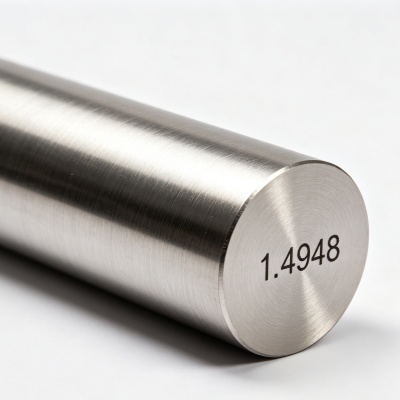
X7CrNi18-9, designated as EN 1.4948, UNS S30409, and JIS SUS304H (trade name AISI 304H), is a high-carbon austenitic stainless steel engineered for prolonged elevated-temperature service. FUSHUN METAL supplies this heat-resistant grade under ISO 9001:2015 and AS9120B certified quality systems, with full material traceability from melt to shipment. Its controlled carbon range of 0.04–0.10% delivers superior creep strength and stress-rupture resistance at temperatures from 500°C to 816°C, making it the definitive choice for boilers, superheaters, pressure vessels, and petrochemical process equipment where standard 304 or 304L would lack long-term thermal stability.
X7CrNi18-9 (1.4948 / S30409) Overview
Belonging to the ASTM A240 / ASME SA-240 family of chromium-nickel austenitic stainless steels, X7CrNi18-9 is the high-carbon variant of the widely used 304 grade. The elevated carbon content—0.04% minimum per ASTM A240—is intentional: it stabilizes the austenitic microstructure under prolonged thermal exposure and directly improves creep-rupture strength above 500°C. At FUSHUN METAL, every heat of X7CrNi18-9 undergoes optical emission spectroscopy verification before entering production, and the material is solution-annealed at 1040–1120°C followed by rapid water quenching to ensure a fully recrystallized grain structure free of chromium carbide precipitation. This grade retains good oxidation resistance in continuous service up to approximately 870°C and is approved under ASME Section I and Section VIII for pressure-containing components in high-temperature duty. Key industries served include power generation (boiler and superheater tubing), oil refining (heat exchangers and condensers), petrochemical processing (reformer tubes and catalytic converter shells), and nuclear engineering (structural supports and thermal sleeves).
Typical Applications by Industry
Power Generation
- Superheater & reheater tubes
- Boiler headers & drums
- Steam piping (main steam)
- High-temperature fasteners
Petrochemical
- Catalytic reformer tubes
- Furnace radiant coils
- Cracking furnace tubes
- Hot process piping
Oil & Gas Refining
- Heat exchanger tube bundles
- Condenser shells & plates
- Crude unit transfer lines
- Flare system components
Pressure Vessels
- ASME Section VIII vessels
- Storage tanks (hot media)
- Autoclaves & digesters
- Expansion bellows
Nuclear Engineering
- Reactor internal supports
- Thermal sleeves & liners
- Moderator cooling pipes
- Containment penetrations
Aerospace & Defense
- Exhaust system components
- Afterburner parts
- Thermal ducting
- Engine test rig hardware
Furnace & Kiln
- Radiant tubes & muffles
- Retorts & hearth plates
- Annealing boxes & baskets
- Burner nozzles & tips
Automotive
- Exhaust manifolds
- Turbocharger housings
- EGR system tubing
- Catalytic converter shells
X7CrNi18-9 Supply Range — FUSHUN METAL
FUSHUN METAL stocks and processes X7CrNi18-9 in an extensive dimensional range, manufactured under ISO 9001:2015 quality management and AS9120B aerospace distribution protocols. Every product is shipped with MTC 3.1 documentation including heat number, full spectroscopy, mechanical test results, and dimensional report. Independent third-party inspection and PMI testing are available upon request.
| Product Form | Process | Diameter / Thickness Range | Width / Length Range |
|---|---|---|---|
| Round Bar | Hot-Rolled | Φ5mm – Φ500mm | L: 3000 – 12000mm |
| Round Bar | Forged | Φ50mm – Φ800mm | L: 2000 – 12000mm |
| Flat Bar | Hot-Rolled | T: 5 – 100mm | W: 10 – 610mm |
| Flat Bar | Forged | T: 20 – 300mm | W: 50 – 800mm |
| Plate | Hot-Rolled / Cold-Rolled | T: 0.5 – 100mm | W: up to 2500mm; L: up to 12000mm |
| Seamless Tube | Cold-Drawn / Hot-Finished | OD: 6 – 610mm | WT: 0.5 – 60mm; L: up to 18000mm |
| Forging | Open-Die / Closed-Die | Custom dimensions: shafts, discs, rings, flanges, blocks — to customer drawing | |
Chemical Composition per ASTM A240
At FUSHUN METAL, each incoming heat is verified by optical emission spectroscopy against the ordered standard. The following composition conforms to ASTM A240 / ASME SA-240 for grade S30409 (304H). EN 10028-7 limits for 1.4948 are slightly tighter on sulfur and phosphorus, which FUSHUN METAL can meet upon request.
| Element | C | Si | Mn | P | S | Cr | Ni | N |
|---|---|---|---|---|---|---|---|---|
| Min (%) | 0.04 | — | — | — | — | 18.0 | 8.0 | — |
| Max (%) | 0.10 | 0.75 | 2.00 | 0.045 | 0.030 | 20.0 | 10.5 | 0.10 |
Iron (Fe) balance. The defined minimum carbon of 0.04% is the critical differentiator from standard 304 (max 0.08%) and 304L (max 0.03%)—it ensures predictable creep-rupture properties at elevated temperature as required by ASME Code Case limits.
Mechanical Properties — X7CrNi18-9 in Solution-Annealed Condition
Values below represent minimum room-temperature properties after solution annealing at 1040–1120°C followed by water quenching, per ASTM A240 / A276. FUSHUN METAL’s heat treatment furnaces are instrumented with embedded thermocouples and logged continuously, with every cycle record archived for full traceability under ISO 9001 and AS9120B requirements.
| Property | Metric Value | Imperial Value | Remarks |
|---|---|---|---|
| Tensile Strength (Rm) | ≥515 MPa | ≥75 ksi | For sections t ≤ 130mm; min 485 MPa for t > 130mm |
| Yield Strength (Rp0.2) | ≥205 MPa | ≥30 ksi | 0.2% offset method |
| Elongation (A) | ≥35–40% | ≥35–40% | In 50mm gauge length; varies by product form |
| Brinell Hardness | ≤201 HBW | ≤92 HRB | Max. as-annealed; EN 10028-7 permits ≤215 HBW |
| Density | 7.93 g/cm³ | 0.286 lb/in³ | Ambient temperature |
| Melting Range | 1400–1450°C | 2550–2640°F | Solidus–Liquidus |
| Thermal Conductivity | 16.2 W/m·K | 112 BTU·in/h·ft²·°F | At 100°C |
| Max. Service Temp | 816°C (ASME) | 1500°F | Oxidation resistance up to 870°C intermittent |
Frequently Asked Questions on X7CrNi18-9 / 304H
What distinguishes 304H from standard 304 and 304L?
Carbon content. Standard 304 allows up to 0.08% C with no minimum; 304L caps at 0.03% C to prevent weld sensitization; 304H mandates 0.04–0.10% C. This controlled minimum carbon ensures predictable creep strength at elevated temperatures—ASME codes specifically require 304H (not 304 or 304L) for pressure-boundary components in high-temperature service because the minimum carbon guarantee provides calculable long-term stress-rupture values.
Does X7CrNi18-9 require post-weld heat treatment?
For most non-critical fabrications, post-weld heat treatment is not required—the grade welds readily with standard austenitic procedures (GTAW, GMAW, SMAW). However, for service above 425°C in corrosive environments, or where ASME code mandates it, solution annealing after welding may be specified to dissolve chromium carbides and restore intergranular corrosion resistance. FUSHUN METAL advises customers to reference the applicable construction code for specific PWHT requirements.
What filler metal should be used when welding 304H?
AWS ER308H or E308H electrodes are the standard match for 304H base metal, maintaining the required carbon level in the weld deposit. For dissimilar joints or elevated-temperature service beyond 650°C, ERNiCrMo-3 (Inconel 625) filler is often specified for enhanced creep-rupture strength across the joint. FUSHUN METAL can include matching filler metal with material shipments upon request.
Is 304H susceptible to sigma-phase embrittlement?
Yes, like all standard 18Cr-8Ni austenitic grades, 304H can form brittle sigma phase during prolonged exposure between 540°C and 900°C. The higher carbon in 304H provides some resistance compared to 304L, but the risk remains. Proper solution annealing and avoiding prolonged holds in the sigma-forming range during fabrication are essential precautions FUSHUN METAL’s technical team can advise on for critical applications.
What certifications accompany FUSHUN METAL shipments?
Every shipment of X7CrNi18-9 from FUSHUN METAL is supplied with an EN 10204 Type 3.1 Mill Test Certificate bearing heat number, full chemical analysis by optical emission spectroscopy, mechanical property results (tensile, yield, elongation, hardness), and dimensional conformance report. The material is produced and verified under our ISO 9001:2015 registered quality management system, with AS9120B protocols governing traceability, storage, handling, and documentation retention—the same rigor demanded by the global aerospace supply chain. For orders requiring enhanced assurance, FUSHUN METAL offers third-party witnessed testing, positive material identification, intergranular corrosion testing per ASTM A262 Practice E, and custom test protocols defined at the time of order placement.