
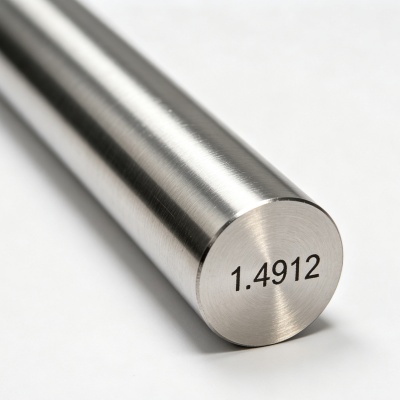
X7CrNiNb18-10, designated as EN 1.4912, UNS S34709, and JIS SUS347H (trade name AISI 347H), is a niobium-stabilized high-carbon austenitic stainless steel that delivers the strongest creep-rupture performance among the 300-series heat-resistant grades. FUSHUN METAL supplies this premium grade under ISO 9001:2015 and AS9120B certified quality systems, with full material traceability from melt to shipment. The 347H alloy combines two deliberate metallurgical levers: an elevated carbon band of 0.04–0.10% to guarantee calculable creep strength under ASME Section I and VIII codes, and a niobium addition at 8×C to 1.00% that permanently locks free carbon as stable NbC particles, rendering the heat-affected zone immune to intergranular corrosion even after prolonged exposure within the 450–850°C sensitization range. Compared to its titanium-stabilized counterpart (321H / X7CrNiTi18-10), the niobium in 347H transfers more reliably across the welding arc without oxidation loss, and the resulting alloy achieves measurably higher stress-rupture life—approximately 10,000 hours at 650°C and 100 MPa, versus roughly 6,000 hours for 347 and 8,000–9,000 hours for 321H under equivalent conditions. This makes X7CrNiNb18-10 the material of choice for ultra-supercritical boiler tubing, gas turbine combustion hardware, nuclear steam generator components, and high-temperature molten-salt storage systems in concentrated solar power (CSP) plants operating at design temperatures up to 575°C.
X7CrNiNb18-10 (1.4912 / S34709) Overview
X7CrNiNb18-10 belongs to the ASTM A240 / ASME SA-240 family of niobium-stabilized austenitic stainless steels and is the high-carbon, code-recognized variant of Type 347 (UNS S34700). The defining metallurgical feature is its niobium (+ tantalum) stabilization: niobium has a far stronger affinity for carbon than chromium does, so during solidification and subsequent thermal exposure, carbon precipitates as finely dispersed niobium carbides (NbC) rather than chromium carbides (Cr₂₃C₆) at grain boundaries. This leaves the full chromium content in solid solution to maintain the protective passive oxide layer, conferring intrinsic immunity to intergranular attack—a property that unstabilized grades like 304H and 316H can only achieve through rapid post-weld quenching, which is impractical in thick sections. At FUSHUN METAL, every heat of X7CrNiNb18-10 undergoes optical emission spectroscopy with independent niobium verification at intake, followed by solution annealing at 980–1150°C with rapid cooling to produce a fully recrystallized austenitic microstructure with uniformly distributed NbC precipitates. The grade retains oxidation resistance in continuous service up to approximately 900°C (intermittent exposure to 925°C), and its 100,000-hour creep-rupture strength at 600°C reaches approximately 115 MPa—roughly 20–25% higher than 321H at the same condition—making it the definitive specification for pressure-boundary components in ultra-supercritical fossil-fuel boilers, gas turbine combustion chambers, nuclear steam generators, and molten-salt thermal energy storage systems. Primary industries served include thermal power generation, concentrated solar power (CSP), petrochemical processing, oil refining, nuclear engineering, aerospace propulsion, and high-temperature environmental systems.
Typical Applications by Industry
Power Generation
- USC boiler superheater tubes
- High-temperature reheater tubing
- Main steam piping (HP)
- Boiler headers & drums
- Boiler evaporator shells
Solar Thermal (CSP)
- Molten-salt storage tanks (575°C)
- Heat transfer fluid piping
- Thermal receiver tubes
- Hot-salt header manifolds
Aerospace & Gas Turbine
- Combustion chamber liners
- Turbine exhaust components
- Afterburner flame holders
- Hot-section ducting
- Expansion bellows
Petrochemical & Refining
- Cracking furnace radiant tubes
- Catalytic reformer tubing
- Hydroprocessing unit piping
- High-temp heat exchangers
- Pyrolysis coil assemblies
Nuclear Engineering
- Steam generator tubing
- Reactor high-temp internals
- Pressurizer components
- Containment penetrations
Thermal Processing
- Industrial furnace radiant tubes
- Annealing covers & boxes
- Heat treatment trays & baskets
- Kiln muffles & retorts
Environmental Systems
- Flue gas desulfurization units
- Waste incinerator components
- Exhaust gas treatment piping
- Scrubber internals
Oil & Gas Equipment
- Refinery heater tubes
- Expansion joints & bellows
- Spiral heat exchangers
- Hot flare system piping
X7CrNiNb18-10 Supply Range — FUSHUN METAL
FUSHUN METAL stocks and processes X7CrNiNb18-10 in an extensive dimensional range, manufactured under ISO 9001:2015 quality management and AS9120B aerospace distribution protocols. Every shipment includes MTC 3.1 documentation with heat number, full spectroscopy (including independent Nb verification by XRF or OES), mechanical test results, grain size determination (target ASTM 5.0 or finer), and dimensional conformance. Third-party inspection, PMI with niobium confirmation, and intergranular corrosion testing per ASTM A262 Practice E (Strauss test) are available upon request.
| Product Form | Process | Diameter / Thickness Range | Width / Length Range |
|---|---|---|---|
| Round Bar | Hot-Rolled | Φ5mm – Φ500mm | L: 3000 – 12000mm |
| Round Bar | Forged | Φ50mm – Φ800mm | L: 2000 – 12000mm |
| Flat Bar | Hot-Rolled | T: 5 – 100mm | W: 10 – 610mm |
| Flat Bar | Forged | T: 20 – 300mm | W: 50 – 800mm |
| Plate / Sheet | Hot-Rolled / Cold-Rolled | T: 0.3 – 100mm | W: 1000 – 2500mm; L: up to 12000mm |
| Seamless Tube | Cold-Drawn / Hot-Finished | OD: 6 – 610mm | WT: 0.5 – 60mm; L: up to 24000mm |
| Forging / Flange | Open-Die / Closed-Die | Custom: shafts, discs, rings, flanges, tube sheets, valve bodies — to customer drawing per ASTM A182 F347H | |
Chemical Composition — X7CrNiNb18-10 per ASTM A240
At FUSHUN METAL, each incoming heat is verified by optical emission spectroscopy, with niobium content independently confirmed by XRF against the ordered standard. The composition below conforms to ASTM A240 / ASME SA-240 for grade S34709 (347H). The Nb:C ratio—minimum 8×C—is the critical metallurgical control: insufficient niobium leaves free carbon to form chromium carbides, defeating the stabilization purpose. FUSHUN METAL’s metallurgical lab verifies this ratio on every heat certificate.
| Element | C | Si | Mn | P | S | Cr | Ni | Nb+Ta | N |
|---|---|---|---|---|---|---|---|---|---|
| Min (%) | 0.04 | — | — | — | — | 17.0 | 9.0 | 8×C | — |
| Max (%) | 0.10 | 1.00 | 2.00 | 0.045 | 0.030 | 19.0 | 13.0 | 1.00 | 0.10 |
Iron (Fe) balance. The minimum Nb requirement of 8×C (or 10×C in some EN variants) is the defining quality gate—FUSHUN METAL’s spectrometric lab verifies this ratio for every heat. EN 10028-7 for 1.4912 imposes tighter sulfur (≤0.015%) and phosphorus (≤0.035%) limits, available upon request for critical applications.
Mechanical Properties — X7CrNiNb18-10 in Solution-Annealed Condition
Values below represent minimum room-temperature properties after solution annealing at 980–1150°C followed by rapid cooling (water or forced air, depending on section thickness), per ASTM A240 / A276 / A213. FUSHUN METAL’s heat treatment furnaces are instrumented with embedded thermocouples and logged continuously; every cycle record is archived for full traceability under ISO 9001 and AS9120B protocols. Where applicable, elevated-temperature creep data from published ASME code tables is also noted.
| Property | Metric Value | Imperial Value | Remarks |
|---|---|---|---|
| Tensile Strength (Rm) | ≥515 MPa | ≥75 ksi | For sections t ≤ 130mm; typical range 515–750 MPa |
| Yield Strength (Rp0.2) | ≥205 MPa | ≥30 ksi | 0.2% offset; typical 205–310 MPa |
| Elongation (A) | ≥35–40% | ≥35–40% | In 50mm gauge; varies by product form |
| Reduction of Area | ≥40–50% | ≥40–50% | Per ASTM A182 for forged products |
| Brinell Hardness | ≤187–201 HBW | ≤90–95 HRB | Varies by product spec; some permit ≤217 HBW |
| ASTM Grain Size | ≥ASTM 5.0 | — | Finer grain = better creep; verified per ASTM E112 |
| Density | 7.93–7.98 g/cm³ | 0.287 lb/in³ | Ambient temperature |
| Melting Range | 1398–1427°C | 2550–2600°F | Solidus–Liquidus |
| Thermal Conductivity | ~16 W/m·K | ~111 BTU·in/h·ft²·°F | At 100°C |
| Creep Strength (600°C, 100kh) | ~115 MPa | ~16.7 ksi | 100,000-hour rupture; ~20–25% above 321H |
| Max. Service Temp | 816°C (ASME) | 1500°F | Oxidation resistance: 850–900°C continuous; 925°C intermittent |
Frequently Asked Questions on X7CrNiNb18-10 / 347H
What distinguishes 347H from standard 347?
Carbon content. Standard 347 (S34700) permits a maximum of 0.08% C with no minimum; 347H (S34709) mandates 0.04–0.10% C. This guaranteed minimum carbon translates directly into predictable creep-rupture strength under ASME code allowables. At 650°C and 100 MPa, 347H achieves approximately 10,000 hours to rupture versus roughly 6,000 hours for standard 347—a 60%+ life advantage that justifies the “H” designation for any load-bearing component above 500°C. Both grades share identical niobium stabilization for intergranular corrosion immunity, so upgrading from 347 to 347H in a specification carries no fabrication or welding penalty.
Why choose X7CrNiNb18-10 (347H) over X7CrNiTi18-10 (321H)?
Three practical advantages drive the preference for 347H in critical applications. First, niobium transfers more reliably through the welding arc than titanium does—titanium is prone to oxidation loss in the weld pool, which can compromise stabilization in the as-deposited weld metal. Niobium experiences negligible arc loss, so the weld deposit retains the full stabilizing effect without special shielding measures. Second, 347H delivers measurably higher creep-rupture strength: approximately 115 MPa versus 90–95 MPa at 600°C for 100,000-hour life, making it the preferred choice for ultra-supercritical boilers and gas turbine components where every MPa of allowable stress translates into reduced wall thickness and weight. Third, the nickel range of 347H extends to 13% (versus 12% for 321H), providing enhanced austenite stability and sigma-phase resistance during prolonged service above 800°C. For standard applications below 600°C where cost is the primary driver, 321H remains a fully capable alternative.
What filler metal should be used for welding 347H?
AWS ER347 or ER347H is the standard matching filler, formulated with niobium to maintain stabilization in the deposited weld metal. Unlike titanium-bearing fillers (ER321), niobium-stabilized electrodes transfer their stabilizing element with near-total efficiency across the arc, producing a weld that is intrinsically immune to intergranular corrosion without post-weld heat treatment. For dissimilar joints or service above 700°C, ERNiCrMo-3 (Inconel 625) is often specified for maximum creep-rupture strength and oxidation resistance across the joint. FUSHUN METAL can supply matching ER347/ER347H filler metal and covered electrodes (E347) with base metal shipments.
Is 347H susceptible to sigma-phase embrittlement?
The risk is significantly lower than for unstabilized or molybdenum-bearing grades. The 9–13% nickel range of 347H stabilizes the austenitic matrix against sigma-phase formation more effectively than the 8–10.5% Ni range of 304H or the leaner stabilization of 321H. Sigma phase can still form during prolonged exposure between 540°C and 900°C, particularly above 900°C where hold times should be limited to approximately one hour without post-exposure solution annealing. For long-term service at 800–900°C, 347H is demonstrably safer than ferritic or lean-austenitic alternatives. FUSHUN METAL’s technical team can advise on maximum recommended exposure times for specific operating conditions and perform metallographic verification if required.
What certifications accompany FUSHUN METAL shipments of X7CrNiNb18-10?
Every shipment from FUSHUN METAL is supplied with an EN 10204 Type 3.1 Mill Test Certificate bearing heat number, full chemical analysis by optical emission spectroscopy (with independent niobium verification by XRF), mechanical property results (tensile, yield, elongation, hardness, reduction of area), grain size determination per ASTM E112, and dimensional conformance report. The material is produced and verified under our ISO 9001:2015 registered quality management system, with AS9120B protocols governing traceability, storage, handling, and documentation retention—the same rigor required by the global aerospace supply chain. For orders requiring enhanced assurance, FUSHUN METAL offers intergranular corrosion testing per ASTM A262 Practice E (Strauss test) to verify niobium stabilization effectiveness, creep-rupture testing at the customer’s design temperature and stress level, third-party witnessed testing, PMI with niobium confirmation, and custom test protocols defined at the time of order placement. All test equipment is calibrated to national standards and all records are archived for the full product lifecycle.