
X7CrNiTi18-10, designated as EN 1.4940, UNS S32109, and JIS SUS321H (trade name AISI 321H), is a titanium-stabilized high-carbon austenitic stainless steel purpose-built for sustained elevated-temperature service in the carbide-precipitation range of 427–816°C. FUSHUN METAL supplies this heat-resistant grade under ISO 9001:2015 and AS9120B certified quality systems, with full material traceability from melt to shipment. The defining feature of X7CrNiTi18-10 is its dual metallurgical design: a controlled carbon range of 0.04–0.10% provides predictable creep-rupture strength at high temperature, while a deliberate titanium addition—minimum 4×(C+N) up to 0.70%—scavenges free carbon to suppress chromium carbide precipitation at grain boundaries, delivering immunity to intergranular corrosion that neither 304H nor standard 304 can match after prolonged thermal exposure or welding.
X7CrNiTi18-10 (1.4940 / S32109) Overview
X7CrNiTi18-10 belongs to the ASTM A240 / ASME SA-240 family of titanium-stabilized austenitic stainless steels and is the high-carbon variant of the widely specified Type 321. While standard 321 (UNS S32100, EN 1.4541) already carries titanium for stabilization, the “H” designation (S32109) mandates a minimum carbon of 0.04%—intentionally higher than the 0.08% maximum of standard 321—to guarantee calculable creep-rupture strength under ASME Section I and Section VIII design codes. At FUSHUN METAL, every heat of X7CrNiTi18-10 is verified by optical emission spectroscopy at intake, then solution-annealed at 920–1150°C with rapid cooling to achieve a fully recrystallized austenitic grain structure with titanium carbides uniformly dispersed throughout the matrix. This microstructure is inherently resistant to sensitization: unlike unstabilized grades (304H, 316H) that precipitate chromium carbides at grain boundaries when held between 450–850°C, X7CrNiTi18-10 locks carbon into stable TiC particles, preserving chromium in solid solution for corrosion resistance even after welding or long-term thermal cycling. Oxidation resistance is maintained in continuous service up to approximately 900°C and intermittent exposure up to 925°C. Primary industries served include aerospace (engine exhaust systems and hot-air ducting), power generation (superheater and reheater tubing), petrochemical processing (cracking furnace and reformer tubes), oil refining (heat exchangers and furnace components), and thermal processing (radiant tubes and furnace rollers).
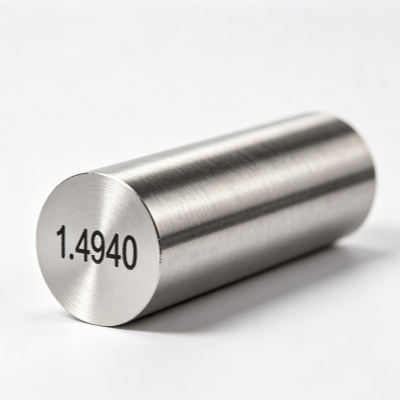
Typical Applications by Industry
Aerospace
- Aircraft engine exhaust manifolds
- Hot-air ducting & bleed lines
- Afterburner components
- Ground test rig hardware
- Piston engine exhaust stacks
Power Generation
- Superheater & reheater tubing
- Boiler headers & drums
- Main steam piping
- Turbine exhaust casings
Petrochemical
- Cracking furnace tubes
- Catalytic reformer tubing
- Pyrolysis coils & headers
- Hot process transfer lines
- Regenerator internals
Oil & Gas Refining
- Heat exchanger tube bundles
- Condenser shells & tubing
- Furnace radiant coils
- Flare system components
- Crude unit transfer piping
Chemical Processing
- Distillation column internals
- Hot corrosive media piping
- Reactors & pressure vessels
- Separation column trays
Thermal Processing
- Heat treatment furnace rollers
- Radiant tubes & muffles
- Annealing boxes & baskets
- Burner nozzles & combustion tubes
Food Processing
- High-temperature sterilizers
- Hot processing conveyors
- Thermal treatment vessels
- Non-reactive transfer piping
Automotive
- Turbocharger housings
- Exhaust system flex couplings
- EGR cooler tubing
- Catalytic converter shells
X7CrNiTi18-10 Supply Range — FUSHUN METAL
FUSHUN METAL stocks and processes X7CrNiTi18-10 in an extensive dimensional range, manufactured under ISO 9001:2015 quality management and AS9120B aerospace distribution protocols. Every product is shipped with MTC 3.1 documentation including heat number, full spectroscopy (with Ti verification), mechanical test results, and dimensional conformance report. Independent third-party inspection and PMI testing, including titanium verification by X-ray fluorescence, are available upon request.
| Product Form | Process | Diameter / Thickness Range | Width / Length Range |
|---|---|---|---|
| Round Bar | Hot-Rolled | Φ5mm – Φ500mm | L: 3000 – 12000mm |
| Round Bar | Forged | Φ50mm – Φ800mm | L: 2000 – 12000mm |
| Flat Bar | Hot-Rolled | T: 5 – 100mm | W: 10 – 610mm |
| Flat Bar | Forged | T: 20 – 300mm | W: 50 – 800mm |
| Plate | Hot-Rolled / Cold-Rolled | T: 0.5 – 100mm | W: up to 2500mm; L: up to 12000mm |
| Seamless Tube | Cold-Drawn / Hot-Finished | OD: 6 – 610mm | WT: 0.5 – 60mm; L: up to 18000mm |
| Forging | Open-Die / Closed-Die | Custom dimensions: shafts, discs, rings, flanges, tube sheets — to customer drawing | |
Chemical Composition — X7CrNiTi18-10 per ASTM A240
At FUSHUN METAL, each incoming heat is verified by optical emission spectroscopy, with titanium content independently confirmed against the ordered standard. The composition below conforms to ASTM A240 / ASME SA-240 for grade S32109 (321H). The Ti addition is the critical metallurgical control: it must be at least 4 times the combined carbon-plus-nitrogen content to ensure complete stabilization, with a practical maximum of 0.70%.
| Element | C | Si | Mn | P | S | Cr | Ni | Ti | N |
|---|---|---|---|---|---|---|---|---|---|
| Min (%) | 0.04 | — | — | — | — | 17.0 | 9.0 | 4×(C+N) | — |
| Max (%) | 0.10 | 0.75 | 2.00 | 0.045 | 0.030 | 19.0 | 12.0 | 0.70 | 0.10 |
Iron (Fe) balance. The Ti:C+N ratio is the defining quality metric—FUSHUN METAL’s metallurgical lab verifies this ratio on every heat certificate. EN 10028-7 for 1.4940 imposes slightly tighter phosphorus (≤0.035%) and sulfur (≤0.015%) limits, available upon request.
Mechanical Properties — X7CrNiTi18-10 in Solution-Annealed Condition
Values below represent minimum room-temperature properties after solution annealing at 920–1150°C followed by rapid cooling (water or air, depending on section thickness), per ASTM A240 / A276 / A479. FUSHUN METAL’s heat treatment furnaces are instrumented with embedded thermocouples and logged continuously; every cycle record is archived for full traceability under ISO 9001 and AS9120B protocols.
| Property | Metric Value | Imperial Value | Remarks |
|---|---|---|---|
| Tensile Strength (Rm) | ≥515 MPa | ≥75 ksi | For sections t ≤ 130mm; min 485 MPa for t > 130mm per ASTM A182 |
| Yield Strength (Rp0.2) | ≥205 MPa | ≥30 ksi | 0.2% offset method; typical 205–310 MPa |
| Elongation (A) | ≥40% | ≥40% | In 50mm gauge length; typical range 30–45% |
| Reduction of Area | ≥50% | ≥50% | Per ASTM A182 for forged products |
| Brinell Hardness | ≤217 HBW | ≤95 HRB | Max. as-annealed; some specs permit ≤215 HBW |
| Density | 8.00 g/cm³ | 0.289 lb/in³ | Ambient temperature |
| Melting Range | 1400–1450°C | 2550–2640°F | Solidus–Liquidus |
| Thermal Conductivity | 16.3 W/m·K | 113 BTU·in/h·ft²·°F | At 100°C |
| Max. Service Temp | 816°C (ASME) | 1500°F | Oxidation resistance up to 900°C continuous; 925°C intermittent |
Frequently Asked Questions on X7CrNiTi18-10 / 321H
What distinguishes 321H from standard 321 and why does it matter?
Carbon content. Standard 321 (S32100) permits a maximum of 0.08% C with no minimum; 321H (S32109) mandates 0.04–0.10% C. This intentional minimum guarantees predictable creep-rupture strength under ASME Section I and VIII design codes—standard 321 does not carry the code-recognized high-temperature stress allowables that 321H does. Both grades share the same titanium stabilization against intergranular corrosion, making 321H the definitive specification for pressure-boundary components where both creep strength and post-weld corrosion resistance are required.
Why choose X7CrNiTi18-10 (321H) over 304H for welded high-temperature service?
The titanium stabilization is the decisive advantage. 304H relies on a low carbon level plus a rapid post-weld quench to avoid chromium carbide sensitization, but this approach fails in thick sections that cool slowly through the 450–850°C range, or in service conditions where the component dwells in the sensitization window. X7CrNiTi18-10 forms stable TiC particles during melting, locking up free carbon permanently. The result: it can be welded in thick sections, operated continuously within the sensitization range, and thermally cycled without losing intergranular corrosion resistance—capabilities that 304H fundamentally cannot guarantee.
Does 321H require post-weld heat treatment?
Generally no, which is one of its principal advantages. The titanium stabilization renders the heat-affected zone immune to sensitization, so post-weld solution annealing is not required for corrosion resistance. However, stress-relief heat treatment may be specified for dimensional stability in heavily restrained fabrications, or where the governing construction code mandates it. For critical aerospace weldments, FUSHUN METAL can supply material with supplementary stabilization annealing at 870–900°C followed by air cooling to maximize TiC precipitation before the component enters service.
What filler metal is recommended for welding X7CrNiTi18-10?
AWS ER347 (niobium-stabilized) or ER321 (titanium-stabilized) are the standard matching fillers. ER347 is generally preferred because niobium transfers more reliably across the arc than titanium, which is prone to oxidation losses in the weld pool. For service above 650°C, ERNiCrMo-3 (Inconel 625) is often specified for maximum creep-rupture strength in the joint. FUSHUN METAL can supply matching filler materials with base metal shipments.
What certifications accompany FUSHUN METAL shipments of X7CrNiTi18-10?
Every shipment from FUSHUN METAL is supplied with an EN 10204 Type 3.1 Mill Test Certificate bearing heat number, full chemical analysis by optical emission spectroscopy (including independent Ti verification), mechanical property results (tensile, yield, elongation, hardness, reduction of area where applicable), and dimensional conformance report. The material is produced and verified under our ISO 9001:2015 registered quality management system, with AS9120B protocols governing traceability, storage, handling, and documentation retention—the same rigor demanded by the global aerospace supply chain. For orders requiring enhanced assurance, FUSHUN METAL offers intergranular corrosion testing to ASTM A262 Practice E (Strauss test) to verify titanium stabilization effectiveness, third-party witnessed testing, PMI with titanium verification, and custom test protocols defined at the time of order placement. Test equipment is calibrated to national standards and all records are archived for the full product lifecycle.