
1.2367 X38CrMoV5-3 Hot Work Die Steel
Forged blocks and bars for die-casting dies, hot forging and extrusion tooling. Supplied soft annealed to 235 HB for machining, or hardened and tempered to your drawing. Molybdenum at 2.7–3.3 % holds hardness at service temperatures where 1.2344 starts to drop off.
At a glance
| Item | Detail |
|---|---|
| Grade | 1.2367 / X38CrMoV5-3 |
| Standard | BS EN ISO 4957-2000 |
| Delivery condition | Soft annealed, max 235 HB — or quenched and tempered on request |
| Melt route | EAF plus vacuum degassing; ESR or EFS on request |
| Typical use | Aluminium and magnesium die-casting dies, hot forging dies, extrusion mandrels and liners |
| Certificate | EN 10204 3.1 with chemistry, mechanical properties and test results |
Why 1.2367 instead of 1.2344
1.2367 sits in the same 5 % chromium family as 1.2344 (H13), but the molybdenum is roughly doubled — 2.7–3.3 % against 1.1–1.75 %. That shifts the secondary hardening peak upward and widens it, so the die holds hardness through a longer thermal cycle instead of softening after the first few thousand shots.
It matters in three situations: dies running above 500 °C at the cavity surface, tools cooled directly by water, and large blocks where the core has to stay hard after the block is machined back. Where the tool never exceeds 400 °C, 1.2344 is the cheaper answer and we will say so.
The grade also resists heat-checking — the fine crack network that ends the life of a die-casting die. It is less sensitive to rapid temperature change than standard H13, which is why it is common on aluminium and magnesium dies running short cycles.
Supply range and delivery condition
| Form | Size range | Condition |
|---|---|---|
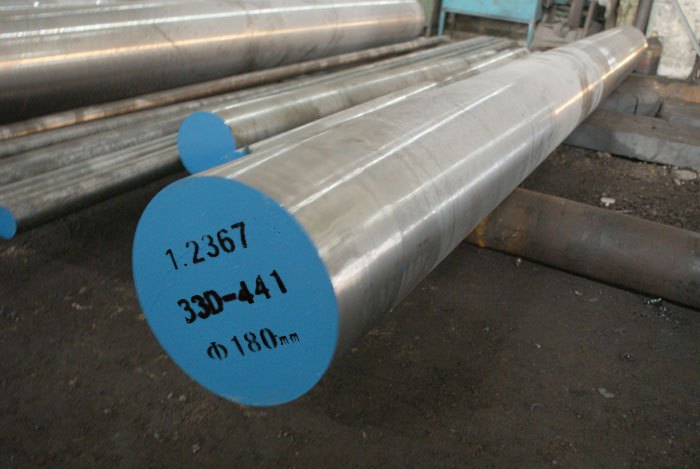
| Forged round bar | Ø150–1200 mm | Soft annealed / Q+T |
| Forged flat bar | Thickness 100–600 mm × width 300–2000 mm | Soft annealed |
| Rolled round bar | Ø10–200 mm | Soft annealed |
| Hot rolled plate | Thickness 1–100 mm × width 60–1600 mm | Annealed |
Sawn to size within these ranges. Blocks over 600 mm thickness are quoted individually.
Chemical composition
| C | Si | Mn | P | S | Cr | Mo | V |
|---|---|---|---|---|---|---|---|
| 0.35–0.40 | 0.30–0.50 | 0.30–0.60 | 0.030 max | 0.030 max | 4.70–5.20 | 2.70–3.30 | 0.40–0.70 |
Heat analysis to BS EN ISO 4957-2000; product analysis limits per the standard.
Heat treatment
Soft annealing — heat to 800–840 °C and cool slowly in the furnace. Maximum 235 HB, which is the condition we ship unless you specify otherwise.
Hardening — austenitise at 1030–1080 °C, then air, oil or warm-bath quench at 500–550 °C. As-quenched hardness 53–57 HRC.
Stress relieving — 650 °C, one hour at temperature, air cool. Do this after rough machining on large blocks; it is the difference between a die that stays flat and one that moves in the final cut.
| Tempering °C | Hardness HRC | Tensile N/mm² |
|---|---|---|
| 100 | 57 | 2140 |
| 200 | 55 | 1980 |
| 300 | 54 | 1910 |
| 400 | 53 | 1845 |
| 500 | 55.5 | 2010 |
| 550 | 56 | 2050 |
| 600 | 53 | 1845 |
| 650 | 43 | 1360 |
| 700 | 31 | 995 |
Double temper for dies in cyclic service. The rise between 400 and 550 °C is secondary hardening, not scatter.
What ships with every lot
- EN 10204 3.1 mill certificate — chemistry, mechanical properties and the result of each test
- Hardness map across the block section on request, so you know the core value before you start cutting
- Ultrasonic inspection to SEP 1921 or ASTM A388 on request
- Dimensional, straightness and squareness report on sawn blocks
- ESR or EFS remelt route for mirror-polish or high-cycle dies
Where the 1.2367 comes from
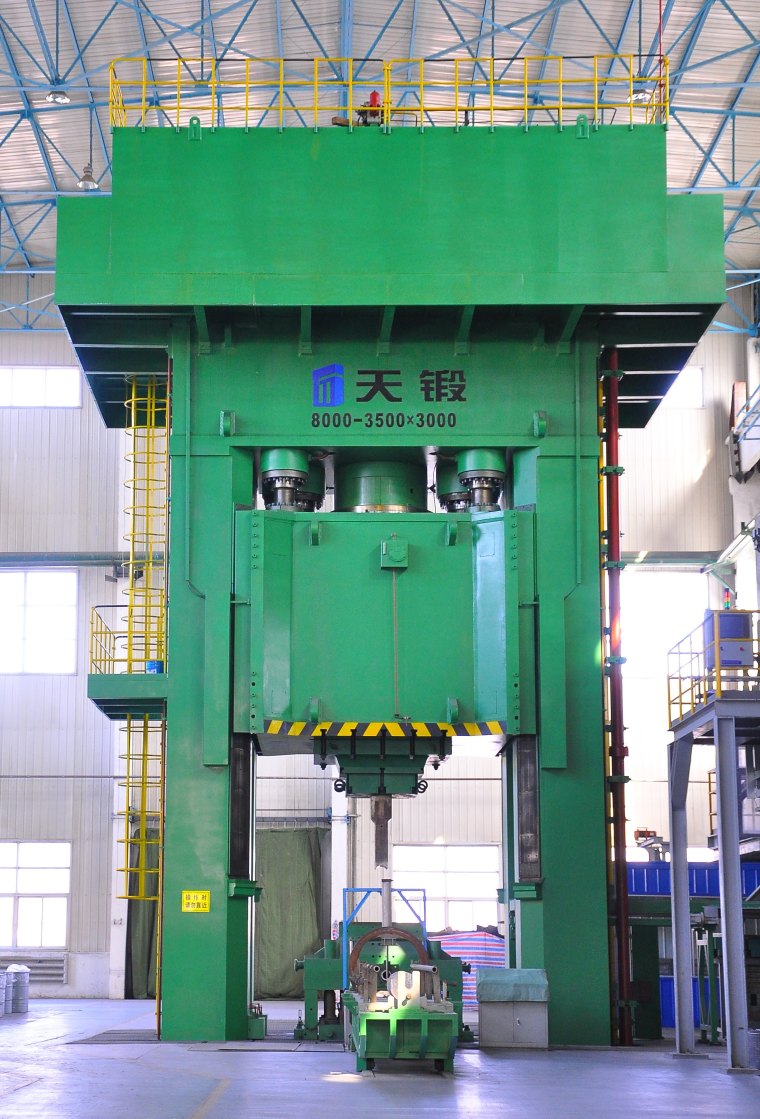
Ingots are cast in our own melting shop, then forged on an 8000 t hydraulic press or a 1800 t GFM precision forging machine depending on section. Press forging suits large blocks and discs; the GFM reduces bar stock with a controlled reduction ratio, which is what gives forged bar a finer, more uniform structure than rolled bar of the same diameter.
VAR remelt is available where cleanliness drives die life — the 3 t and 7 t furnaces cover ESR and VAR routes. Every heat is traced from ingot to dispatch; the heat number on the sawn end matches the heat number on the 3.1 certificate.
Cutting, machining and surface
| Operation | What we hold |
|---|---|
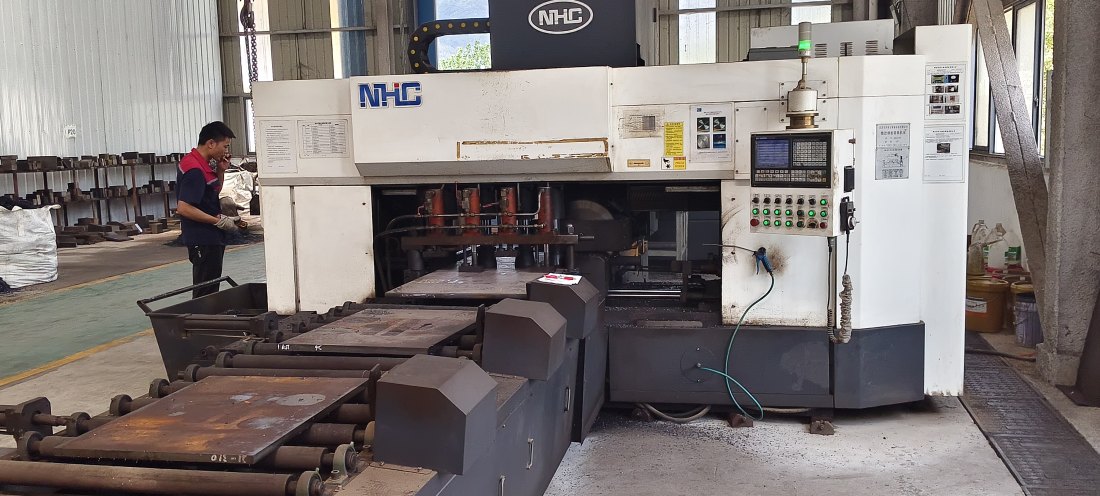
| Saw cutting | Section up to 1200 mm; square within 1 mm per 100 mm |
| Surface grinding | Thickness tolerance −0 to +0.1 mm; flatness 0.01/100 mm; Ra ≤1.6 |
| Milling | Bright milled surface, edges deburred |
| Vacuum heat treatment | Hardening and double tempering to your hardness window |
| Deep drilling and CNC | Quoted from drawing — DXF, STEP or PDF |
Rough machine before hardening on large dies, and tell us the allowance you want left; we hold it.
Packing and delivery
Blocks are coated with rust-preventive oil, wrapped, and fixed in plywood cases or on strapped pallets. Bars are bundled by heat number. Every package is stencilled with grade, heat number, size and net weight to match the 3.1 certificate inside.
Typical lead time is 20–30 days from order confirmation on stock sizes, longer for ESR or fully heat-treated blocks. Loading from Shanghai, Qingdao or Shenzhen, FOB or CIF as you prefer.
Request a quote
- Grade and standard — 1.2367 is assumed unless you write otherwise
- Form and size — thickness × width × length, or diameter and cut length
- Quantity in pieces or kilograms
- Delivery condition — soft annealed or hardened and tempered, with the hardness window you need
- Certificate and inspection — 3.1, plus UT or hardness map if required
Email [email protected] or use the form below. Drawings in DXF, STEP or PDF are all fine.
Related mould steel grades
One heat-treatment route, one certification route — grades can be combined in a single shipment.
