
1.5919, 15CrNi6, Alloy Steel
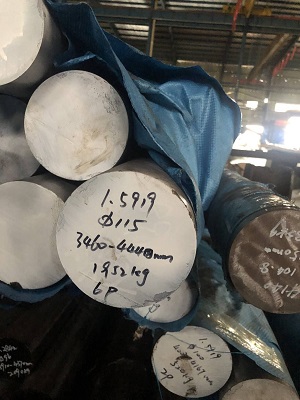
1.5919 Alloyed case hardening steel for highly strained parts and good toughness at core tensile strength of 900 – 1200 N/mm². Driving bevel gears, crown wheels, gears, shafts, bolts for automotive and gear components.
| Chemical
composition: (Typical analysis in %) |
C | Si | Mn | Cr | Ni | other |
| 0,15 | 0,25 | 0,50 | 1,55 | 1,55 | (Pb) |
| Hot forming and
heat treatment: |
Forging or hot rolling:
Normalising: Soft annealing: Carburising: Core hardening: Intermediate annealing: Case hardening: Tempering: |
1100 – 850°C
850 – 880°C/air 650 – 700°C/furnace 880 – 980°C 830 – 870°C/oil 630 – 650°C 780 – 820°C/oil 150 – 200°C |
Why nickel is in this grade
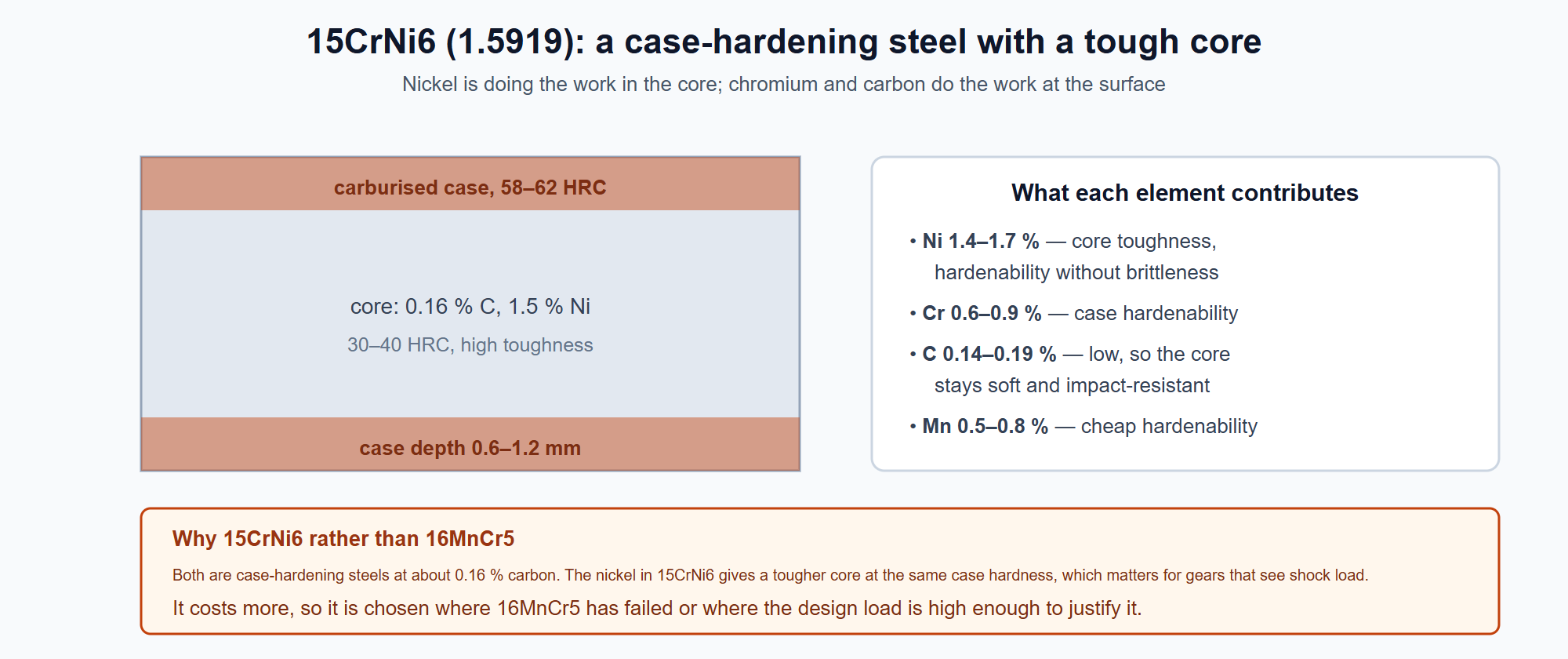
15CrNi6 carries 1.4–1.7 % nickel, which is expensive and does only one job: it makes the core tough. At 0.14–0.19 % carbon the core cannot harden much, and that is the design intent — a gear tooth needs a hard surface and a core that bends rather than breaks.
Compared with 16MnCr5, the nickel version costs more and delivers a core that absorbs shock better at the same case hardness. That is why it appears in heavily loaded gears and in parts that have already failed in service on the cheaper grade.
Case depth for this grade
Carburise at 900–930 °C, quench, temper at 150–200 °C. Case depth follows the same rule as any carburising steel: about 0.15–0.20 × the gear module, or 0.6–1.2 mm for general transmission work.
Beyond about 1.5 mm the case becomes disproportionate to the core and starts to spall rather than wear, which is a heat treatment specification error rather than a steel problem.
What to ask for
The certificate should give the analysis, the core hardness after the specified heat treatment, and the grain size. Fine grain is what stops the case becoming brittle; a coarse-grained heat will show the right hardness numbers and still chip.