
Titanium VAR Segregation: Two Families, Three Mechanisms
A press closes a pore and a heat treatment dissolves a precipitate. Neither undoes a composition gradient that was set while the ingot was freezing — and in titanium that gradient is set inside a pool a few hundred millimetres deep, under an arc that runs at 2 000 °C.
Titanium is not difficult to melt because it is refractory in the way a nickel superalloy is. It is difficult because it is allotropic, because it reacts with everything at temperature, and because its thermal conductivity is low enough that a vacuum arc pool stays deep and sluggish. Those three facts produce every segregation defect described below.
The commercial consequence is that the defects are not interchangeable. Two of the four are raw-material problems that a purchasing decision can fix. One is a pool-geometry problem that a melt schedule can fix. One is a solidification-time problem that only a bigger ingot, a different melt route or a different alloy can fix. Treating them as one quality complaint is how a heat gets scrapped without anyone learning anything.
Why the partition coefficient is never 1
Below 882 °C titanium is hexagonal close packed and is called α; above it, body centred cubic, β. Every alloying element moves that boundary. Aluminium, oxygen, nitrogen and carbon raise it and are α stabilisers. Molybdenum, vanadium, niobium, tantalum, chromium and iron lower it and are β stabilisers. Tin and zirconium sit close to neutral, which is why they are added for solid-solution strength without much effect on phase balance.
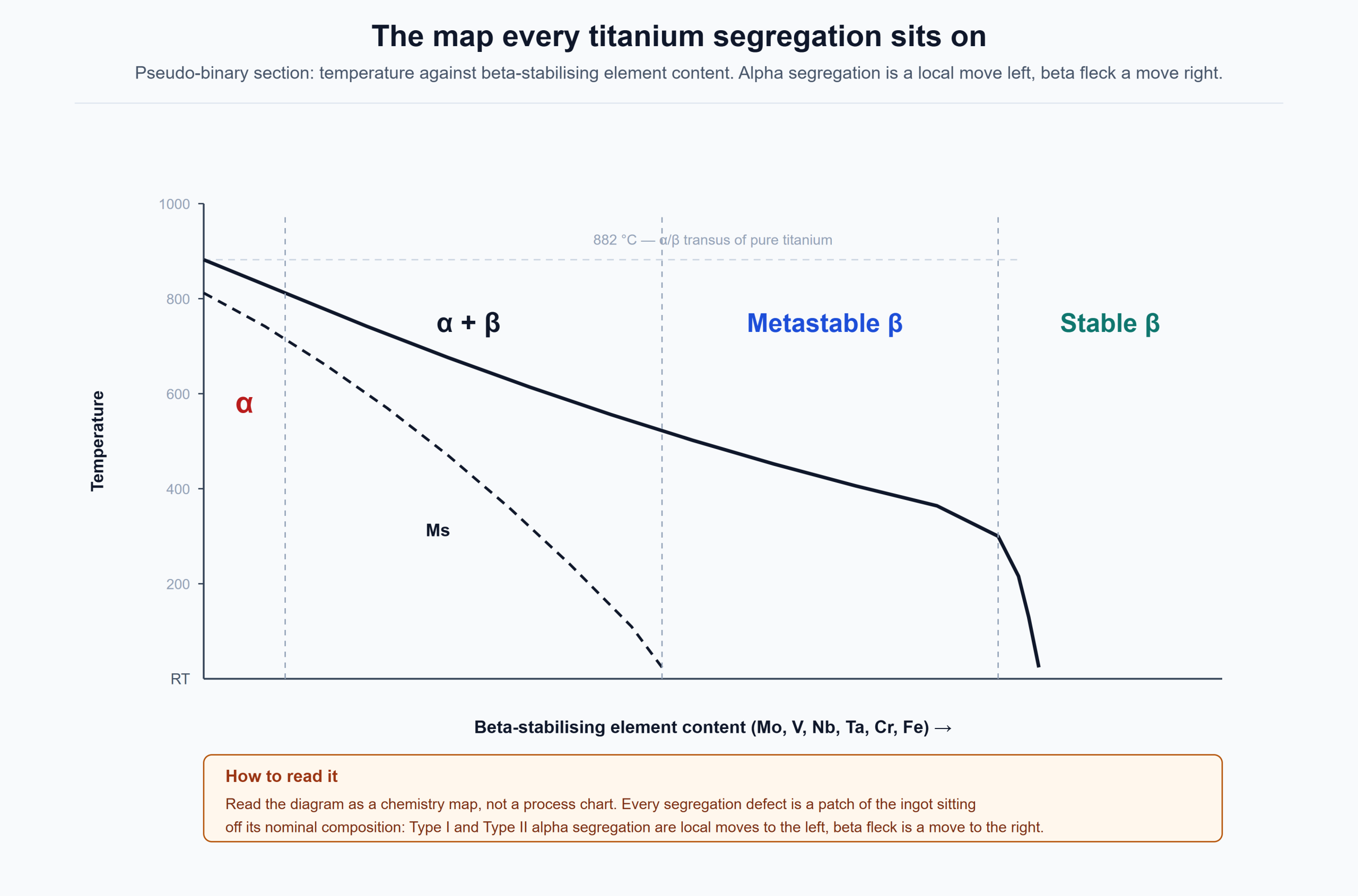
A two-phase field means the solid and the liquid want different compositions at the same temperature. The ratio of what the solid takes to what the liquid holds is the equilibrium partition coefficient, k0 = Cs/Cl. For the solutes used in titanium it is never exactly one, and the further it sits from one, the harder the freezing front pushes solute into the liquid ahead of it.
That rejected solute has nowhere to go. It accumulates in the last liquid to freeze, which in a VAR ingot is the thermal centre and the hot top. The result is an ingot that is correct on the certificate — a certificate reports one analysis for a multi-tonne ingot — and wrong at mid-radius in the finished forging.
Macro segregation: the gradient heat treatment cannot reach
Macro segregation is a composition difference over centimetres: surface to centre, base to top. The mechanism is not diffusion, which is far too slow at these cooling rates, but fluid flow. The mushy zone is a sponge of dendrites with liquid between them. When the pool convects, that solute-rich liquid is washed out and replaced by fresher melt, and nothing that solidifies afterwards is nominal.
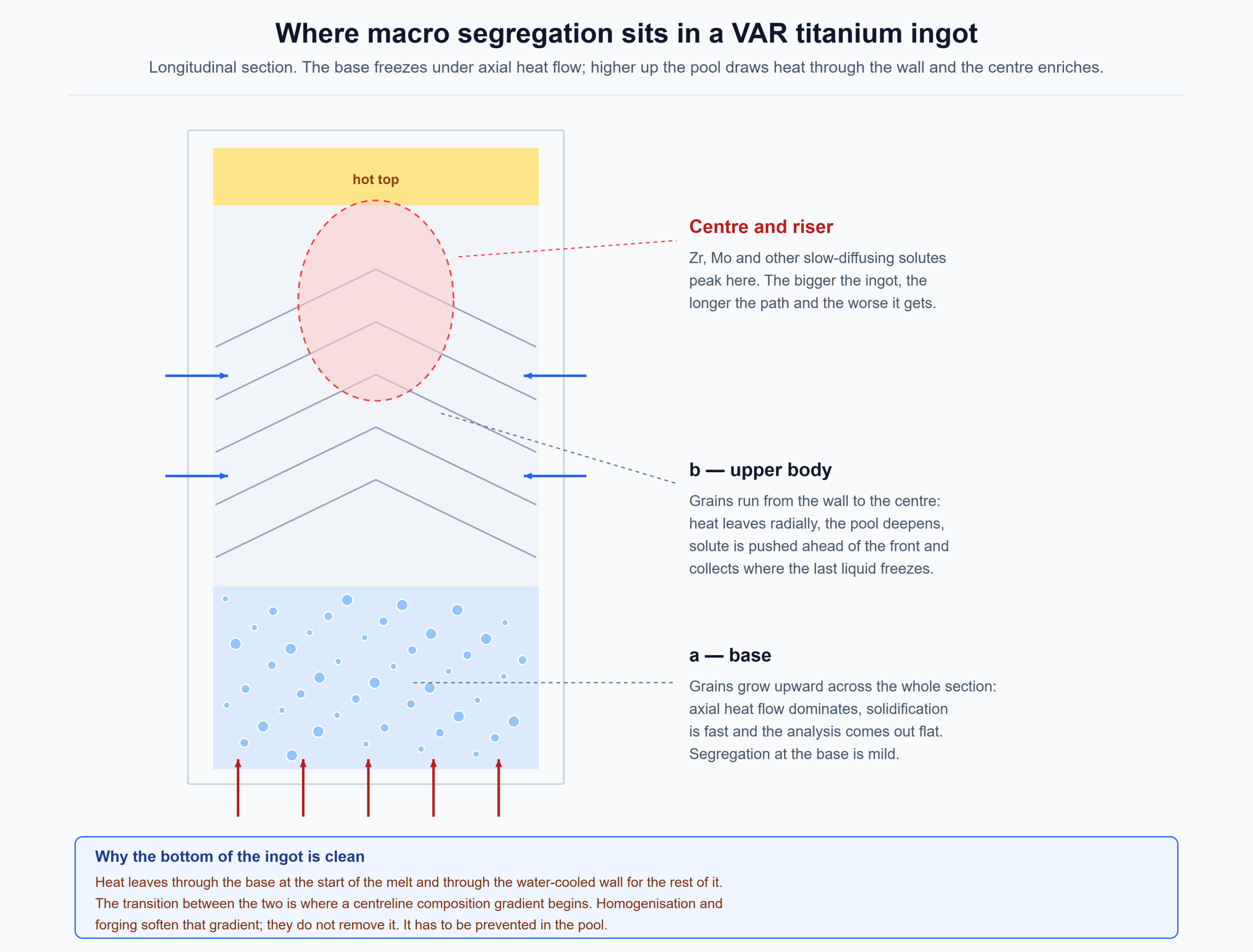
What the published work reports is consistent in shape and inconsistent in detail, which is the useful part.
Table 1. Macro segregation reported in three titanium alloys, by element and by position in the ingot.
| Alloy | Element | Reported pattern |
|---|---|---|
| Ti60 | Zr | Uniform at the base and around the circumference; enriched at the centre and in the hot top. Centre content rises further as melting current is increased. |
| Ti2AlNb | Al | Positive at the base, weakening with height, crossing to negative at about one fifth of ingot height in a coupled multi-physics simulation. |
| TC19 | Mo, Zr | Al and Sn flat. Mo concentrates in the centre equiaxed zone and is depleted in the top riser; Zr does the opposite. |
Three alloys, three different elements, one pattern: the element that segregates is the one whose partition coefficient sits furthest from unity, and the sign of the gradient follows the element rather than the process. That is why “we melt to the same schedule” is not a quality argument. It is also why the gradient grows with ingot size: the same current over a longer solidification path gives the last liquid more time to enrich.
Micro segregation: three mechanisms behind one word
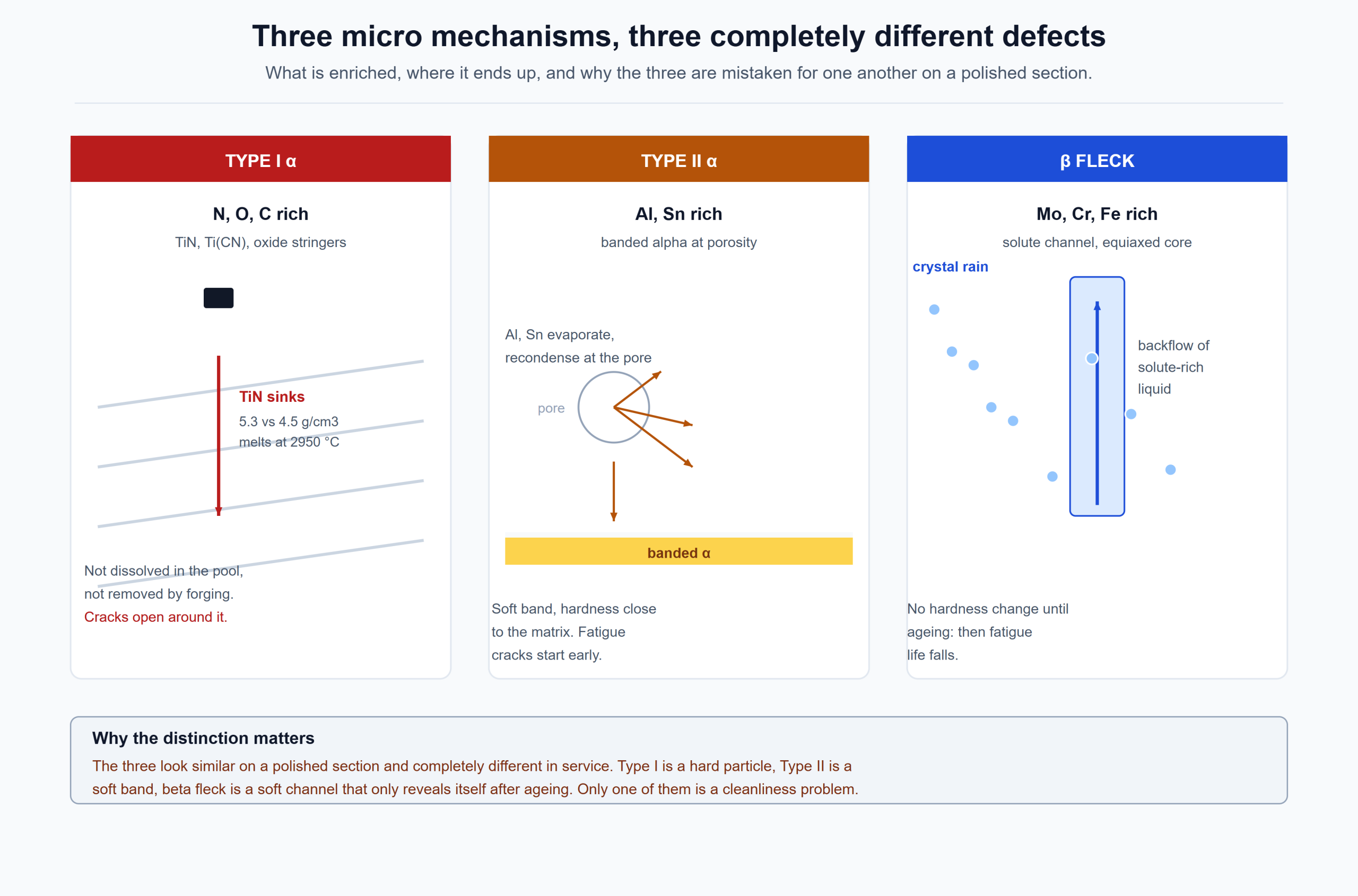
Micro segregation is composition variation over a few dendrite arm spacings — tens to a few hundred micrometres. It is small enough to survive forging and large enough to change fatigue life, and it is the reason two ingots with identical chemistry behave differently in service. Titanium splits it into three mechanisms that share almost nothing except the name.
Type I α: the interstitial problem
Nitrogen, oxygen and carbon are strong α stabilisers with small atomic radii. Locally enriched, they form TiN, titanium carbonitride and oxide particles ahead of the freezing front. Those particles are hard, brittle and chemically stubborn: TiN melts at about 2 950 °C while a VAR pool runs at roughly 2 080 °C at the surface and 1 974 °C in the body. The particle is not dissolved. It is carried.
Density decides where it ends up. TiN at 5.3 g/cm3 against a titanium melt at about 4.5 g/cm3 sinks, so the defect collects low in the pool and freezes into the base of the ingot. On a polished section it is bright after grinding and stands proud after polishing, with porosity and microcracks around it. The matrix is softer and more ductile than the defect, so forging opens a crack rather than closing it. This is the mechanism behind the classic hard alpha reject.
Control is entirely upstream: sponge quality, electrode welds, and any air or water ingress into the furnace. No melt schedule removes nitrogen that is already in the electrode. This is the one segregation type that overlaps with the cleanliness specification discussed in ultra-clean and highly homogeneous alloys.
Type II α: the volatile problem
Type II is aluminium-rich, appears as a band or stringer of α rather than a particle, and has hardness close to the matrix — which is exactly why it is missed on a hardness check. It is tied to shrinkage porosity. A pore inside the ingot sits at low pressure; aluminium and tin have appreciable vapour pressure at melt temperature; they evaporate from the pore surface, condense a short distance away and leave a locally enriched band. Forging deforms the pore and smears the band into the stringer the metallographer sees.
Service behaviour is the opposite of Type I. In high-strength grades such as TC11 and TC17 the band is softer than the matrix, deforms first under cyclic load and initiates fatigue cracks early. Where the aluminium enrichment is severe, Ti3Al forms and toughness falls. The practical countermeasure is thermal rather than chemical: a hot top that keeps the riser liquid long enough for the pore to feed during solidification, so the pore never becomes a condensation site in the first place.
β fleck: the flow problem
β fleck is a channel, not a particle and not a band. Where the interdendritic liquid becomes less dense than the bulk metal ahead of it, that liquid rises, erodes or remelts the dendrite arms above, and establishes a persistent solute-rich channel that freezes last as a freckle. The mechanism is the same one that produces freckles in the vacuum arc and electroslag remelting of nickel superalloys, which is covered in detail for IN718 VAR ingot structure.
The second route is mechanical. Large pools convect weakly and carry a low temperature gradient, which favours equiaxed grains nucleating in the liquid. Those grains settle as a crystal rain, pile up, and trap solute-rich liquid in the gaps between them — Mitchell’s equiaxed grain sedimentation. Either way the fleck looks the same afterwards: a channel or patch with an equiaxed core, α at the grain boundaries in long strings, and hardness that only diverges after ageing.
That last point is what makes β fleck expensive. It passes incoming inspection, machines normally and shows up as a fatigue failure. Under cyclic load the softer channel concentrates slip, dislocations pile up at the boundary, and a microcrack nucleates inside material the drawing assumed was homogeneous.
Table 2. The three micro segregation mechanisms side by side. Only one of them is a cleanliness problem.
| Character | Type I α | Type II α | β fleck |
|---|---|---|---|
| Enriched in | N, O, C | Al, Sn | Mo, Cr, Fe, V |
| Form | Particle, stringer | Band, stringer | Channel, patch |
| Hardness vs matrix | Much harder, brittle | Close to matrix | Lower, but only after ageing |
| Position in ingot | Low in the pool, ingot base | At porosity, anywhere | Channel from the mushy zone |
| Found by | Grinding and polishing contrast, microcracks | Metallography, hardness traverse | Macro-etch, UT, post-ageing hardness |
| Fails by | Cracking during forging | Early fatigue initiation | Fatigue life collapse |
| Controlled by | Sponge and scrap cleanliness | Hot top, pore feeding | Pool shape, melt rate, stirring |
Control lever 1: the melt pool
Every parameter that matters changes one thing: the shape of the pool. Current, arc length and arc radius set the heat input and how it is distributed; crucible cooling sets the heat sink; melt rate sets how fast the front advances; stirring and stray magnetic fields set the flow. The pool starts shallow and flat at the base and deepens into a V as the arc keeps heating, while its volume grows with the ingot. That alone explains why segregation risk rises with ingot size at constant current.
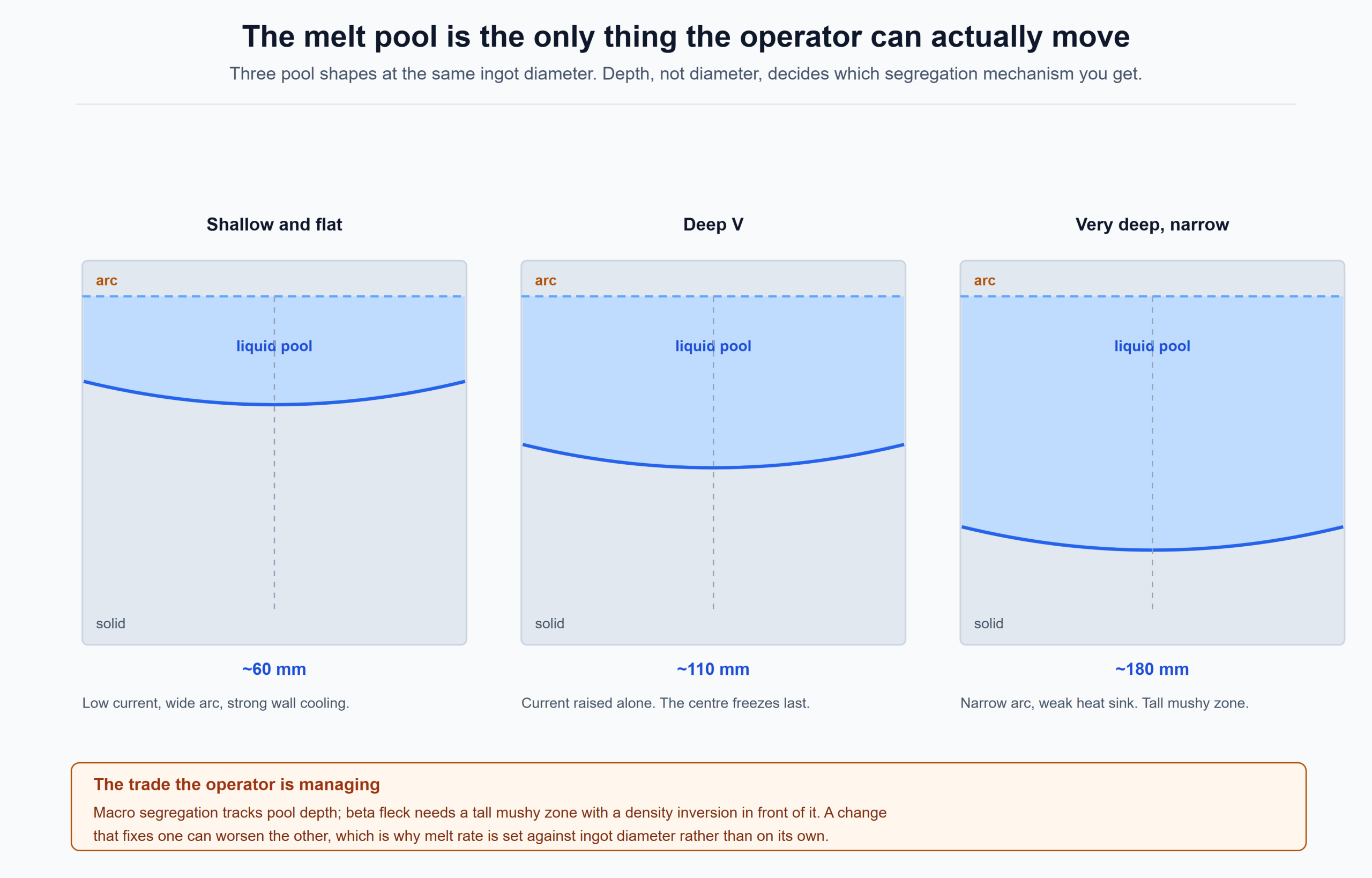
Three results from the modelling literature are worth carrying into a melt schedule:
- Power above a threshold is worse than composition. Excessive arc power drives a strong electromagnetically driven flow and markedly aggravates macro segregation; under those conditions the electrode’s own composition distribution matters less than the flow does (Zagrebelnyy and co-workers).
- Arc geometry sets depth. Pool depth grows as the arc radius shrinks; multiple side arcs make the pool shallower; and even a weak stray field has an axial component large enough to restructure the flow in the pool (Karimi-Sibaki and co-workers).
- Suppressing natural convection helps. Damping convection in the pool reduces macro segregation, and with the flow fixed the residual pattern is set by k0. An applied field that produces a favourable flow is the theoretical route to a more uniform ingot (Fan and co-workers).
Control lever 2: the furnace and the instruments
Most segregation control in a modern VAR is control-loop quality, not metallurgy. The electrode loses mass continuously, but the weighing signal lags the pool: an operator reacting to a display is always minutes late. That is why melt rate has to be regulated by algorithm rather than by hand.
Three developments are worth asking about when you audit a supplier. Arc-position detection with coordinated control of melt rate and steering coil (Chen and co-workers). Dynamic argon filling with flow and pressure feedback, which lifted pressure control from below 1 kPa to as much as 10 kPa (Tong and co-workers). And the shift from PID alone to PID plus fuzzy or neural control, which improved both accuracy and repeatability. Stable argon does two jobs at once: it suppresses volatilisation of aluminium and tin — the Type II mechanism — and it stabilises the arc.
Equipment capability has improved unevenly. A 15 t furnace producing 1 040 mm diameter ingots exists and runs; melt-rate control and the argon system remain the weak points on plenty of older furnaces. The distinction matters to a buyer because a 1 040 mm ingot holds a far larger pool than a 600 mm one, and the certificate rarely says which one the bar came from.
Control lever 3: sponge, scrap and the electrode
The third lever is the one a purchase order can reach. Sponge titanium carries oxygen, iron and residual chloride. Chloride from incomplete distillation corrodes the furnace; localised oxygen and iron become Type I α. The standard practice is 100 % visual sorting of sponge to remove oxidised and nitrided particles before anything is blended, with oxygen and nitrogen checked by inert gas fusion on the incoming lot.
Return scrap is the harder decision, because it trades cost against uniformity directly.
Table 3. Two ways to build an electrode with return material. The trade is uniform chemistry against capital and labour.
| Aspect | Pressed electrode | Bundled electrode |
|---|---|---|
| Return material | Tight dimensional control | As received; small pieces unusable |
| Preparation | Cleaning and crushing | Cleaning only |
| Maximum addition | 25 % | 100 % |
| Equipment | Blender, press, welding | Dedicated rack, little welding |
| Cost | High | Lowest |
| Composition uniformity | Good | Poorer |
| Operation | Complex | Simple |
| Electrode strength | High | Adequate |
The trade is legible: pressing buys uniformity with capital and labour, bundling buys cost with variability. For a grade where β fleck or Type II α is a known risk, the pressed route at 25 % is usually the cheaper decision once scrap rates are counted — which is the same argument that applies to revert purification before remelting in nickel alloys.
Alloying method matters as much as the scrap ratio. Comparing multi-element master alloys with the pure-metal-plus-binary route, Yue and co-workers found that master alloys raise the efficiency of the alloying reaction and improve composition uniformity: fewer undissolved high-melting particles, shorter hold at temperature, less burn-off of aluminium. That is a Type II α control as much as a cost control.
Diagnosis: which one is in front of you
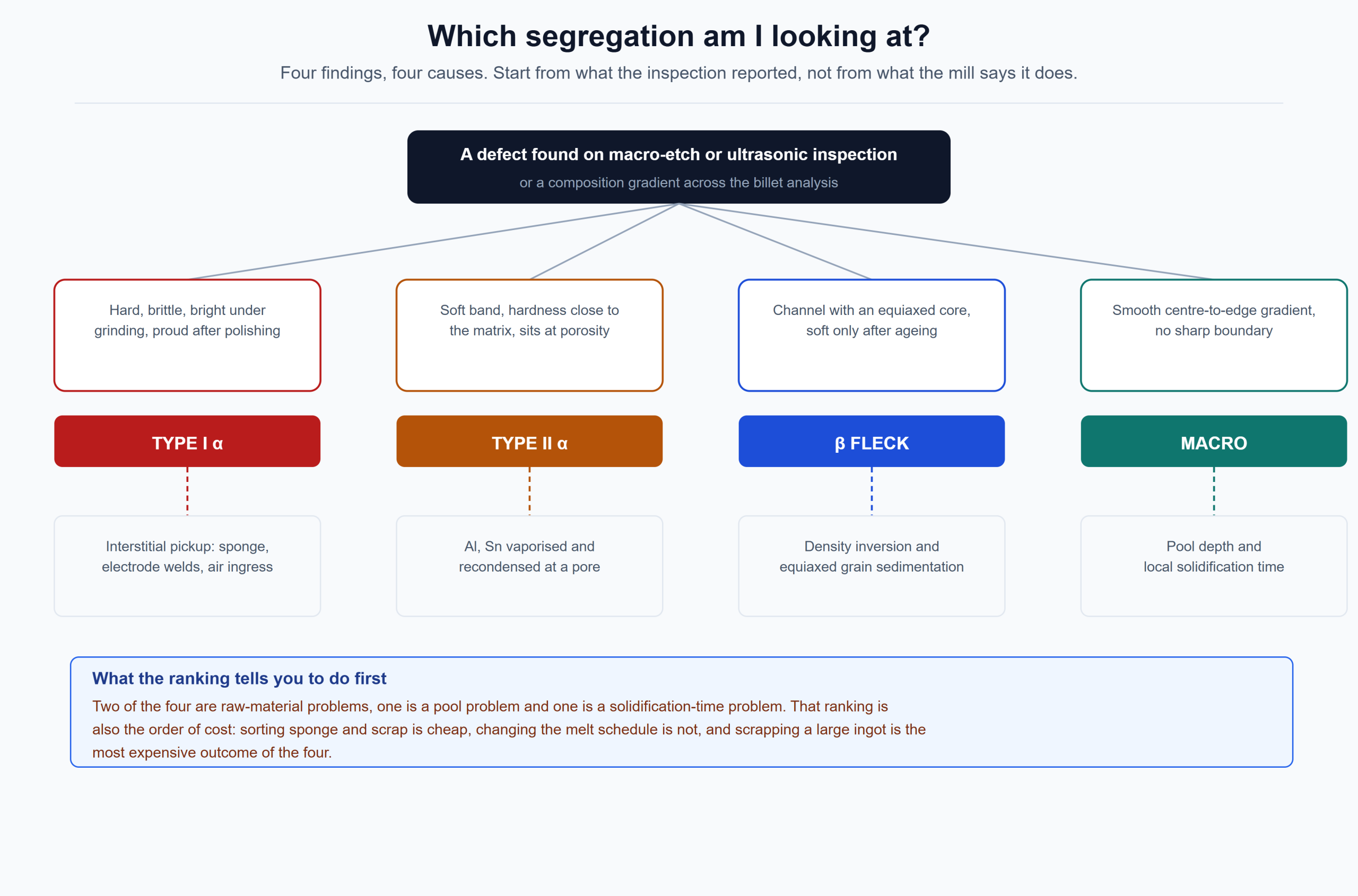
The order of the branches is also the order of cost. Sorting sponge and scrap is cheap, changing a melt schedule is not, and scrapping a large ingot is the most expensive outcome of the four. A plant that starts with the metallography rather than with the supplier conversation usually picks the wrong lever twice.
What to put on the purchase order
Segregation is invisible on a chemical certificate, because the certificate reports one analysis for a multi-tonne ingot. If the part is fatigue-critical, the specification has to reach past it:
- Melt route, stated explicitly. VAR only, electron beam or plasma arc plus VAR, or triple melt. Each removes a different class of defect and none removes all of them.
- Ingot diameter and the melt-rate window. Those two numbers predict pool depth more reliably than the grade designation does.
- Macro-etch of a longitudinal section to ASTM E340, with Type I and Type II α assessed against an agreed reference. “No segregation” is not an acceptance criterion; a reference is.
- Ultrasonic inspection to AMS 2631 on the finished billet, with the acceptance class named rather than “UT done”.
- Oxygen, nitrogen and hydrogen on the billet, not only on the electrode, to ASTM E1409 and E1447.
- A hardness traverse across the section after ageing on β-fleck-prone grades. It is the cheapest test that catches the one defect which passes everything else.
If you are specifying titanium or a VAR nickel alloy and want those six questions answered before the order rather than after the first rejected billet, send the grade and the section size. The titanium product range sits alongside the nickel alloys that go through the same melt route.
Conclusions
- Segregation in a titanium VAR ingot comes in two families. Macro segregation is flow-driven and measured in centimetres; micro segregation is partition-driven and measured in micrometres. Only the second is partly fixable downstream, and only partly.
- Type I α is a cleanliness defect, Type II α is a pore-and-volatility defect, and β fleck is a flow-and-settling defect. Three names, three owners, three different fixes.
- The melt pool is the only lever the operator actually holds, and pool depth is the variable that predicts which mechanism will dominate.
- Furnace control and argon management decide whether the second half of the melt schedule is possible at all.
- Electrode build, sponge sorting and alloying method are the levers a buyer can write into a purchase order — and they are the cheapest ones to move.
The ingot either has a composition gradient or it does not. Everything the forge does afterwards is expensive either way.
Related reading
- IN718 VAR ingot structure — how melting rate sets pool depth, dendrite arm spacing and Laves phase
- Ultra-clean and highly homogeneous alloys — why cleanliness and homogeneity are two separate specifications
- Superalloy revert purification — what return scrap does to a remelted heat
- Titanium Grade 2 — the commercially pure grade, and what its oxygen level buys
- Why a bar failed ultrasonic testing — when the inspection finds structure instead of a defect
You get chemical composition, mechanical properties and a price — with inspection certificates to EN 10204 3.1 issued against the heat number.