
2205 Duplex Stainless Steel (S32205 / 1.4462 / F51)
Roughly twice the yield of 316L, with far better chloride resistance, at a modest premium. The 50/50 ferrite-austenite structure is why it resists stress corrosion cracking that destroys 304 and 316 in warm chloride, and why wall thickness can drop by a third in pressure service.
At a glance
Table 1 — 2205 at a glance
| Item | Detail |
|---|---|
| Designations | 2205 / UNS S32205 / S31803 / 1.4462 / F51 / X2CrNiMoN22-5-3 |
| Standards | ASTM A240, A790, A182; EN 10088-2; NORSOK M-630 |
| Delivery condition | Solution annealed, water quenched |
| Melt route | EAF + AOD + VD; controlled rolling to balance ferrite and austenite |
| Typical use | Chemical tankers, process piping, desalination, pulp digesters, structural sections |
| Certificate | EN 10204 3.1 with chemistry, PREN and ferrite content |
Why duplex beats 316 where it counts
316L fails by chloride stress corrosion cracking above about 60 °C. The ferrite phase in 2205 breaks up the crack path, so the alloy survives in warm chloride where austenitic grades crack. That is the single biggest reason chemical and desalination plants moved to duplex.
The second reason is strength. Yield of 450 MPa against 205 for 316L lets a designer reduce wall thickness, which often brings the total cost of a duplex vessel below the 316L version despite the higher price per tonne.
The limits: 2205 is not for service above 300 °C (sigma phase embrittlement), it is not for concentrated sulphuric or hydrochloric acid, and it needs careful welding. Above about 60 °C in chloride, or for higher strength, move to 2507 super duplex.
Where 2205 orders go wrong
- Accepting a chemistry certificate as phase balance — a slow-cooled heat can be 30/70 ferrite and still pass the table.
- Stress-relieving a welded 2205 fabrication at 700 °C; sigma phase forms between 600 and 900 °C.
- Treating 2205 as a universal 316 replacement — it is worse in concentrated sulphuric and hydrochloric acid.
- Reading the 60 °C chloride limit as a guarantee; pH, oxygen and stress move it in both directions.
When 2205 is the wrong grade
Above 300 °C the ferrite embrittles and the alloy is out of its range; that is an austenitic or a nickel alloy. For concentrated acids or hot caustic, a super austenitic or a nickel alloy is the honest answer.
And where the design needs 550 MPa yield in a thick section with heavy welding, 2507 super duplex carries the same idea further — but only if the fabricator can hold the procedure.
Supply range and delivery condition
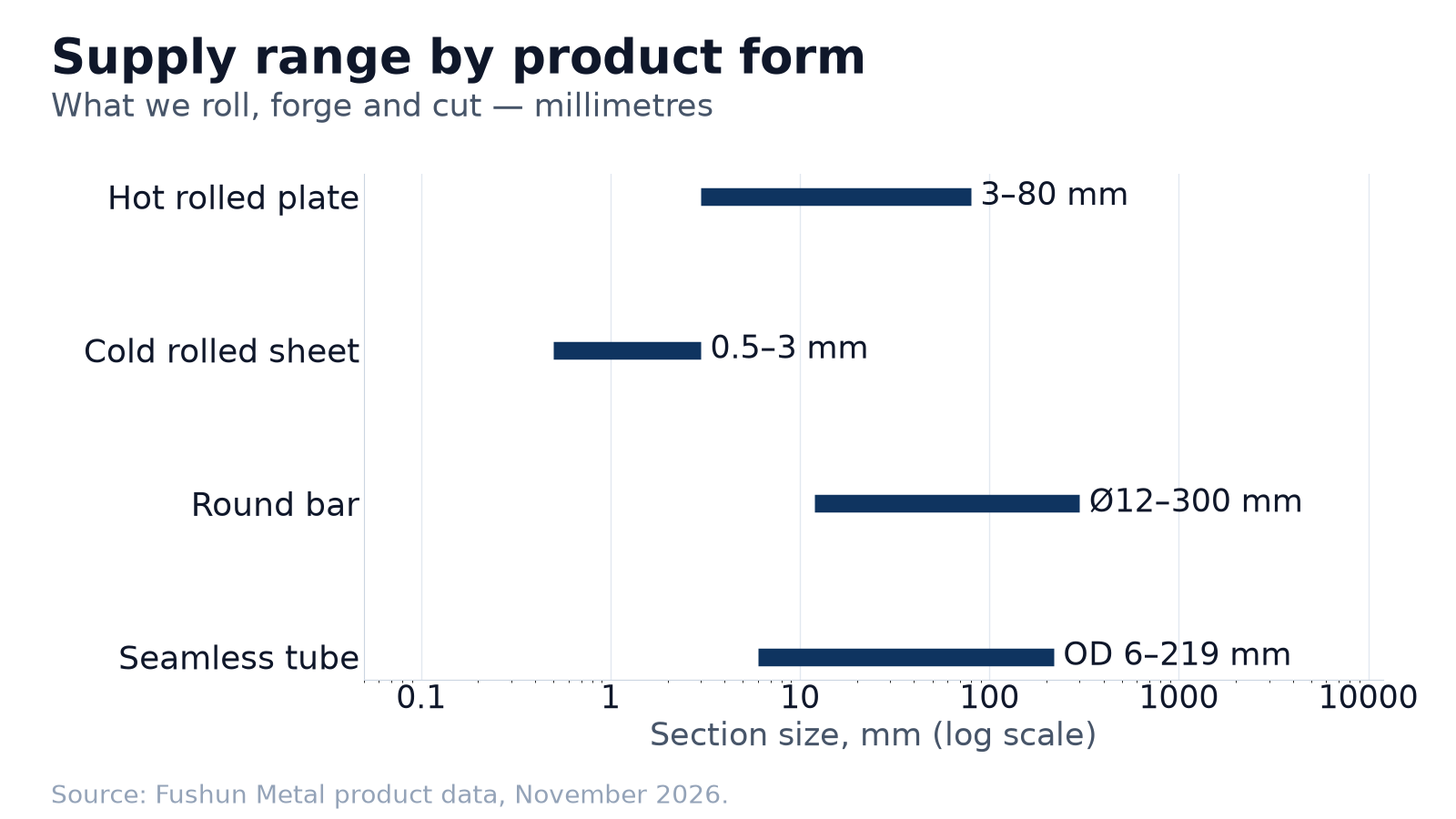
Table 2 — Supply range by form and delivery condition
| Form | Size range | Condition |
|---|---|---|
| Hot rolled plate | Thickness 3–80 mm × width up to 2500 mm | Solution annealed |
| Cold rolled sheet | Thickness 0.5–3.0 mm | 2B / BA |
| Round bar | Ø12–300 mm | Solution annealed |
| Seamless tube | OD 6–219 mm × wall 1–20 mm | Annealed, pickled |
Chemical composition
Table 3 — Chemical composition (wt. %), balance Fe
| C | Cr | Ni | Mo | N | Mn | Si |
|---|---|---|---|---|---|---|
| ≤0.030 | 22.0–23.0 | 4.5–6.5 | 3.0–3.5 | 0.14–0.20 | ≤2.00 | ≤1.00 |
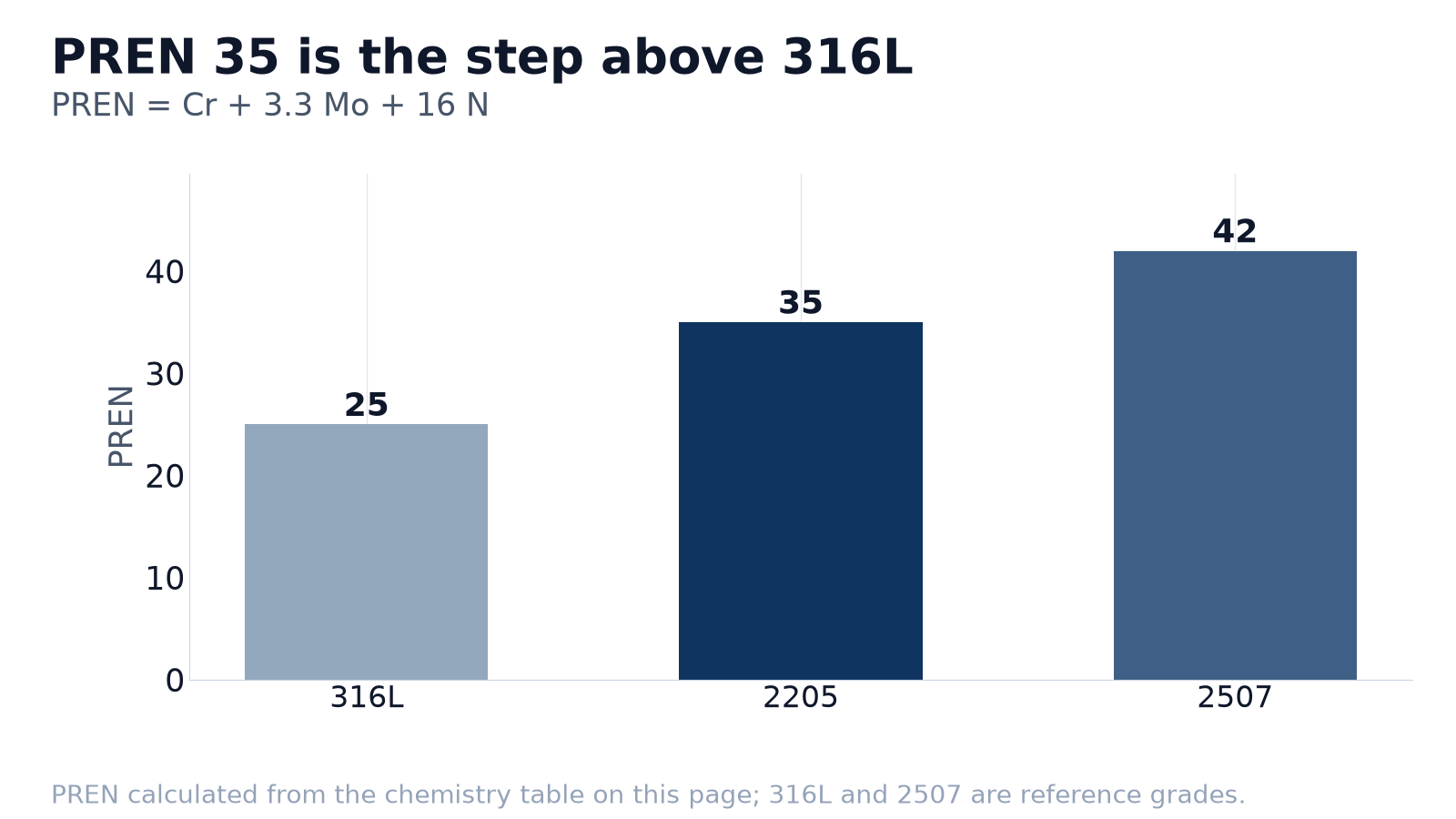
UNS S32205 (the higher-nitrogen variant of S31803). PREN = Cr + 3.3Mo + 16N, typically 34–36.
Mechanical properties
Table 4 — Mechanical properties
| Condition | Tensile MPa | 0.2 % proof MPa | Elongation % | Hardness |
|---|---|---|---|---|
| Solution annealed | ≥620 | ≥450 | ≥25 | ≤30 HRC |
| At 100 C | ≥550 | ≥380 | ≥20 | — |
| Ferrite content | 40–60 % | — | — | — |
Heat treatment
Solution anneal 1020–1100 °C, then water quench. The cooling rate has to be fast enough to prevent sigma phase forming between 600 and 900 °C; slow cooling is the usual cause of a duplex part failing the corrosion test.
Do not stress relieve above 550 °C. If stress relief is needed, do it at 500 °C and accept partial relief.
What ships with every lot
- EN 10204 3.1 with chemistry, PREN and ferrite content
- Corrosion test to ASTM G48 Method A on request
- Impact test for low-temperature service
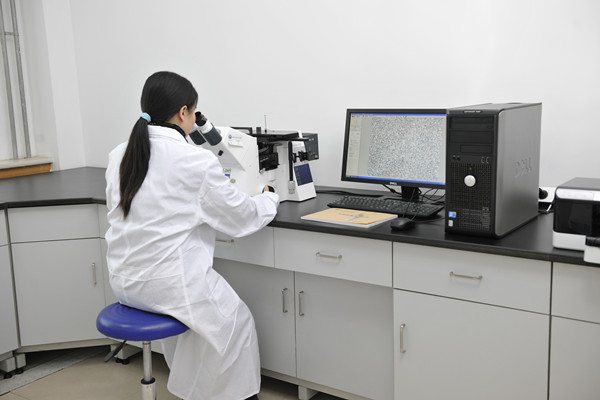
- Microstructure / phase balance report
- Ultrasonic inspection to SEP 1921 for plate
Packing and delivery
Plate with edge protection, tube capped and crated, bar bundled by heat. Typical lead time 30–45 days.
Table 5 — Trade terms, packing and documents
| Item | Standard terms |
|---|---|
| Trade terms | FOB Shanghai, Qingdao or Shenzhen; CIF and CFR quoted against the destination port. |
| Minimum order | One bundle, plate or spool for stock sizes; mill runs quoted individually. |
| Lead time | 20–30 days from order confirmation for stock sizes; 30–45 days where forging, heat treatment or machining is included |
| Payment | T/T 30 % advance with the order, 70 % against the bill of lading copy; irrevocable L/C at sight accepted for orders above 20 t |
| Packing | Seaworthy export packing — crated or strapped, marked with grade, heat number, size and net weight. |
| Documents | 3.1 certificate, packing list, commercial invoice, bill of lading, certificate of origin; legalisation or chamber attestation on request |
Frequently asked questions
What is 2205 equivalent to?
The same steel is sold under these designations: 2205 / UNS S32205 / S31803 / 1.4462 / F51 / X2CrNiMoN22-5-3. We supply against the designation you specify on the purchase order, and the 3.1 certificate carries that designation plus the heat number.
Which standard does 2205 meet?
ASTM A240, A790, A182; EN 10088-2; NORSOK M-630. Chemistry and mechanical properties are tested to that standard, and the certificate names the edition used for the heat.
What is the largest size you can supply?
Our widest section is round bar at Ø12–300 mm. Anything above that is quoted individually, usually as a forging, with the same certificate route.
What forms and sizes are held in stock?
hot rolled plate thickness 3–80 mm; cold rolled sheet thickness 0.5–3 mm; round bar Ø12–300 mm; seamless tube OD 6–219 mm. Stock sizes ship from the warehouse; other sizes are rolled or forged to order.
What strength does 2205 reach at room temperature?
550 MPa tensile and 380 MPa 0.2 % proof. Values are minimums for the delivery condition stated in the table above, tested on a sample from the same heat.
Request a quote
Send these five lines and we quote within one working day
- Standard — ASTM A240 / A790, or EN 1.4462
- Form and size — plate thickness, bar diameter, or tube OD × wall
- Quantity in pieces or kilograms
- Condition — solution annealed
- Inspection — 3.1, G48 corrosion test, ferrite content
Email [email protected] or use the form below. Drawings in DXF, STEP or PDF are all fine.