
410 1.4006 X12Cr13 Stainless Steel For Steam Turbine Blade

Supplying dimension
Round bar from 30mm to 600mm Diameter
Flat and square bar from 30mm to 500mm Width
8mm to 300mm Thickness
*accept special shape
Forming option
Hot rolling or hot forged
Smelting process
EAF →VD→LF→ESR Electro-Slag Remelting
Surface option
Black
Grinding
Rough turned
Peeled
Polished
Quality
UT, size and surface for each pcs
Macrostructure
Ferritic Metallographic
Grain size
Nonmetallic inclusion
Etch test of tower sample
Delivery condition and hardness
Annealed or high temperature temper
| Annealed | high temperature temper | Hardness |
| 800 to 900 Celsius, slow | 700 to 770 Celsius, fast | Max 200 HBW |
*Accept +QT delivery condition
Equivalent Grade
| Chinese UNS | Chinese New Grade | Chinese Old Grade | JIS | ASTM SAE AISI | EN BS DIN | EN BS DIN |
| S41010 | 12Cr13 | 1Cr13 | SUS410 | 410 | 1.4006 | X12Cr13 |
Chemical component
| C | Si | Mn | P | S | Ni | Cr | Cu |
| 0.10 to 0.15 | Max 0.60 | Max 0.60 | Max 0.030 | Max 0.020 | Max 0.60 | 11.50 to 13.50 | Max 0.30 |
Mechanical property and heat treatment
| Quench temperature | Temper temperature | Specified Plastic Elongation Strength | Tensile strength | Elongation | Reduction | Impact | Hardness |
| 980 to 1040 Celsius, oil | 660 to 770 Celsius, air | Min 440 Mpa | Min 620 Mpa | Min 20 % | Min 60% | Min 35 KJ | 192 to 241 HBW |
Why 410 is the default blade steel
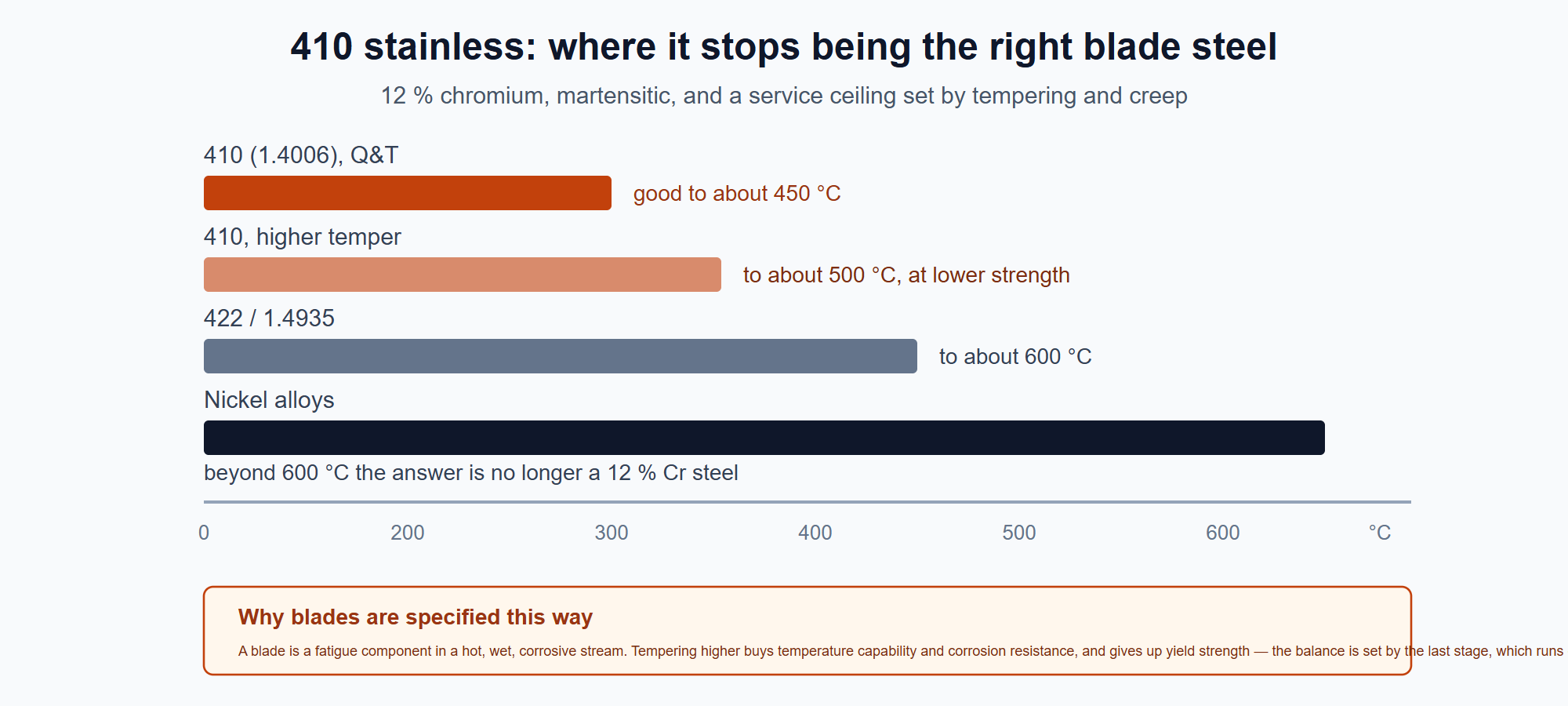
410 is a 12 % chromium martensitic stainless that hardens and tempers like an alloy steel but resists corrosion like a stainless. For steam turbine blades it offers the combination the application needs: enough strength at 400–450 °C, resistance to the wet steam environment, and a price that makes a few hundred blades affordable.
It is also the grade used for compressor blades, valve parts and pump shafts — anywhere that needs hardness plus moderate corrosion resistance.
Where it stops
| Service | Material |
|---|---|
| Up to about 450 °C | 410, quenched and tempered |
| 450–540 °C, higher strength | 422 (1.4935), or a modified 12 % Cr |
| Above 540 °C | Nickel alloys or austenitic grades |
The limit is not oxidation but creep and temper resistance: above roughly 450 °C the tempered martensite starts to soften and the blade loses the strength it was designed around.
What to specify
- Tempering temperature, not only the hardness — two tempers can give the same hardness with different creep behaviour
- Impact toughness at the service temperature
- Non-metallic inclusion rating, since blade failures usually start at an inclusion
- Any NDT requirement: blades are usually fluorescent penetrant inspected
Related reading
- The 400 series — where 410 sits against 420, 430 and 440.
- AISI 420 — the higher-carbon variant for wear.
- Pitting and crevice corrosion — the corrosion risk in wet steam.