
400 series stainless steel
The 400 series group of stainless steels has an 11 percent chromium and 1-percent manganese increase, above the 300 series group. The 400 series is susceptible to rust and corrosion under some conditions. Heat-treating will harden the 400 series. The 400 series of stainless steels have higher carbon content, giving it a martensitic crystalline structure. This provides high strength and high wear resistance. The 400 series steels tend to be used in agricultural equipment, gas turbine exhaust silencers, hardware, motor shafts, and more.
The 400 series includes both ferritic and martensitic steels.
Ferritic stainless steels: non-hardening steels, ideal for conditions in elevated temperatures. Typical applications for ferritic stainless steels include petrochemical, automotive exhaust systems, heat exchanges, furnaces, appliances and food equipment to name a few. Advantage of ferritic stainless steels:
*superior corrosion resistance
*resistance to scaling at elevated temperatures
*inherent strength greater than carbon steels
*provide an advantage in many applications where thinner materials and reduced weight are necessary
*nonhardenable by heat treating
*always magnetic
Martensitic stainless steels: able to be hardened, ideal for a wide variety of common uses. Martensitic stainless steels are used extensively in cutlery, sport knives and multi-purpose tools. Advantage of martensitic stainless steels:
*higher levels of carbon than ferritics
*ability to be heat treated to a wide range of hardness and strength levels
*excellent corrosion resistance
*easily machined
*good ductility
What separates the families
Every grade in the 400 series sits at 11–18 % chromium. The difference is carbon, and what carbon does to the crystal structure. Low carbon leaves ferrite, which cannot be hardened. Higher carbon allows martensite, which can be hardened — and the more carbon, the harder it goes.
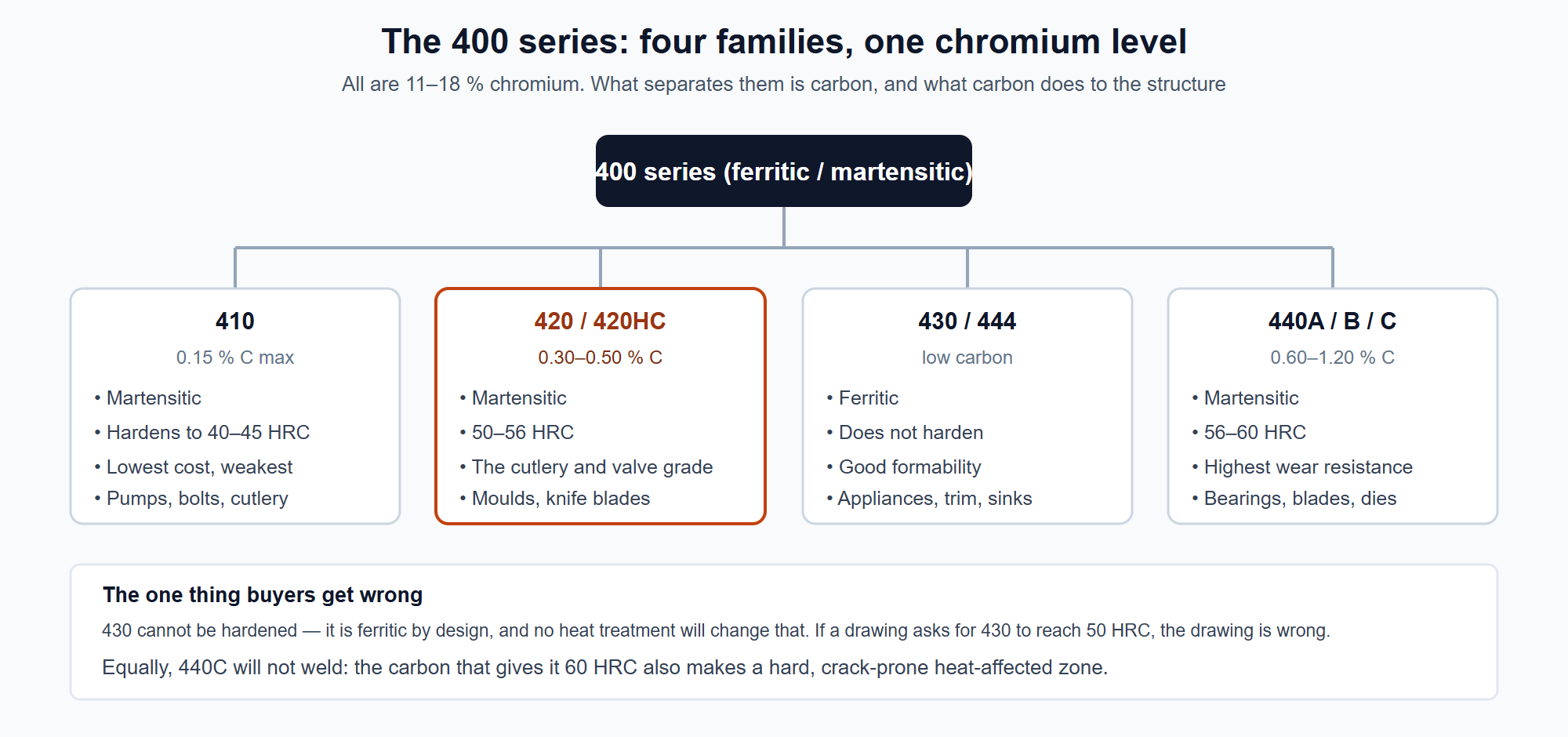
That single fact explains the whole table: 430 is formable and never hard, 440C is hard and barely formable, and 410 and 420 sit between them.
The two mistakes that keep coming back
Expecting 430 to harden. It is ferritic by design. No heat treatment will take it above about 85 HRB, and a drawing that asks for 430 at 50 HRC is simply wrong.
Welding 440C. The carbon that gives 60 HRC also makes the heat-affected zone hard and crack-prone. If a 440C part must be joined, it is usually a design error rather than a welding procedure problem.
How to specify a 400 grade
Start from the requirement, not the grade name: does it need to be hardened (410/420/440), does it need to be formed and welded (430/444), or does it need to resist a specific medium? Then check the carbon range against the hardness you actually need — the same 420 at 0.18 % and 0.25 % carbon will not give the same result after tempering.
