
420HC Stainless Steel Manufacturer
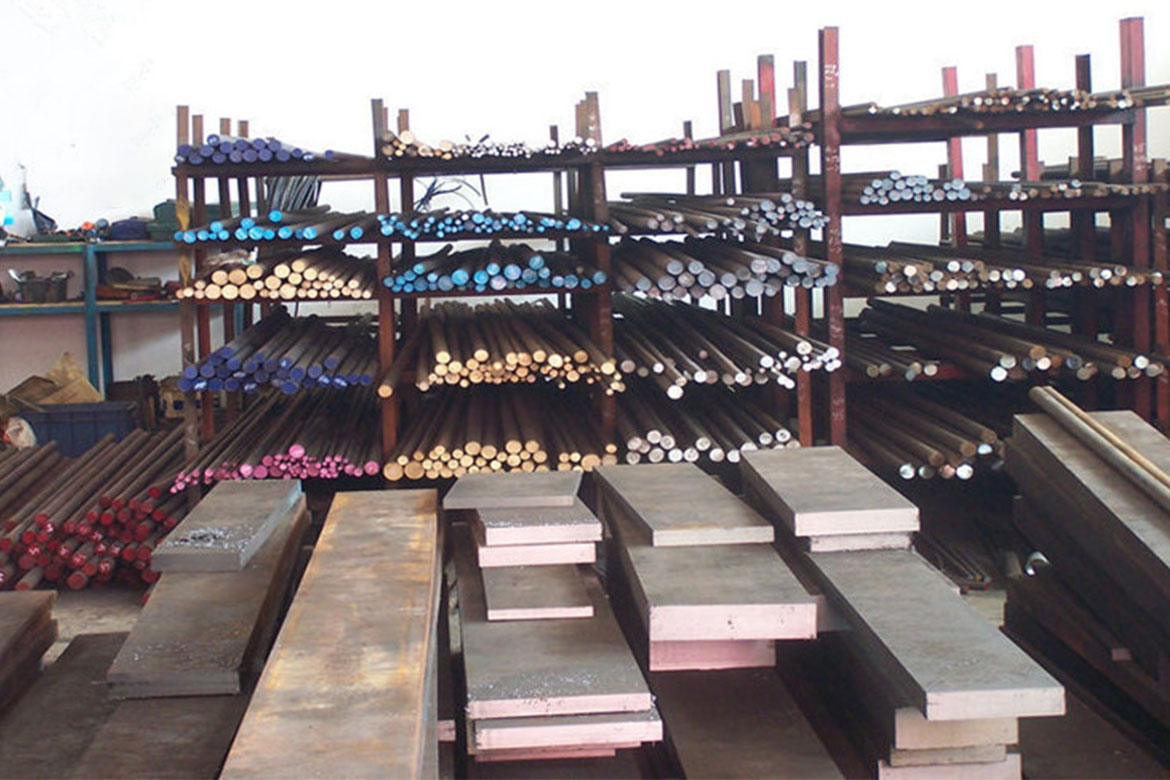
We are a leading professional manufacturer specializing in the production of 420HC stainless steel flat bars, steel plates, and sheets. Feel free to inquire about our products; we offer competitive prices, maintain consistent product quality, and ensure ample supply.
420HC Supplying
Shape: Flat, Sheet, Round
Heat-treatment: Annealed, Hardened
Surface: Black, Bright
Please send your inquiry to [email protected]
What is 420HC?
420HC is a Martensitic 420 series steel grade. The HC in its name stands for high carbon which means the steel can be hardened through heat treatment to reach higher levels of hardness.
In addition to Carbon elements, the steel contains 13% Chromium which gives it corrosion resistance properties.
420HC is mostly used in production of cutlery, shear blades, surgical tools, scissors, needle valves, among other applications.
420HC differs from it by an increased carbon content of 0.44-0.60%, while in 420 steel this content is approximately 0.12 – 0.14%. In addition, 420HC steel has an increased chromium content of about 13-14% and has silicon, manganese, molybdenum and vanadium in its composition. It approximately corresponds in its composition to the Russian tool steels 50X14MF and 65X13.
420HC Chemical component
| STEEL GRADE | CARBON (C) | MANGANESE (Mn) | CHROMIUM (Cr) | SILICIUM (Si) | VANADIUM (V) | MOLYBDENUM (Mo) |
| 420HC/425 modified | 0.45-0.54 | 0.80 | 13.50-14.00 | 0.80-1.0 | 0.18 | 1.00 |
Usage of 420HC
Tools made from 420HC Steel are easy to sharpen and are durable when in constant use and they’re pretty rust-resistant. This makes them great for some machetes. A knife made from this level of steel is one of the best products available when on any expedition. Any product made from 420HC steel is a smart purchase. Using old-fashioned sharpening tools works fine on this steel and it still takes the pressure of everyday use. Blades made from this material are less apt to corrode; the machete is a good example. They are an excellent work tool. While rusting is always an issue for many steels, just remember to rinse, dry, and oil your knife after use if you’re concerned.
Trade terms and how an order runs
The terms below apply unless the enquiry states otherwise. They are the terms most of our European and North American buyers work to, and they can be adjusted in the quotation.
| Item | Standard terms |
|---|---|
| Incoterms 2020 | FOB Shanghai, Qingdao or Shenzhen; CIF and CFR quoted against the destination port. |
| Payment | T/T 30 % advance with the order, 70 % against the bill of lading copy; irrevocable L/C at sight accepted for orders above 20 t |
| Minimum quantity | One bundle or one plate for stock sizes; mill runs and special sections are quoted individually |
| Lead time | 20–30 days from order confirmation for stock sizes; 30–45 days where forging, heat treatment or machining is included |
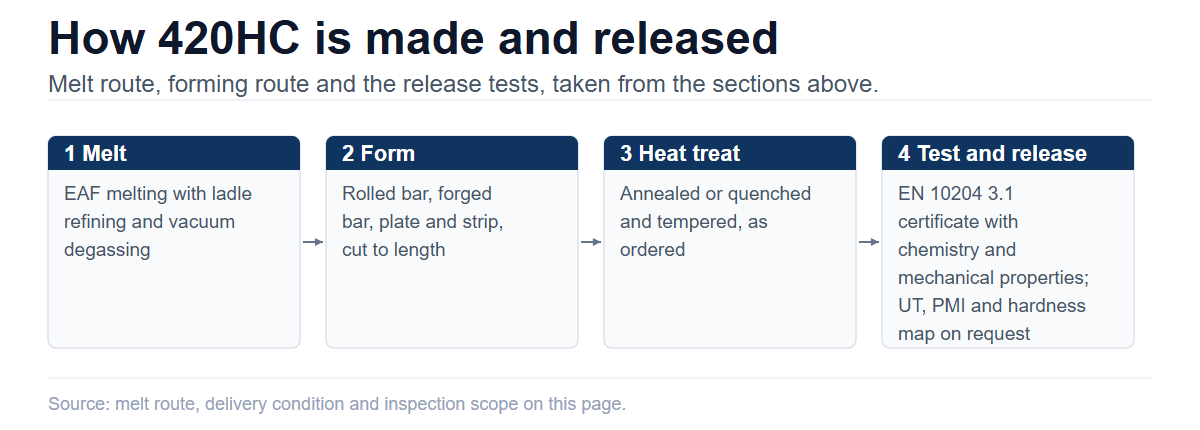
| Inspection | EN 10204 3.1 with every lot; third-party inspection (SGS, BV, TUV) arranged on request before dispatch |
| Documents | 3.1 certificate, packing list, commercial invoice, bill of lading, certificate of origin; legalisation or chamber attestation on request |
| Packing | Seaworthy export packing — oiled, wrapped, crated or strapped on skids, marked with grade, heat number, size and net weight |
Frequently asked questions
There is no exact EN equivalent. 420HC is a 420 modified with about 0.45 % carbon and 13 % chromium; 1.4034 / X46Cr13 is the closest European grade, and 5Cr15MoV the closest Chinese one.
56–58 HRC after hardening at 1000–1050 °C and tempering at 150–200 °C. Above 58 the edge chips on bone; below 55 it rolls on a plastic board.
It balances three things at a low cost: enough carbon for 56–58 HRC, enough chromium to resist food acids, and enough toughness to survive a thin edge. It is not a salt-water grade.
20–30 days from order confirmation for stock sizes, 30–45 days where forging, heat treatment or machining is included. Loading from Shanghai, Qingdao or Shenzhen.
Yes. Grades that share a heat-treatment and certification route are consolidated into one export package, which is usually what keeps a mixed order economical.