
AISI 4140 Alloy Steel (42CrMo4 / 1.7225)
The chromium-molybdenum steel most shafts, gears and bolts are made from. 0.40 % carbon, 1 % chromium, 0.2 % molybdenum. It hardens through 100 mm in oil, holds 300 HB at 30 HRC, and gets its temper resistance from the molybdenum rather than the carbon.
At a glance
| Item | Detail |
|---|---|
| Designations | AISI 4140 / UNS G41400 / 42CrMo4 / 1.7225 / SCM440 |
| Standards | ASTM A29, A322, A193 B7; EN 10083-3 |
| Delivery condition | Annealed max 250 HB, or quenched and tempered to your window |
| Melt route | EAF + ladle refining + vacuum degassing; ESR on request |
| Typical use | Shafts, gears, connecting rods, A193 B7 bolts, mould bases, hydraulic rods |
| Certificate | EN 10204 3.1 with chemistry, hardenability and mechanical results |
Why 4140 and not 1045 or 4340
The molybdenum is what separates 4140 from a plain 0.4 % carbon steel. It suppresses temper embrittlement, so a shaft quenched and tempered to 30 HRC stays there through service at 300 °C, where 1045 would soften and start to embrittle at the grain boundaries. It also buys depth of hardening: oil quenching gives full hardness to roughly 60–100 mm diameter, which covers most shaft work without going to a more expensive alloy.
Against 4340 the difference is nickel, and it is expensive. 4340 carries 1.65–2.00 % Ni and hardens through 150 mm, with better toughness at the same strength — but it distorts more in quench and costs roughly twice as much. Under 100 mm section, in bending or torsion rather than pure tension, 4140 is the right answer and we will say so before you order.
For pressure bolting the same steel is bought as A193 B7, which fixes the chemistry and the minimum tempering temperature at 620 °C. B7 and B7M come off the same heats, and the grade marking on the bar and the 3.1 certificate both carry the B7 designation rather than the mill grade.
Supply range and delivery condition
| Form | Size range | Condition |
|---|---|---|
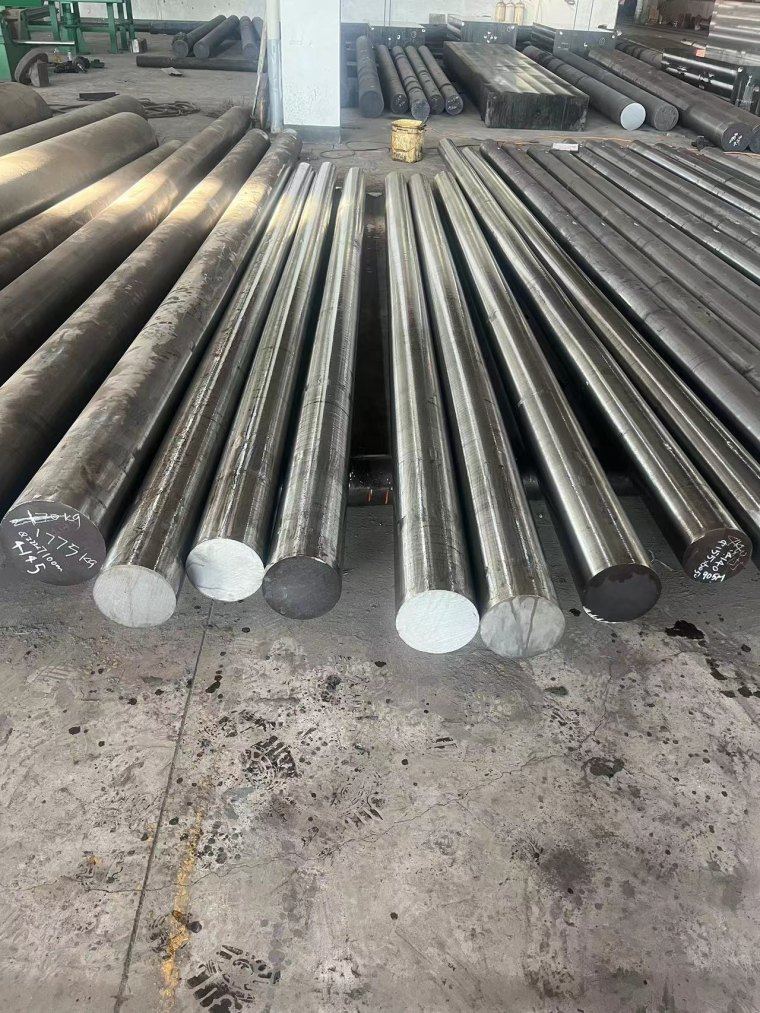
| Rolled round bar | Ø10–200 mm | As rolled / annealed / Q+T |
| Forged round bar | Ø80–1200 mm | Annealed / Q+T |
| Forged flat bar | Thickness 100–600 mm × width 300–2000 mm | Annealed |
| Rolled wire rod | Ø5.5–20 mm | As rolled / annealed |
Sawn and squared within these ranges. Hollow bar and rough-machined tube shells quoted on request.
Chemical composition
| C | Si | Mn | P | S | Cr | Mo |
|---|---|---|---|---|---|---|
| 0.38–0.43 | ≤0.35 | 0.75–1.00 | ≤0.035 | ≤0.040 | 0.80–1.10 | 0.15–0.25 |
AISI 4140 to ASTM A29. The EN 42CrMo4 window differs slightly — Cr 0.90–1.20, P 0.025 and S 0.035 max. Tell us which one the drawing calls for.
Mechanical properties you can design to
| Condition | Tensile MPa | 0.2 % proof MPa | Elongation % | Hardness |
|---|---|---|---|---|
| Annealed | 655 | 415 | 25.7 | 197 HB |
| Q+T, 28–32 HRC | 950–1100 | 750–900 | 14–18 | 300 HB |
| Q+T, 35 HRC | 1150–1250 | 950–1050 | 10–13 | 340 HB |
| A193 B7 minimum | 860 | 725 | 16 | ≤35 HRC |
Section size matters. The figures above apply to bar up to 100 mm; larger sections are tested at the quarter point and reported as such on the certificate.
Heat treatment
Normalising 870–900 °C, air cool. Annealing 840–870 °C, furnace cool to 250 HB max. Hardening 830–860 °C, oil quench; water only under 25 mm and with the cracking risk understood.
Tempering one hour per 25 mm of section, one hour minimum, air cool. 300 HB needs about 540 °C, 340 HB about 480 °C. Temper twice on anything with a stress concentration, and stay out of the 250–400 °C band — that is the embrittlement trough for this family even with the molybdenum present.
What ships with every lot
- EN 10204 3.1 mill certificate — chemistry, mechanical properties and the heat number
- Ultrasonic inspection to SEP 1921 / ASTM A388 on request
- Hardness survey across the section on request
- Grain size to ASTM E112 on request
- ESR or remelt route where the application needs it
Cutting, machining and surface
| Operation | What we hold |
|---|---|
| Saw cutting | Section up to 1200 mm; square within 1 mm per 100 mm |
| Surface grinding | Thickness tolerance −0 to +0.1 mm; flatness 0.01/100 mm |
| Milling | Bright milled, six faces squared |
| Vacuum heat treatment | Hardening and double tempering to your window |
| CNC / deep drilling | Quoted from drawing — DXF, STEP or PDF |
Packing and delivery
Bars are bundled by heat number, end-painted with grade and heat number, and strapped to wooden skids. Blocks travel in plywood cases with the machined faces protected. Every package is stencilled to match the certificate inside.
Typical lead time 20–30 days on stock sizes, 30–40 days for quenched and tempered bar where the mechanical test has to be run and reported. Loading from Shanghai, Qingdao or Shenzhen, FOB or CIF.
Request a quote
- Grade and standard — 4140 to ASTM A29, 42CrMo4 to EN 10083-3, or A193 B7
- Form and size — diameter and cut length, or thickness × width × length
- Quantity in pieces or kilograms
- Delivery condition — annealed or Q+T, with the hardness or tensile window
- Inspection — 3.1, UT, Jominy curve or grain size
Email [email protected] or use the form below. Drawings in DXF, STEP or PDF are all fine.
Related grades
One heat-treatment route, one certification route — grades can be combined in a single shipment.