
42CrMo4 / 1.7225 Alloy Steel: Properties, Equivalents and Supply Range
0.42 % carbon, 1 % chromium, 0.2 % molybdenum. The most widely specified engineering steel in Europe, and the one grade that can be bought in almost any form, at almost any size, from almost any mill.
42CrMo4 is the European designation for the chromium–molybdenum steel known as AISI 4140 in the United States and SCM440 in Japan. It is a through-hardening engineering steel: quenched and tempered, it carries shafts, gears, spindles, connecting rods, forging dies and the bolts that hold a press together. Supplied annealed it machines at about 197 HB; supplied quenched and tempered it is usually specified between 28 and 32 HRC.
It is not a tool steel and it is not a stainless steel. What it does have is the best balance of strength, toughness and hardenability per unit cost of any grade in its class, which is why a drawing that says “shaft, 42CrMo4, Q&T 1000 MPa” needs no further explanation in most of the world.
Equivalent designations
Table 1. The same steel under different systems. If a drawing cites any of these, 42CrMo4 meets it provided the heat-treatment condition matches.
| System | Designation | Standard |
|---|---|---|
| DIN / EN | 42CrMo4 — 1.7225 | EN 10083-3 |
| AISI / SAE | 4140 — UNS G41400 | ASTM A29 / A322 |
| JIS | SCM440 | JIS G4105 |
| AFNOR | 42CD4 | NF A35-556 |
| GOST | 40KhMFA | GOST 4543 |
| GB | 42CrMo | GB/T 3077 |
The chemistry limits are not identical between systems, and the difference is worth knowing when a certificate is checked against a drawing. EN 10083-3 allows 0.38–0.45 % carbon and 0.90–1.20 % chromium; the AISI 4140 limits are slightly tighter on carbon and slightly wider on manganese. Both satisfy the mechanical property requirements that matter, and both are routinely cross-certified.
What each element is doing
- Carbon at 0.42 % sets the ceiling on hardness after quenching and the floor on toughness. It is the reason the grade can reach 54 HRC as-quenched and still be tough at 30 HRC.
- Chromium at 1 % slows the transformation enough that a 100 mm bar hardens through in oil rather than only at the surface.
- Molybdenum at 0.2 % does two jobs: it suppresses temper embrittlement, so the steel can be tempered in the 450–550 °C band without becoming brittle, and it raises creep resistance at temperature.
- Manganese at 0.6–0.9 % adds hardenability cheaply and ties up sulphur.
- Silicon is a deoxidation remnant; above about 0.4 % it starts to hurt toughness and machinability.
Chemical composition
Table 2. Chemical composition to EN 10083-3, mass fraction in percent. Single values are maxima.
| C | Si | Mn | P | S | Cr | Mo |
|---|---|---|---|---|---|---|
| 0.38–0.45 | ≤0.40 | 0.60–0.90 | ≤0.025 | ≤0.035 | 0.90–1.20 | 0.15–0.30 |
Tempering response
The properties a shaft actually gets are set at the tempering furnace, not at the steel mill. The curve below is the one to work from when a drawing gives a hardness but no tempering temperature: pick the hardness, read across, and the temperature follows.
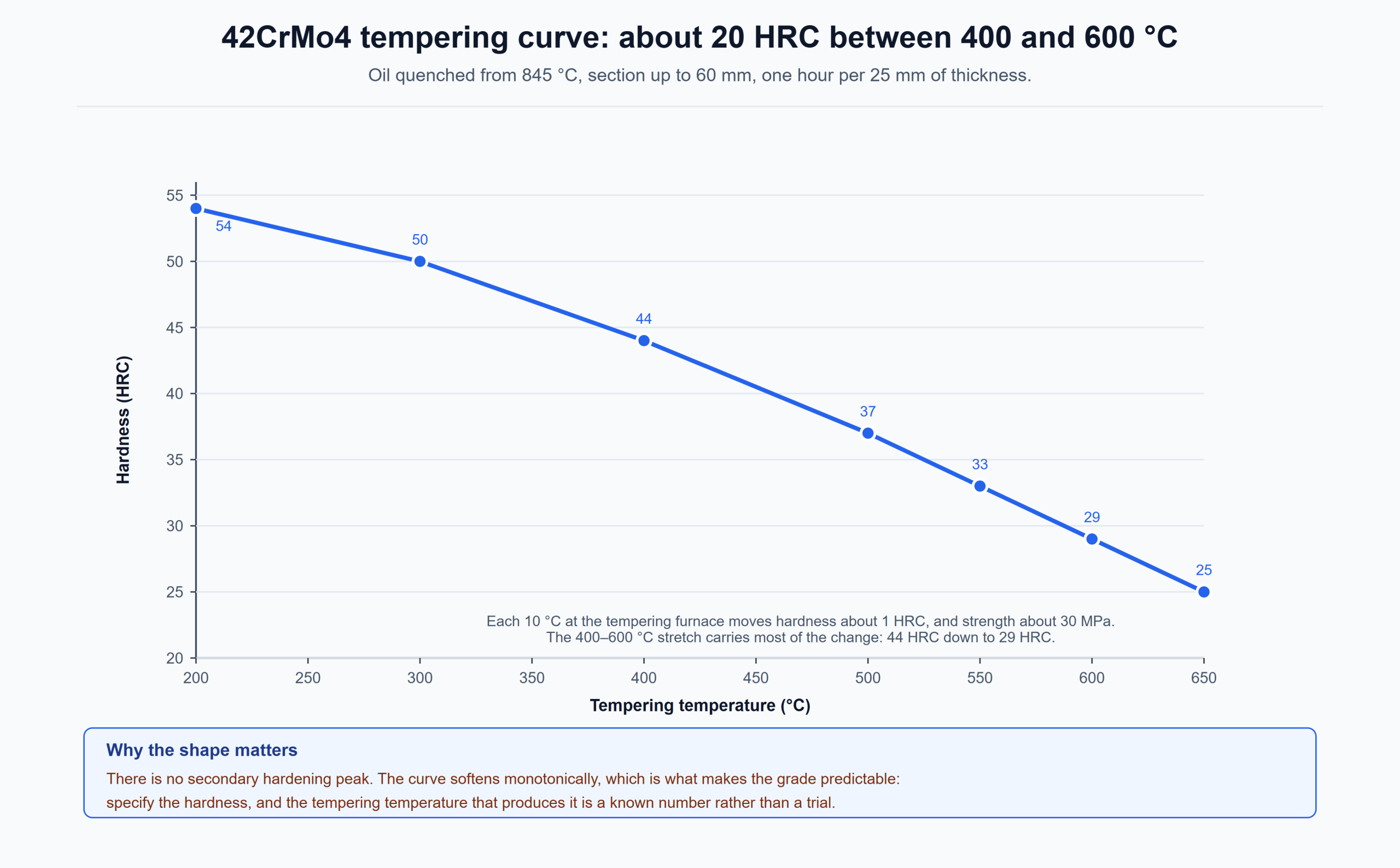
Two features are worth pointing out. The curve is steep between 400 °C and 600 °C — about 20 HRC over 200 °C — so a ±10 °C furnace error moves hardness by roughly 1 HRC and strength by 30 MPa. And there is no secondary hardening peak: 42CrMo4 softens monotonically, which is what makes its tempering behaviour predictable and its specification easy to hold.
Mechanical properties
Table 3. Typical mechanical properties in two conditions. The annealed values are for machining stock; the quenched and tempered values are for finished parts.
| Condition | Tensile strength | 0.2 % proof | Elongation | Hardness | Typical use |
|---|---|---|---|---|---|
| Annealed | 655 MPa | 415 MPa | 25.7 % | 197 HB | Machining stock |
| Q&T, 28–32 HRC | 950–1100 MPa | 750–900 MPa | 14–18 % | 300 HB | Shafts, gears, spindles |
| Q&T, 35 HRC | 1150–1250 MPa | 950–1050 MPa | 10–13 % | 340 HB | High-load pins, press columns |
| Q&T, 45 HRC | 1400–1500 MPa | 1250–1350 MPa | 7–9 % | 430 HB | Wear parts, limited toughness |
The 45 HRC row is included to make a point: 42CrMo4 can be pushed that hard, but it is no longer a tough steel at that level, and a part that sees impact should be designed at 30 HRC and made larger rather than designed at 45 HRC and made smaller.
Heat treatment
- Annealing: 872 °C, then slow furnace cool. Produces the 197 HB condition in which the steel is machined.
- Normalising: 913 °C, air cool. Used to refine structure before hardening, or as a final treatment for large forgings.
- Hardening: 845 °C, oil quench. Water is used only for sections simple enough to survive it; the risk of cracking is real.
- Tempering: 205–649 °C depending on the hardness required, followed by air cool. Temper immediately after quenching, before the part reaches room temperature, to avoid quench cracking.
- Stress relief: 550–650 °C after rough machining, before finish machining, for parts with tight dimensional tolerances.
Will it harden through at your section size?
Hardenability is the question that decides whether 42CrMo4 is the right grade. It is a 1 % chromium steel, not a 2 % nickel–chromium–molybdenum steel, and at large sections the core will not follow the surface. The chart below is indicative for oil quenching; for a critical part it should be confirmed by a Jominy test on the actual heat or by simulation.
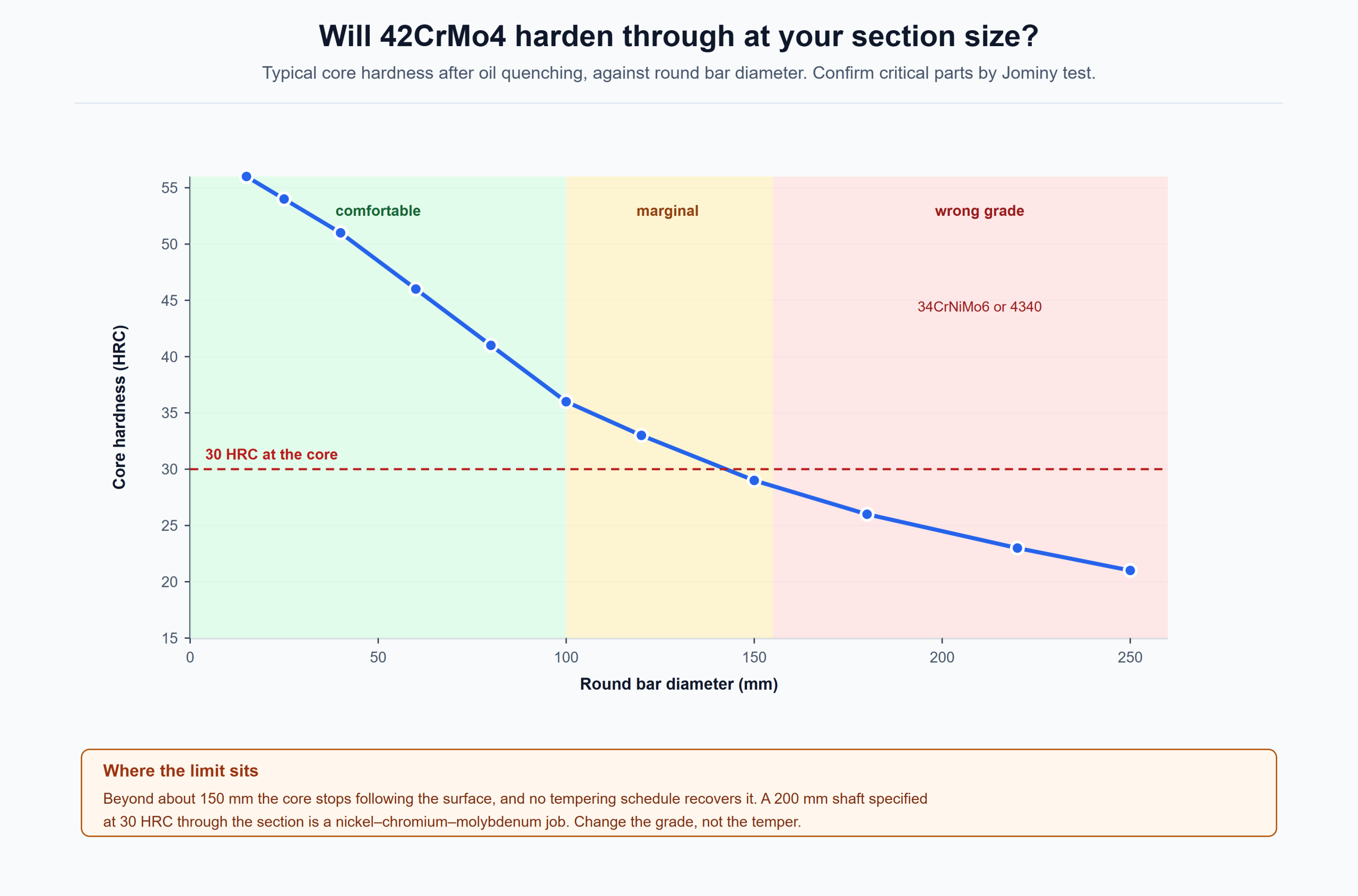
The practical reading: up to about 100 mm section, 42CrMo4 will give a core hardness in the high 30s and carry a 30 HRC specification comfortably. Between 100 and 150 mm it becomes marginal, and beyond that the core falls away fast. A 200 mm shaft that must be 30 HRC at the centre is a 34CrNiMo6 or 4340 job, not a 42CrMo4 job — and no amount of tempering will fix it.
Machining, welding and forming
In the annealed condition 42CrMo4 machines at about 65 % of the rate of a free-cutting carbon steel (AISI 1212 = 100 %), which is good for a 1 % chromium steel. Carbide tooling at 150–200 m/min with coolant is the normal starting point. In the quenched and tempered condition above 30 HRC, machining is possible but the tool life falls quickly and grinding is usually cheaper.
Welding is the weak point. 42CrMo4 is a hardenable steel with 0.42 % carbon, so the heat-affected zone transforms to untempered martensite and cracks. If welding is unavoidable: preheat to 200–300 °C, use a low-hydrogen process and a matching or slightly over-alloyed filler, and post-weld heat treat at 550–650 °C immediately. A welded joint in this grade will never match the parent metal fatigue strength, and the design should not assume it will.
Forging is done at 926–1205 °C, with the part cooled slowly afterwards. Hot working below 816 °C should be avoided. Cold working is possible only in the annealed condition and only for light deformation; the grade is not intended for cold forming.
Supply range and condition
Table 4. Typical supply range for 42CrMo4 / 1.7225.
| Form | Size range | Condition |
|---|---|---|
| Round bar | Ø16–800 mm | Annealed, normalised, or Q&T |
| Flat bar and plate | Thickness 10–300 mm | Annealed or Q&T |
| Forged blocks and shafts | To drawing, up to several tonnes | Annealed or Q&T |
| Tube and hollow bar | OD 50–500 mm | Annealed |
| Wire and bar for fasteners | Ø5–40 mm | Spheroidise annealed, cold heading quality |
Table 5. Delivery condition and surface finish.
| Item | Options |
|---|---|
| Delivery condition | +A annealed, +N normalised, +NT normalised and tempered, +QT quenched and tempered to a stated hardness |
| Surface | Black, ground, peeled or turned, polished; UT-tested forgings supplied with the test report |
| Melting route | EAF + LF + VD as standard; EAF + ESR for cleanness-critical forgings |
| Tolerance | Bar to EN 10060 / EN 10278; plate to EN 10029; machining allowance to drawing |
Inspection, certification and services
Inspection normally covers chemical analysis, tensile and impact testing, hardness survey, ultrasonic testing for forgings and a 3.1 certificate to EN 10204. For sour service or pressure equipment the specification changes: P and S limits tighten, hardness is capped, and the grade is bought against NACE MR0175 rather than EN 10083.
The same mill supply covers the neighbouring grades, which is useful when one enquiry turns into a family of parts: 4130 and 4130 P+X, 4140, 4330V mod, 4340, 4145H mod and 4317, plus the European equivalents 1.8509, 1.6523, 1.7707, 1.6657, 1.6587, 1.6582 and 1.6773.
Table 6. Workshop and commercial services offered with 42CrMo4.
| Service | Detail |
|---|---|
| Cutting | Saw-cut blanks to length; laser or waterjet cut plate to drawing |
| Machining | CNC turning, milling, drilling and gear cutting to drawing |
| Heat treatment | Normalising, hardening and tempering, stress relief, induction hardening of journals |
| Packing | Bare, nylon wrap, wooden case; export seaworthy packing |
| Payment and terms | T/T, L/C at sight, or O/A against approved credit; FOB, CFR, CIF, DDU or DDP |
What to put on the enquiry
- Grade and standard: 42CrMo4 to EN 10083-3, or 4140 to ASTM A29 — state which, because the chemistry limits differ.
- Section size and the hardness or strength required at the core, not only at the surface.
- Condition: annealed for machining, or quenched and tempered to a hardness range.
- Test requirements: impact energy at a stated temperature, ultrasonic acceptance level, and whether a Jominy test is needed.
Related reading
- AISI 4140 alloy steel — the US designation, with the full property and heat-treatment data
- SCM440 alloy steel — the JIS designation and Japanese supply sizes
- 34CrNiMo6 / EN24 — the nickel-bearing step up when the section is too large for 42CrMo4
- 4140 against 4130 — what the extra carbon and chromium buy, and where 4130 is the better choice
- AISI 4340 — the nickel–chromium–molybdenum grade for the heaviest sections
You get chemical composition, mechanical properties and a price — with inspection certificates to EN 10204 3.1 issued against the heat number.