
Cr12MoV Cold Work Tool Steel
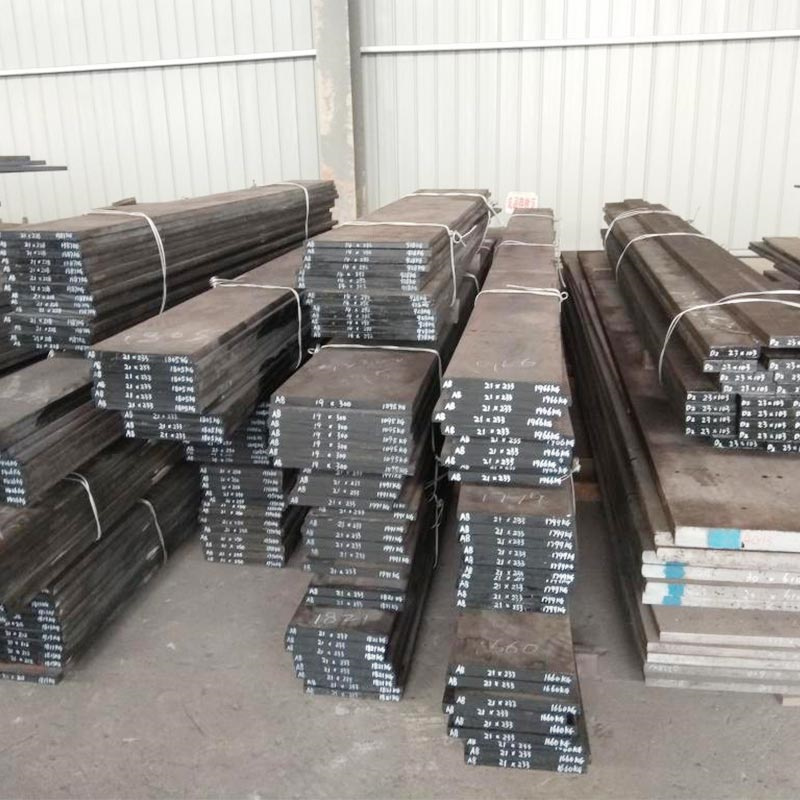
Description
Cr12MoV steel is a kind of ledeburite cold work tool steel which developed from Cr12 steel, as the added content of Mo, V, and decrease of C, Cr12MoV have the advantage of Higher hardenability, hardness, wear resistance and small heat treatment distortion. It’s regularly be used in manufacturing cold mold with a heavy load, bulk production, and complex shape. Due to Cr12MoV is ledeburite steel, so its toughness is greatly influenced by the carbide morphology and distribution.
Cr12MoV Steel, steel hardenability, quenching and tempering the hardness, wear resistance and strength than that of high Cr12. Cross section used in the manufacture large, complex shape, working under arduous conditions, with a variety of Die and tools, such as die punching, trimming mold, piping die, deep drawing steel mold, circular saws, standards, tools and gauges, thread rolling die and so on.
Cutting:
Precision cutting to standard dimensions
Custom cutting according to client specifications
Cold Work Tool Steel Dimensions
We offer premium cold work tool steel in various forms, manufactured with advanced 5000-ton forging press technology for superior density and performance.
| Product Form | Specifications |
|---|---|
| Forged Round Bar | Dia. up to 1200mm |
| Forged Flat Bar | Thickness 100-600mm, Width 300-2000mm |
| Rolled Round Bar | Dia. 10-200mm |
| Hot Rolled Plate | Thickness 1-100mm, Width 60-1600mm |
Chemical composition% of Cr12MoV steel
| C(%) | Si(%) | Mn(%) | P(%) | S(%) | Cr(%) | Ni(%) | Mo(%) | V(%) | Cu(%) |
| 1.45~1.70 | ≤0.40 | ≤0.40 | ≤0.030 | ≤0.030 | 11.00~12.50 | ≤0.20 | 0.40~0.60 | 0.15~0.30 | ≤0.30 |
Cr12MoV equivalents alloy steel
| Steel | Country Code | C(%) | V(%) | Si(%) | Mn(%) | P(%) | S(%) | Cr(%) |
| SKD11 | CNS | 1.4-1.6 | 0.2-0.5 | ≦0.4 | ≦0.6 | ≦0.03 | ≦0.03 | 11.0-13.0 |
| Cr12MoV | GB | 1.45-1.70 | 0.15-0.30 | ≦0.4 | ≦0.4 | ≦0.03 | ≦0.03 | 11.0-12.5 |
| SKD11 | JIS | 1.4-1.6 | 0.2-0.5 | ≦0.4 | ≦0.6 | ≦0.03 | ≦0.03 | 11.0-13.0 |
| X165Cr-MoV12 | DIN | 1.55-1.75 | 0.1-0.5 | 0.25-0.40 | 0.2-0.4 | ≦0.03 | ≦0.03 | 11.0-12.0 |
Heat treatment of Cr12MoV Alloy Steel
spheroidizing annealing:860℃ X 2h furnace cooling to 750℃ and then furnace cooling to 500-550℃, remove out and air cooling
Quenched + tempered:1100℃ X 20min step quenching + 700℃ X 1h tempering,remove out and air cooling
Quenching:1030℃ X 40min oil quenching(800℃ preheating,vacuum 2.5 pa) Tempering: 250℃ X 1h
Application
Cold work dies steel, steel hardenability, quenching, and tempering hardness, wear resistance, strength is higher than Cr12. Used in the manufacture of various cold stamping dies and tools with large cross- sections, complex shapes and heavy working conditions, such as punching die, trimming die, piping dies, deep drawing dies, circular saw, standard tools, and gauges Thread rolling die, etc
Why Cr12MoV is a carbide steel, not just a “high carbon” steel
Cr12MoV is a ledeburitic cold work steel: at 1.45–1.70 % carbon and 11–12.5 % chromium, the carbon and chromium combine into large primary carbides that form during solidification. Those carbides are what give the steel its wear resistance — and they are also why it behaves differently from a simple high-carbon steel.
The molybdenum and vanadium additions (0.40–0.60 % and 0.15–0.30 %) do two specific jobs: they improve hardenability so thick sections harden through, and they refine the carbide structure, which is what gives Cr12MoV better toughness than the older Cr12 grade at the same hardness. It is still a carbide steel, so its toughness depends on how those carbides are distributed. A badly forged billet with carbide segregation will chip at the edge no matter what hardness the certificate shows.
Hardening: the schedule and the two traps
| Step | Temperature | Note |
|---|---|---|
| Annealing | 850–870 °C, furnace cool | About 207–255 HB, for machining |
| Stress relief | 650–680 °C after rough machining | Before final cuts, to avoid movement |
| Austenitising | 1000–1030 °C | Salt bath, vacuum or atmosphere — air is not enough |
| Quench | Oil, or airblast for thin sections | Quench fast enough to miss the carbide network |
| Tempering | 180–200 °C, twice | 58–62 HRC; double temper to stabilise |
Trap one: tempering in the 250–400 °C range. The steel loses hardness without gaining toughness, and the result is an edge that chips. Either stay at 180–200 °C for hardness or go to 500 °C and above for a tougher, softer die.
Trap two: quenching from too low a temperature. Cr12MoV needs the carbides dissolved; at 950 °C they are not, and the steel will not reach the specified hardness however long it is soaked.
Where it fails in service
Cold work dies made from Cr12MoV fail in three recognisable ways. Chipping at the cutting edge, usually from carbide segregation or from a temper in the brittle range. Cracking across the die, usually from insufficient tempering or from grinding burn. And wear, which is the failure the grade is designed to resist — if a Cr12MoV die wears out quickly, the problem is usually the counterface or the lubrication, not the steel.
Cr12MoV against the grades either side of it
| Grade | Character | Choose it when |
|---|---|---|
| Cr12 | Older ledeburitic grade, coarse carbides | Cheap, low-stress dies only |
| Cr12MoV | Better hardenability and toughness than Cr12 | Heavy-load cold forming, complex shapes |
| D2 / 1.2379 | Higher Mo and V, finer carbides | Higher wear resistance and better edge stability |
| DC53 | Modified D2 with much better toughness | Where D2-class wear is wanted but chipping is the problem |
You get chemical composition, mechanical properties and a price — with inspection certificates to EN 10204 3.1 issued against the heat number.