
DIFFERENCES BETWEEN 4140 STEEL AND 4150 STEEL

The naming structure
Based on the SAE (Society of Automotive Engineers), steels that have a naming structure of 41XX are informally known as chromoly steel, or it is a chromium-molybdenum steel. These steels are usually much harder and tougher than normal carbon steel. Alloying elements allow the steel to be heat treated to obtain stronger physical properties. The last two digits are how much carbon is in the steel. In the case of 4140, there is .40% carbon and 4150 has a .50% carbon content.
These are both extra strong and hard alloys of steel, and are used in applications requiring higher performance than carbon steels can typically withstand.
DIFFERENCES
Tensile strength: 4150 has a higher tensile strength, meaning it has a higher threshold for stress before breaking.
Ductility & workability: 4140 is more ductile, meaning it can be bent easier than 4150. It also can be used in cold working conditions while 4150 needs to be thermally treated before forming.
WHEN TO USE
These types of steel are typically used in industries such as aerospace, defense, underground mining, oil and gas, or automotive. Some of the products you might use 4150 for are shafts, valves, or sprockets while 4140 may be used for crankshafts, gears, collars, and machinery parts.
Fushun Special Steel LTD CO
Fushun Metal is a large special steel manufacturer and supplier. We are metal experts and have been providing quality customer service and products since 1998.
At Fushun Metal, we supply a wide range of metals for a variety of applications. Our products/stock includes: stainless steel, alloy steel, spring steel, tool steel, high speed steel, mould steel, nickel alloy.
Our hot rolled and cold rolled steel is available in a wide range of shapes including: bars, tubes, sheets and plates. We can cut metal to your exact specifications.
Send your inquiry information to us and get a free quotation today!
The 0.1 % that changes the steel
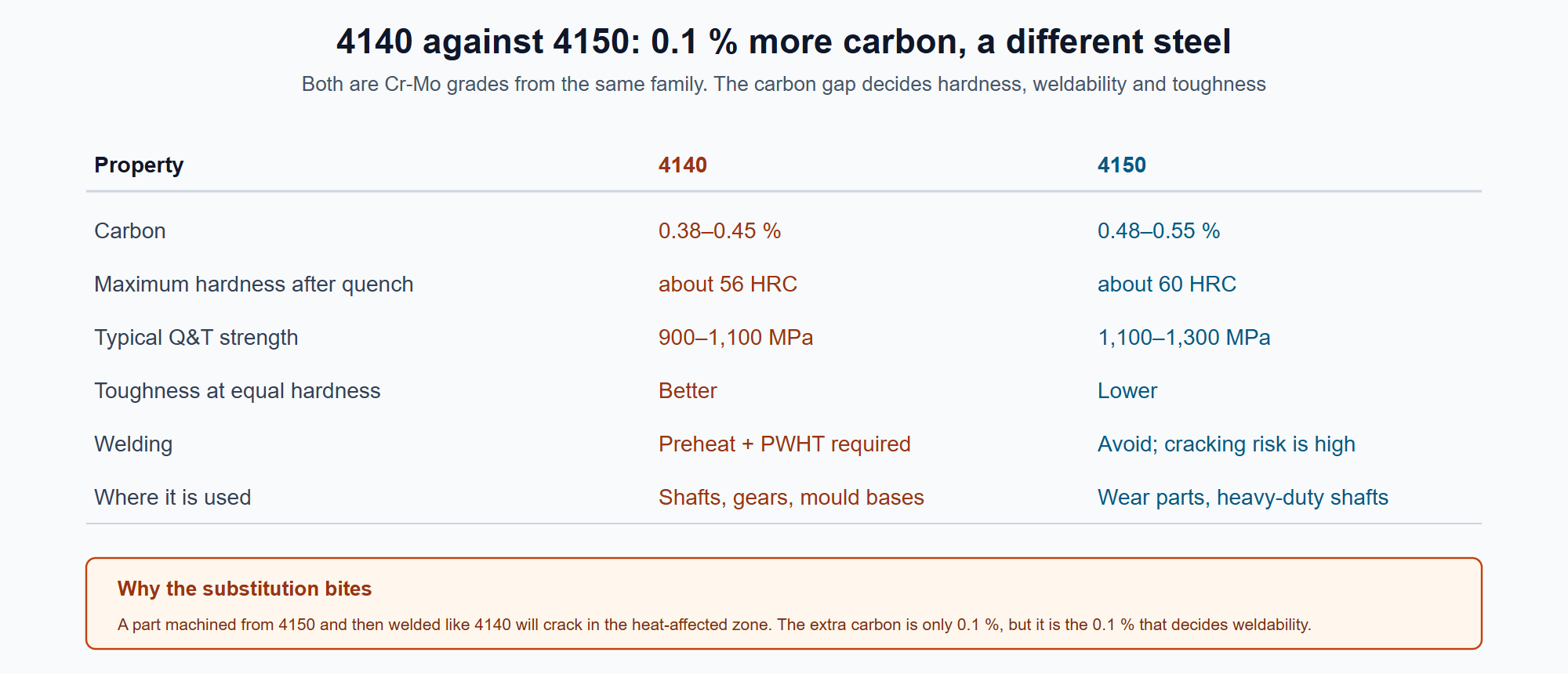
4140 and 4150 come from the same chromium-molybdenum family and are often treated as interchangeable. They are not. The carbon moves from 0.38–0.45 % to 0.48–0.55 %, which lifts maximum hardness from about 56 HRC to about 60 and typical quenched and tempered strength from roughly 900–1,100 MPa to 1,100–1,300 MPa.
The gain is real, and so is the cost: at equal hardness, 4150 is less tough, and it is markedly harder to weld.
The weldability line
4140 already needs preheat and a post-weld heat treatment. 4150 crosses a line: at 0.5 % carbon the heat-affected zone hardens enough that cracking becomes likely even with careful procedure, and many fabricators will decline the job. If the part has to be welded after hardening, 4150 is the wrong grade regardless of the strength requirement.
Choosing between them
Use 4140 for the general case — shafts, gears, mould bases, fasteners — and accept 900–1,100 MPa. Move to 4150 only when the strength requirement genuinely exceeds what 4140 gives at the hardness the part can tolerate, and when the part is not welded.
If both strength and weldability are needed, the answer is not a higher-carbon 4140 family grade but a different family: a low-carbon quenched and tempered or HSLA steel.