
Spring Steel Flat Bar: Grades, Sizes & Properties
Spring steel flat bar is rolled to a rectangular section and supplied either annealed for forming or quenched and tempered to a hardness band. The section is chosen so that the spring can be formed from bar rather than machined from plate — the rolling tolerance and the edge condition decide whether that works.
Spring steel flat bar: How the Families Differ
Leaf springs, parabolic springs and heavy coil springs are made from flat bar, and the bar is rolled to a section close to the finished spring. That saves machining but puts the tolerance under pressure: a 0.2 mm variation in thickness across the width changes the rate of a leaf spring measurably, and a rolled edge with a seam becomes the fatigue origin.
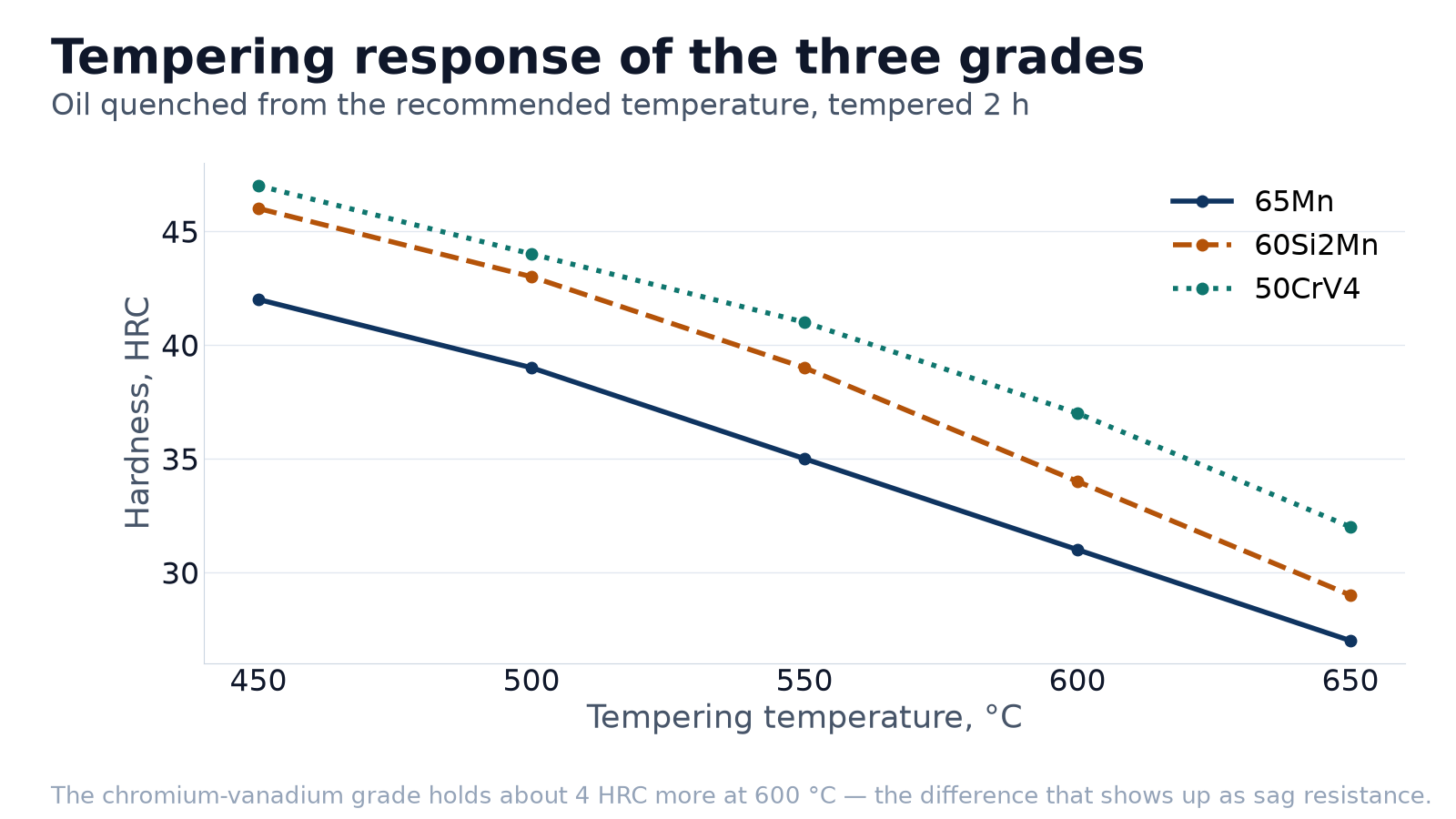
The grades divide by hardenability and by temper resistance. 65Mn is the volume grade for automotive leaf springs; 60Si2Mn adds silicon for a higher elastic limit and better sag resistance; 50CrV adds chromium and vanadium for springs that run warm or see a high stress amplitude.
Spring steel flat bar is spring steel: the part is designed to deflect and return, so the properties that matter are the elastic limit, the fatigue resistance and the surface condition — not hardness alone. The steel is supplied annealed for forming, or hardened and tempered to a stated band.
Silicon raises the elastic limit and the sag resistance; chromium and vanadium hold hardness at temperature and refine the grain. That is why the alloyed grades carry 30 % more tensile than the plain carbon grades at the same section.
The Two Mistakes That Keep Coming Back
Ordering by grade without the thickness tolerance: two bars of the same grade and different tolerance make springs with different rates, and the difference shows up on the test rig.
Shot-peening a bar with a rolled-in seam: the peening hides the seam for a while, then the spring fails from underneath it.
- Buying tempered strip and forming a tight radius; the strip cracks at the bend.
- Specifying hardness without the tempering temperature; the same HRC from different tempers behaves differently in fatigue.
- Ignoring the edge condition; a sheared edge carries micro-cracks straight into the fatigue section.
- Assuming annealed strip has no decarburisation; it has to be measured, not assumed.
Selection Matrix
Table 1 — Grade selection by duty
| Duty | 65Mn | 60Si2Mn | 50CrV4 |
|---|---|---|---|
| Automotive leaf spring | Recommended | Usable | Usable |
| High sag resistance | Usable | Recommended | Usable |
| Service to 250 °C | Avoid | Usable | Recommended |
| Fatigue-critical | Usable | Usable | Recommended |
The matrix assumes a hardened and tempered bar; an annealed bar is for forming only and has none of these properties.
Grades We Supply
The grades below are the ones we roll and cut most often. Each one is a different compromise on the same three axes — hardenability, toughness and cost — and the last column says which duty each was designed for.
Table 2 — Grades supplied, with the duty each one covers
| Grade | C | Mn | Si | Cr | V | Duty |
|---|---|---|---|---|---|---|
| 65# | 0.62–0.70 | 0.50–0.80 | 0.17–0.37 | ≤0.25 | — | General leaf springs |
| 70# | 0.62–0.75 | 0.50–0.80 | 0.17–0.37 | ≤0.25 | — | Higher load leaf springs |
| 85# | 0.82–0.90 | 0.50–0.80 | 0.17–0.37 | ≤0.25 | — | Wear-resistant spring strips |
| 65Mn | 0.62–0.70 | 0.90–1.20 | 0.17–0.37 | ≤0.25 | — | Automotive leaf springs |
| 60Si2Mn | 0.56–0.64 | 0.60–0.90 | 1.50–2.00 | ≤0.35 | — | High elastic limit, sag resistance |
| 50CrV4 | 0.47–0.55 | 0.70–1.10 | 0.15–0.35 | 0.90–1.20 | 0.10–0.20 | Warm service, fatigue |
Supply Range and Tolerances
Supply is quoted by section and length, in coils, bundles or cut lengths, with the straightness and the edge condition stated.
Table 3 — Supply range and tolerances
| Form | Range | Condition |
|---|---|---|
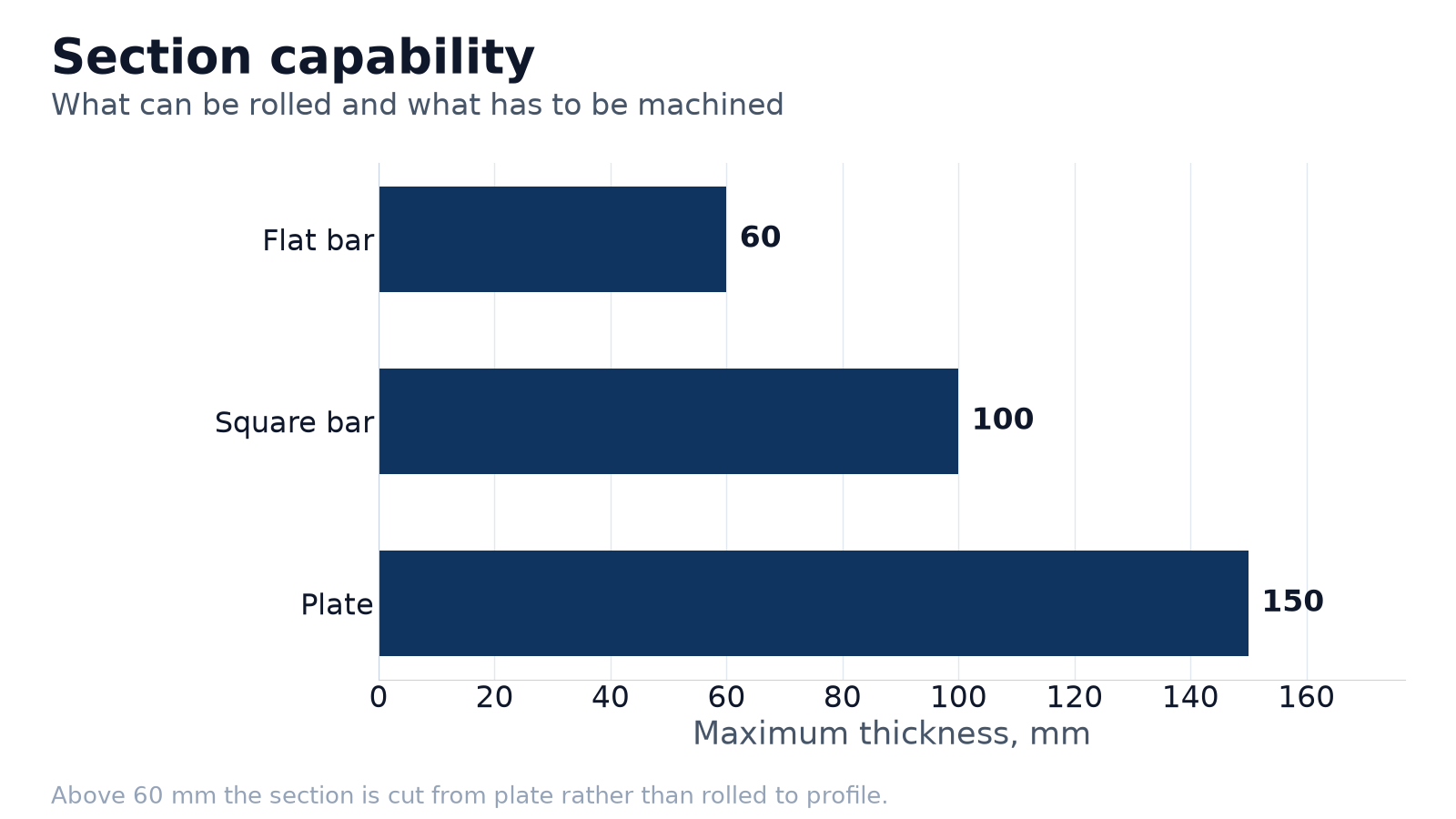
| Flat bar | 3–60 mm thick × 20–300 mm wide | Annealed or Q&T |
| Square bar | 6–100 mm | Annealed or Q&T |
| Coil / bundle | Up to 3 t per bundle | Strapping to the drawing |
| Length | 3–12 m, or cut to length | — |
Bar is supplied in bundles up to 3 t, strapped and tagged. Cut lengths are deburred and packed in wooden cases; the straightness class is agreed at order.
Properties That Decide the Choice
Properties are quoted in the hardened and tempered condition, with the tempering temperature stated. The same grade in the annealed condition is meant for forming only.
Table 4 — Properties that decide the selection
| Grade | Rm (MPa) | Rp0.2 (MPa) | A5 (%) | Hardness |
|---|---|---|---|---|
| 65# | ≥980 | ≥785 | ≥9 | 269–321 HB |
| 70# | ≥1,030 | ≥835 | ≥8 | 285–341 HB |
| 85# | ≥1,130 | ≥980 | ≥6 | 302–363 HB |
| 65Mn | ≥980 | ≥785 | ≥8 | 269–321 HB |
| 60Si2Mn | ≥1,200 | ≥1,050 | ≥6 | 321–375 HB |
| 50CrV4 | ≥1,250 | ≥1,100 | ≥7 | 330–390 HB |
Chemical Composition
Carbon sets the hardness after quench, silicon raises the elastic limit, and chromium and vanadium hold the temper at working temperature.
Table 5 — Chemical composition, wt. %
| Grade | C | Si | Mn | Cr | Mo | Ni | V |
|---|---|---|---|---|---|---|---|
| 65Mn | 0.62–0.70 | 0.17–0.37 | 0.90–1.20 | ≤0.25 | — | ≤0.25 | — |
| 60Si2Mn | 0.56–0.64 | 1.50–2.00 | 0.60–0.90 | ≤0.35 | — | ≤0.25 | — |
| 50CrV4 | 0.47–0.55 | 0.15–0.35 | 0.70–1.10 | 0.90–1.20 | 0.10–0.20 | ≤0.25 | — |
Heat Treatment
Austenitise, quench, temper to the specified band. The tempering temperature, not the hardness alone, is what has to be recorded.
Table 6 — Heat treatment schedule
| Step | Temperature | Time / atmosphere | Cooling |
|---|---|---|---|
| 65Mn | 830 °C | Oil quench, temper 540 °C | Oil |
| 60Si2Mn | 860 °C | Oil quench, temper 480 °C | Oil |
| 50CrV4 | 850 °C | Oil quench, temper 520 °C | Oil |
How These Grades Fail
Flat bar springs fail at the edge. The rolled edge carries seams and decarburisation, and both are crack starters under the bending stress. That is why the edge condition is specified separately from the grade.
The second failure is sag. A spring that runs at 250 °C loses load as the temper backs off; 50CrV4 resists it, 65Mn does not.
Certificate and Testing
- EN 10204 3.1 mill certificate with chemistry and mechanical properties, heat number and melt route.
- Hardness survey and dimensional report on every piece on request.
- Ultrasonic inspection to ASTM A388 or SEP 1921 where the section or the application calls for it.
- Third-party inspection — SGS, BV, TUV — arranged before dispatch, at the customer’s instruction.
- Spectro check on the finished part where a weld or a heat treatment has been added after despatch.
Packing, MOQ and Delivery Terms
Bundles are strapped with steel band and marked with grade, heat number, section and net weight. Export packing is seaworthy, with the bar ends protected.
Table 7 — Trade terms, packing and documents
| Item | Standard terms |
|---|---|
| Trade terms | FOB Shanghai / CIF / CFR / EXW; FOB is the default. |
| Minimum order | One bundle, plate or coil for stock sizes; mill runs quoted individually. |
| Lead time | 20–30 days from order confirmation for stock sizes; 30–45 days where forging or heat treatment is included. |
| Payment | 30 % T/T deposit, 70 % against the bill of lading copy; L/C at sight above 20 t. |
| Packing | Seaworthy export packing — crated or strapped, marked with grade, heat number, size and net weight. |
| Documents | EN 10204 3.1 certificate, packing list, invoice, bill of lading, certificate of origin; legalisation on request. |
Frequently Asked Questions
Which grade for an automotive leaf spring?
65Mn is the volume choice; 60Si2Mn where the spring needs a higher elastic limit and better sag resistance.
Can you supply hardened and tempered bar?
Yes, to the hardness band on this page, with the tempering temperature recorded on the certificate.
What is the thickness tolerance?
To the EN 10092 table or to the drawing; the tolerance is agreed at order because it affects the spring rate.
Is 50CrV4 available?
Yes, in the size range shown, annealed or quenched and tempered.
Do you supply cut lengths?
Yes, 3–12 m as standard, cut to length on request.

Related Grades
Browse the full range: spring steel grades.
Request a Quote
- Grade and governing standard
- Form, size and quantity
- Delivery condition and hardness
- Certificate and testing requirements
- Destination port and required date
Email [email protected] or use the form below. Drawings in DXF, STEP or PDF are all fine. Stock sizes ship within 20 days of order confirmation.