
1.4418 X4CrNiMo16-5-1 Stainless Steel

Grade : X4CrNiMo16-5-1
Number:1.4418
Classification: Martensitic stainless steel
Density:7.7 g/cm³
Our supply size :
Diameter : 80 to 600 mm ;
Length : 1000 to 9000 mm ;
Our advantage :
- High Quality, Reasonable Price
- Over 40 Years Experience
- ISO NQA Certificated Factory
- Worldwide shipping
- Emergency Orders and Fast Delivery
Equivalent grades of steel X4CrNiMo16-5-1 (1.4418)
| EU | France | Sweden |
| EN | AFNOR | SS |
| X4CrNiMo16-5-1 | Z6CND16-05-01 | 2387 |
Chemical composition % of steel X4CrNiMo16-5-1 (1.4418): EN 10088-2-2005
| C | Si | Mn | Ni | P | S | Cr | Mo | N |
| max 0.06 | max 0.7 | max 1.5 | 4-6 | max 0.04 | max 0.015 | 15 – 17 | 0.8 – 1.5 | max 0.02 |
Standard:
EN 10088-2: 2005 Stainless steels. sheet/plate and strip of corrosion resisting steels for general purposes
EN 10088-3: 2005 Stainless steels. semi-finished products, bars, rods, wire, sections and bright products of corrosion resisting steels
EN 10028-7: 2007 Flat products made of steels for pressure purposes. Stainless steels
EN 10272: 2007 Stainless steel bars for pressure purposes
EN 10250-4: 2000 Open steel die forgings for general engineering purposes. Stainless steels
EN 10088-1: 2005 Stainless steels. List of stainless steels
EN 10088-5: 2009 Stainless steels. bars, rods, wire, sections and bright products of corrosion resisting steels
EN 10088-4: 2009 Stainless steels. sheet/plate and strip of corrosion resisting steels
Introduce:
1.4418 is a martensitic stainless steel which combines very high strength and hardness with good corrosion resistance equivalent to the austenitic types, 1.4301 and 1.4307. Otherwise, the usual situation is that the high strength of martensitic steels is achieved at the expense of the anti-corrosion properties. The steel contains about 16% chromium together with 5% nickel and 1% molybdenum. Furthermore, and at variance with other martensitic stainless steels, its carbon content is low. The bars in stock are in the quenched-and-tempered condition with minimum tensile strength 900 MPa and typical hardness 300 HB.
Ground round bars in 1.4418 are standardised in EN 10088-3 and the heat-treatment condition is designated “+QT 900”. This standard covers cold-finished round bars with diameters up to 250 mm even though it is normally only smaller dimensions that are available in ground execution. However, Tibnor’s extensive programme encompasses diameters up to and including 125 mm.
In spite of its high strength, 1.4418 is characterised by good resistance to corrosion in neutral water both indoors and outdoors. The steel also exhibits immunity from atmospheric corrosion. The comparatively good corrosion properties in combination with higher strength render 1.4418 as an attractive alternative for machine components exposed to corrosive environments such as pump parts, axles and in the energy segment (water power, offshore).
Cold forming of 1.4418 is quite difficult because of the high strength. On the other hand, the low carbon content means that for a martensitic steel, it is quite easy to weld. In parity with the high hardness, machining of 1.4418 can be quite difficult but working is always facilitated through bespoke tooling. However, in reality, 1.4418 is no more difficult to machine than quenched-and-tempered carbon steels with the same hardness.
The surface finish of ground bars of 1.4418 as stocked is 2G as defined in EN 10088-3. Grinding is carried after hot-rolled bars have been quenched and tempered, pickled as needed and the surface pre-processed through either cold drawing or peeling. This procedure eliminates any remaining surface defects. The diameter tolerance of ground bars is h9 as stipulated in ISO 286 – 2 which is a zero-minus tolerance. In other words, the actual diameter is marginally less than the nominal one. In addition, ground bars of stainless steel are very straight (height of arc less than 0.001 x length) with fine surface (Ra <1µm).
Surface Option
1 Black Surface
2 Grounded: Bright but rough ; Not precision
3 Machining for plate: Bright and precision; Little turning scar
4 Peeled/Turned: Bright and precision; Little turning scar
5 Polished: Very Bright and precision size; Not turning scar
Other Services
1 Cutting: Small pieces
2 CNC Machine: Produce as your drawing
3 Package: Bare/Nylon/Canvas/Wooden
4 Payment:T/T, L/C, O/A(request credit)
5 Transport:FOB/CFR/CIF/DDU/DDP (train/ship/Air)
We also supply :
1.2510/H10, 1.2842, 1.2379/D2, 1.2080/X210Cr12/D3, 1.2436, 1.2365, 1.2885, 1.2343, 1.2344/H13/SKD61, 1.2581/H21, 1.2709, 1.2345, 1.2738/P20NI, 1.2083/420J2, 1.2316, 1.2312/P20S, 1.2311, 1.2764
For all products, please check here: Fushun products
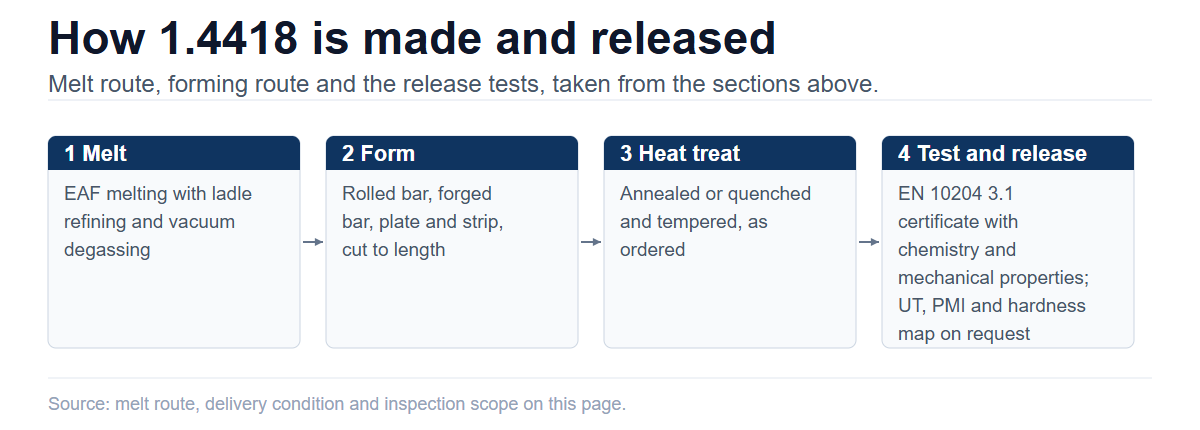
You get chemical composition, mechanical properties and a price — with inspection certificates to EN 10204 3.1 issued against the heat number.
Trade terms and how an order runs
The terms below apply unless the enquiry states otherwise. They are the terms most of our European and North American buyers work to, and they can be adjusted in the quotation.
| Item | Standard terms |
|---|---|
| Incoterms 2020 | FOB Shanghai, Qingdao or Shenzhen; CIF and CFR quoted against the destination port. |
| Payment | T/T 30 % advance with the order, 70 % against the bill of lading copy; irrevocable L/C at sight accepted for orders above 20 t |
| Minimum quantity | One bundle or one plate for stock sizes; mill runs and special sections are quoted individually |
| Lead time | 20–30 days from order confirmation for stock sizes; 30–45 days where forging, heat treatment or machining is included |
| Inspection | EN 10204 3.1 with every lot; third-party inspection (SGS, BV, TUV) arranged on request before dispatch |
| Documents | 3.1 certificate, packing list, commercial invoice, bill of lading, certificate of origin; legalisation or chamber attestation on request |
| Packing | Seaworthy export packing — oiled, wrapped, crated or strapped on skids, marked with grade, heat number, size and net weight |
Frequently asked questions
Large shafts, turbine runners, pump and valve parts and marine hardware — anywhere the part needs 900 MPa strength with better toughness and corrosion resistance than 17-4PH.
Weldability and toughness. Low carbon keeps the martensite soft enough to weld without cracking and keeps impact strength at low temperature; the strength comes from the nickel and molybdenum, not from carbon.
A minimum 900 MPa tensile in the quenched and tempered condition, with the matching proof stress and impact values of EN 10088-3. QT760 is the lower-strength, higher-toughness option.
Yes — this is the grade’s main advantage over 420. Preheat is still required, and the weld should be post-weld heat treated to restore the tempered martensite structure.
Similar strength, better toughness and better corrosion resistance in some acids, but it cannot be age hardened in place. Choose 1.4418 for large sections that must be welded; 17-4PH for small, complex parts.