
20MnCr5 1.7147 SAE 5120 Case Hardening Steel

20MnCr5 DIN1.7147 SAE5120 Case Hardening Steel
1 20MnCr5 Applications
it is a case-hardening steel with low carbon content but good hardenability reaching good wear resistance due to high surface hardness after hardening. The small grain size benefits in good ductility and fatigue strength.
Alloyed case hardening steel for parts with a required core tensile strength of 1000 – 1300 N/mm² and good wearing resistance as boxes, piston bolts, spindles, camshafts, gears, shafts and other mechanical controlling parts.
2 All Grades Comparison:
| DIN | Material No. | AFNOR | SAE | UNI |
|---|---|---|---|---|
| 20MnCr5 | 1.7147 | 20MC | 5120 | 20MnCr5 |
3 20MnCr5 Quality Standard:
BS EN 10084 2008 Case hardening steels
4 20MnCr5 Chemical Composition(%)
| C | Mn | Si | P | S | Cr |
|---|---|---|---|---|---|
| 0.17–0.22 | 1.10–1.40 | 0.40 max | 0.035 max | 0.035 max | 1.00–1.30 |
5 Mechanical Properties( T=20°C if not differently stated )
| Heat treatment state | Diameter(mm) | Rm (Mpa) |
|---|---|---|
| QUENCHED AND TEMPERED | 16 max | 1200 min |
| QUENCHED AND TEMPERED | 16-40 | 1000 min |
| QUENCHED AND TEMPERED | 40-100 | 800 min |
6 HEAT TREATMENT AND HOT PLASTIC DEFORMATION TEMPERATURES
| Process | TEMPERATURE ° C | Cooling Medium |
|---|---|---|
| Forging or hot rolling | 850-1100 | air |
| Normalizing | 840-870 | air |
| Soft Annealing | 650-700 | furnace 217HB max |
| Carburising | 880-980 | / |
| Core hardening | 860-900 | oil |
| Intermediate annealing | 650-700 | / |
| Case hardening | 780-820 | oil |
| Tempering | 150-200 | / |
Why 20MnCr5 rather than 16MnCr5
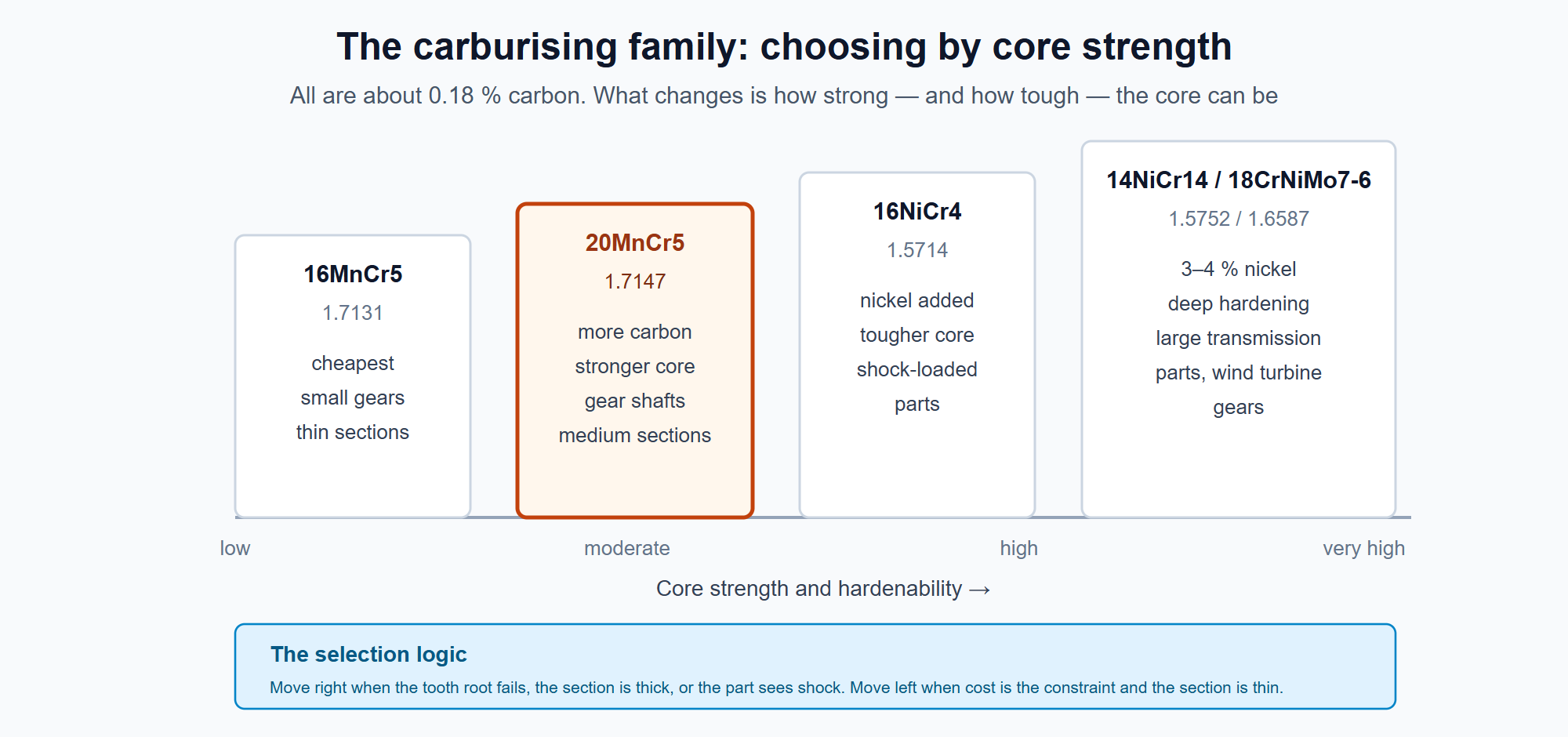
Both are case-hardening steels at about 0.2 % carbon, and on a drawing they look interchangeable. The difference is carbon and manganese: 20MnCr5 carries slightly more of both, so the core hardens to a higher strength after the same quench.
That matters when the tooth root is the failure mode. A gear that pits is a surface problem and 16MnCr5 will do; a gear that breaks at the root is a core strength problem, and 20MnCr5 is the cheaper answer than moving to a nickel grade.
Case and core are specified separately
The case depth follows the module (roughly 0.15–0.20 × module), and the core hardness follows the steel and the quench. A common mistake is to specify the surface hardness and the case depth and leave the core to chance — the core is what carries the bending load.
For 20MnCr5, typical practice is carburise at 900–930 °C, quench, temper at 150–200 °C, giving 58–62 HRC at the surface and roughly 30–40 HRC in the core depending on section.
When to move further right
If the part is large in section, the core of 20MnCr5 will not harden through, and the answer is a nickel grade — 16NiCr4 for toughness, 14NiCr14 or 18CrNiMo7-6 for thick sections. If the part sees shock load rather than steady torque, nickel is again the reason to move.