
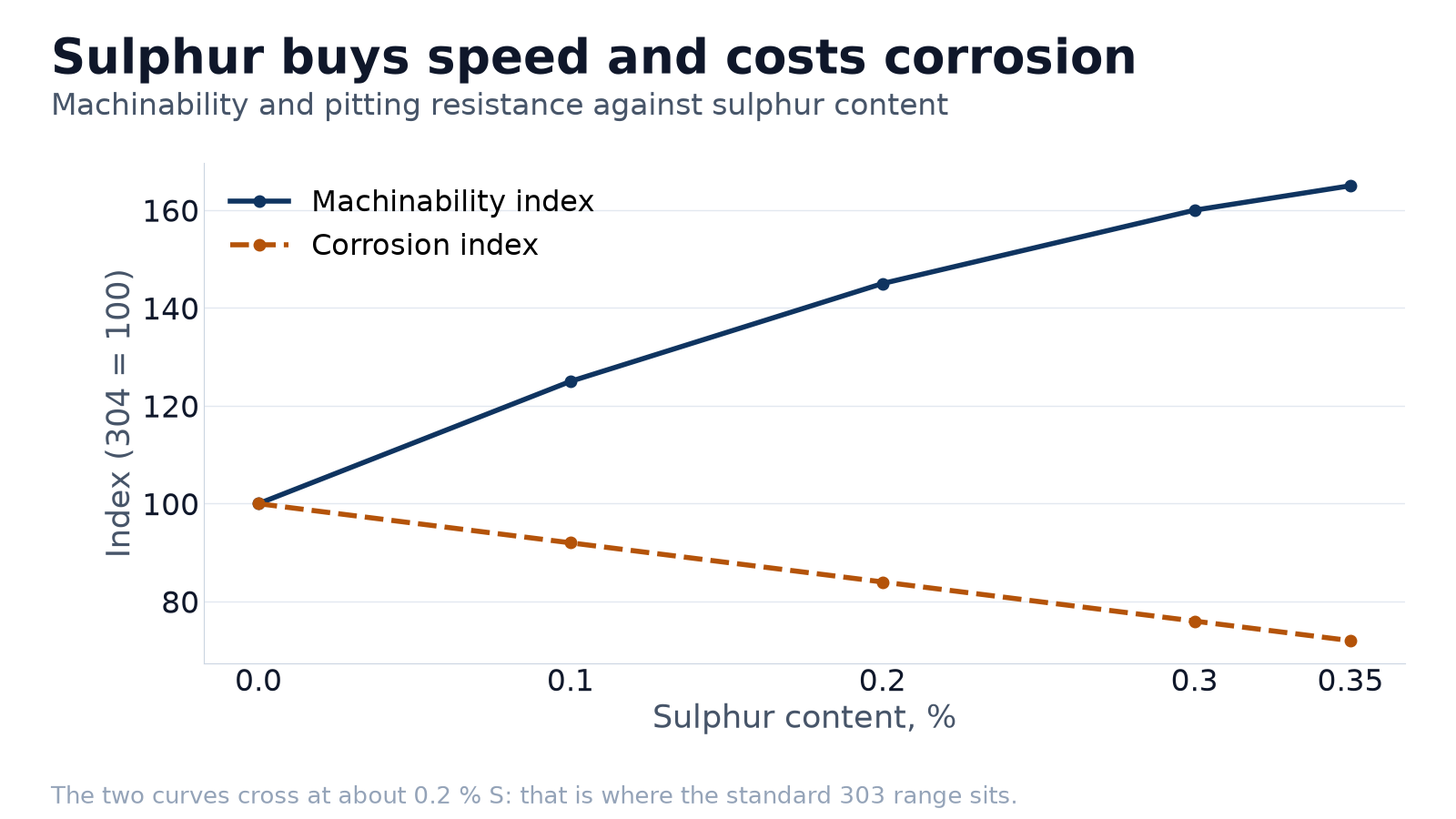
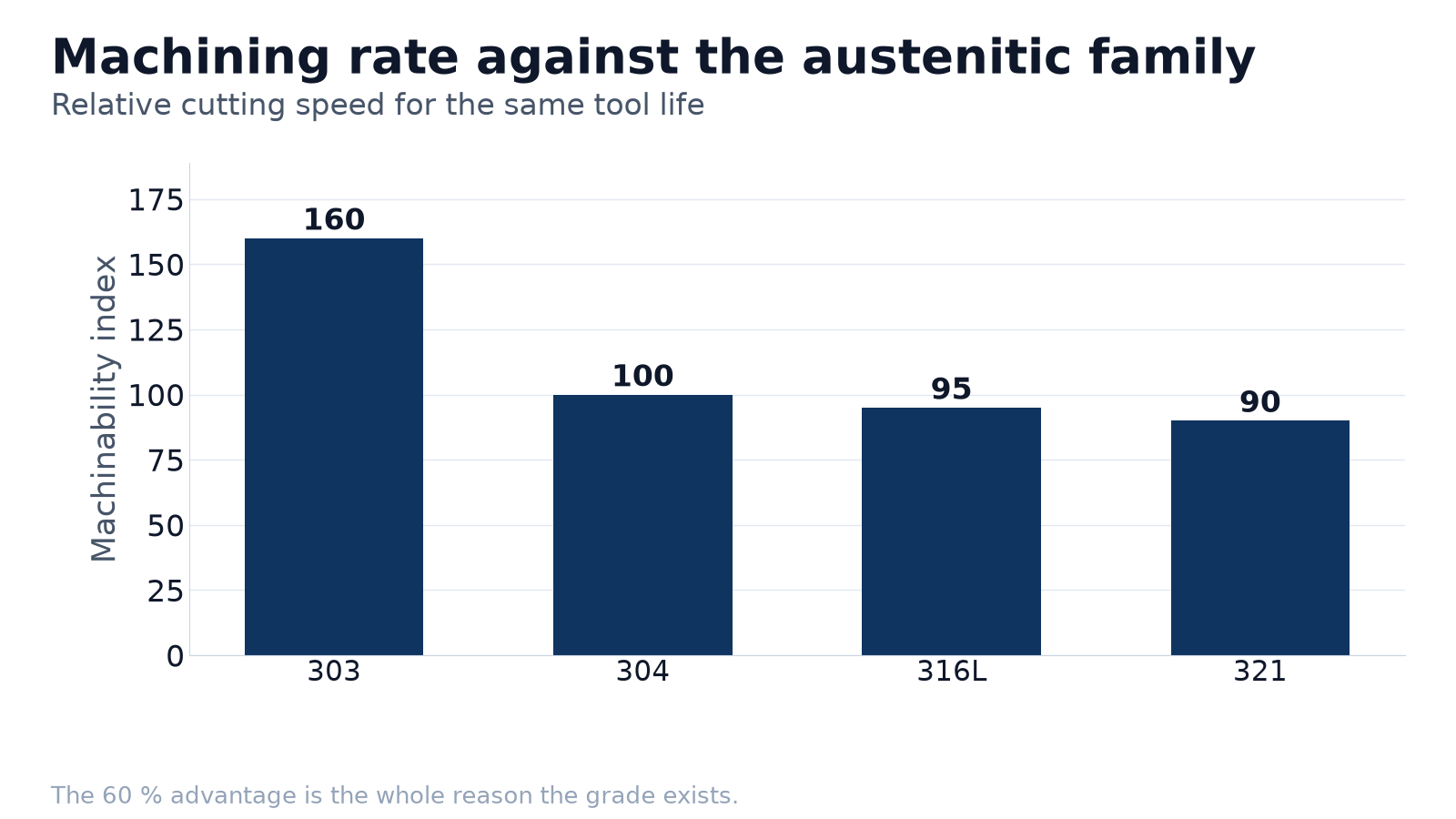
303 is 304 with sulphur added — 0.15–0.35 % — and that sulphur is what makes it machine at 1.6 times the speed of 304. It is the grade for fittings, shafts, nuts and valve parts that are turned in volume and do not see chloride service, because the same sulphur that lubricates the chip also starts a corrosion pit.
Where 303 Fails — and Why
The grade exists because stainless is sticky. Austenitic stainless work-hardens under the tool and forms a built-up edge, which limits cutting speed and surface finish. Sulphur forms manganese sulphide inclusions that act as chip breakers, and the result is a free-cutting steel that machines like a low-alloy steel at 1.5–1.8 times the speed of 304.
The cost is corrosion resistance and weldability. The sulphide inclusions are sites for pitting, so 303 is not used in chloride or wet service; and the sulphur makes the weld crack, so welded assemblies use 304 or 316L and machine the 303 parts separately. Where both are needed, the design is a 303 part screwed or bolted to a 304 weldment.
303 is chosen for corrosion resistance, toughness and weldability rather than for strength. It keeps a stable austenitic structure at room temperature, so it does not harden by quenching and it stays ductile down to cryogenic temperatures.
Chromium builds the passive film, nickel stabilises the austenite, and molybdenum — where present — raises resistance to chloride pitting. That is why the grade is specified by analysis rather than by one mechanical number: two heats with the same tensile can behave very differently in a chloride line.
Fabrication is where the grade earns its place. It welds without preheat, forms readily and can be supplied annealed and pickled or in a 2B finish. The limits are chloride stress corrosion above about 60 °C and sensitisation if the steel is held in the 450–850 °C range after welding.
- Specifying by tensile strength alone; corrosion resistance is set by chromium, molybdenum and nitrogen, not by the Rm on the certificate.
- Welding without purging or pickling the weld zone; the heat tint is a chromium-depleted film and it is where corrosion starts.
- Using an austenitic grade in warm chloride service; stress corrosion cracking appears above 60 °C, often with no visible loss of section.
- Forgetting that cold work makes the steel slightly magnetic and raises its strength — a formed part is not the annealed plate.
How 303 Compares
The three have almost the same tensile; the difference is in the chip and in the pit. That is why 303 is specified by the machining operation rather than by the mechanical requirement.
Table 1 — 303 against 304 and 316L
| Property | 303 | 304 | 316L |
|---|---|---|---|
| Machinability index | 160 | 100 | 95 |
| PREN | ≈19 | ≈19 | ≈25 |
| Weldability | Poor (hot cracking) | Excellent | Excellent |
| Tensile, annealed | 500–700 MPa | ≥515 MPa | ≥485 MPa |
| Typical use | Fittings, shafts, nuts | General fabrication | Chloride service |
Supply Range and Delivery Condition
Supply is quoted by form and finish. Plate, bar, wire and tube carry different tolerances and different test schedules under the same grade name.
Table 2 — Supply range by form, size and delivery condition
| Form | Size range | Delivery condition |
|---|---|---|
| Round bar | Ø 3–300 mm | Annealed, peeled or ground |
| Hexagon bar | 6–70 mm | Annealed |
| Flat bar | 3–60 × 10–150 mm | Annealed |
| Wire | Ø 1.0–12 mm | Annealed or cold drawn |
Bar for automatic lathes is supplied in straight lengths with a controlled diameter tolerance (h9–h11) and a ground or peeled surface, because the bar has to feed through the guide bush without marking.
Chemical Composition
Nickel and chromium are balanced to hold a fully austenitic structure; the residuals are capped because sulphur and phosphorus Embrittle the weld zone.
Table 3 — Chemical composition, wt. % (single values are maximums unless stated)
| Element | Min | Max | Typical |
|---|---|---|---|
| C | — | 0.10 | 0.05 |
| Si | — | 1.00 | 0.50 |
| Mn | — | 2.00 | 1.50 |
| P | — | 0.20 | 0.030 |
| S | 0.15 | 0.35 | 0.25 |
| Cr | 17.0 | 19.0 | 18.0 |
| Ni | 8.0 | 10.0 | 9.0 |
| Mo | — | 0.60 | 0.30 |
Mechanical Properties
Austenitic grades are not strengthened by heat treatment. The numbers in the table are for the annealed condition; cold-worked material is stronger and less ductile.
Table 4 — Mechanical properties by condition
| Condition | Rp0.2 (MPa) | Rm (MPa) | A (%) | KV2 (J) | HB |
|---|---|---|---|---|---|
| Annealed | ≥190 | 500–700 | ≥35 | — | ≤262 |
| Cold drawn | ≥450 | 700–850 | ≥20 | — | — |
Heat Treatment
There is no hardening cycle. The only thermal treatment is solution annealing after cold work or welding, followed by rapid cooling through the sensitisation range.
Table 5 — Heat treatment schedule
| Step | Temperature | Time / atmosphere | Cooling |
|---|---|---|---|
| Solution annealing | 1,040–1,120 °C | 30 min per 25 mm | Water |
| Stress relief after machining | 350–400 °C | 2 h | Air |
Equivalent Grades and Standards
The UNS number fixes the analysis; the EN designation may allow a slightly different nickel or molybdenum range. For nuclear or pharmaceutical service, the tighter of the two governs.
Table 6 — Equivalent grades and governing standards
| System | Designation |
|---|---|
| UNS | S30300 |
| EN | 1.4305 / X8CrNiS18-9 |
| AISI / SAE | 303 |
| JIS | SUS303 |
| BS | 303S31 |
| GB | Y1Cr18Ni9 |
What Ships With Every Lot
- EN 10204 3.1 mill certificate with chemistry and mechanical properties, heat number and melt route.
- Hardness survey and dimensional report on every piece on request.
- Ultrasonic inspection to ASTM A388 or SEP 1921 where the section or the application calls for it.
- Third-party inspection — SGS, BV, TUV — arranged before dispatch, at the customer’s instruction.
- Spectro check on the finished part where a weld or a heat treatment has been added after despatch.
Machining, Welding and Surface Finish
This is the grade that machines best in the austenitic family: 1.5–1.8 times the cutting speed of 304, with a chip that breaks instead of snarling. It is the default for Swiss-type and automatic lathes.
Welding is not recommended. The sulphur causes hot cracking in the weld and the heat-affected zone; a welded assembly should use 304 or 316L, with the free-machining parts threaded or bolted on.
Packing, MOQ and Delivery Terms
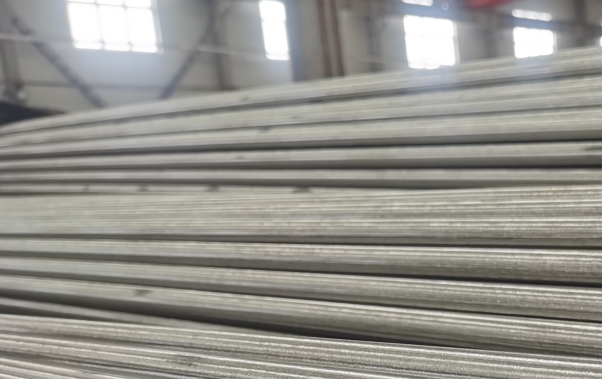
Bars are supplied in 3–4 m lengths, bundled and strapped, with the heat number and the surface condition on the tag. Ground bar is protected with a sleeve.
Table 7 — Trade terms, packing and documents
| Item | Standard terms |
|---|---|
| Trade terms | FOB Shanghai / CIF / CFR / EXW; FOB is the default. |
| Minimum order | One bundle, plate or coil for stock sizes; mill runs quoted individually. |
| Lead time | 20–30 days from order confirmation for stock sizes; 30–45 days where forging or heat treatment is included. |
| Payment | 30 % T/T deposit, 70 % against the bill of lading copy; L/C at sight above 20 t. |
| Packing | Seaworthy export packing — crated or strapped, marked with grade, heat number, size and net weight. |
| Documents | EN 10204 3.1 certificate, packing list, invoice, bill of lading, certificate of origin; legalisation on request. |
Frequently Asked Questions
Is 303 the same as 304?
Chemically it is 304 with sulphur added. The sulphur improves machinability and reduces corrosion resistance and weldability.
Can 303 be welded?
No, not for a functional weld. The sulphur causes hot cracking; use 304 or 316L for the weldment.
Is 303 suitable for marine service?
No. The sulphide inclusions pit in chloride; 316L or a duplex is the right choice.
What is the machining advantage?
About 1.6 times the cutting speed of 304, with a broken chip and a better surface finish.
Do you supply ground bar?
Yes, h9 to h11, peeled or centreless ground, for automatic lathes.
Related Grades
Browse the full range: stainless steel grades.
Request a Quote
- Grade and governing standard
- Form, size and quantity
- Delivery condition and hardness
- Certificate and testing requirements
- Destination port and required date
Email [email protected] or use the form below. Drawings in DXF, STEP or PDF are all fine. Stock sizes ship within 20 days of order confirmation.