
How to Remove Rust from Metal: 5 Methods That Actually Work
Five household removal methods ranked by what they do to the base metal, the three rust grades that decide whether removal is even worth it, and the point at which a rusty part should be replaced rather than cleaned.
Rust is not dirt sitting on top of steel. It is what is left of the steel after the surface has already converted to iron oxide — a volume expansion of roughly two to one, a flaky layer that holds moisture against the metal underneath, and a reaction that keeps going as long as oxygen and water are both present. That single fact explains why some cleaning methods work and others only appear to.
It also explains why the right method depends on the grade. A kitchen knife in 420 stainless, a cast-iron pan, a galvanised bracket and a 4140 shaft that sat outdoors for a season are four different problems. The five methods below cover the domestic end of that range well. Beyond a certain depth of attack they stop being economical, and the honest answer is either a mechanical process or a new part.
Why Steel Rusts, in One Paragraph
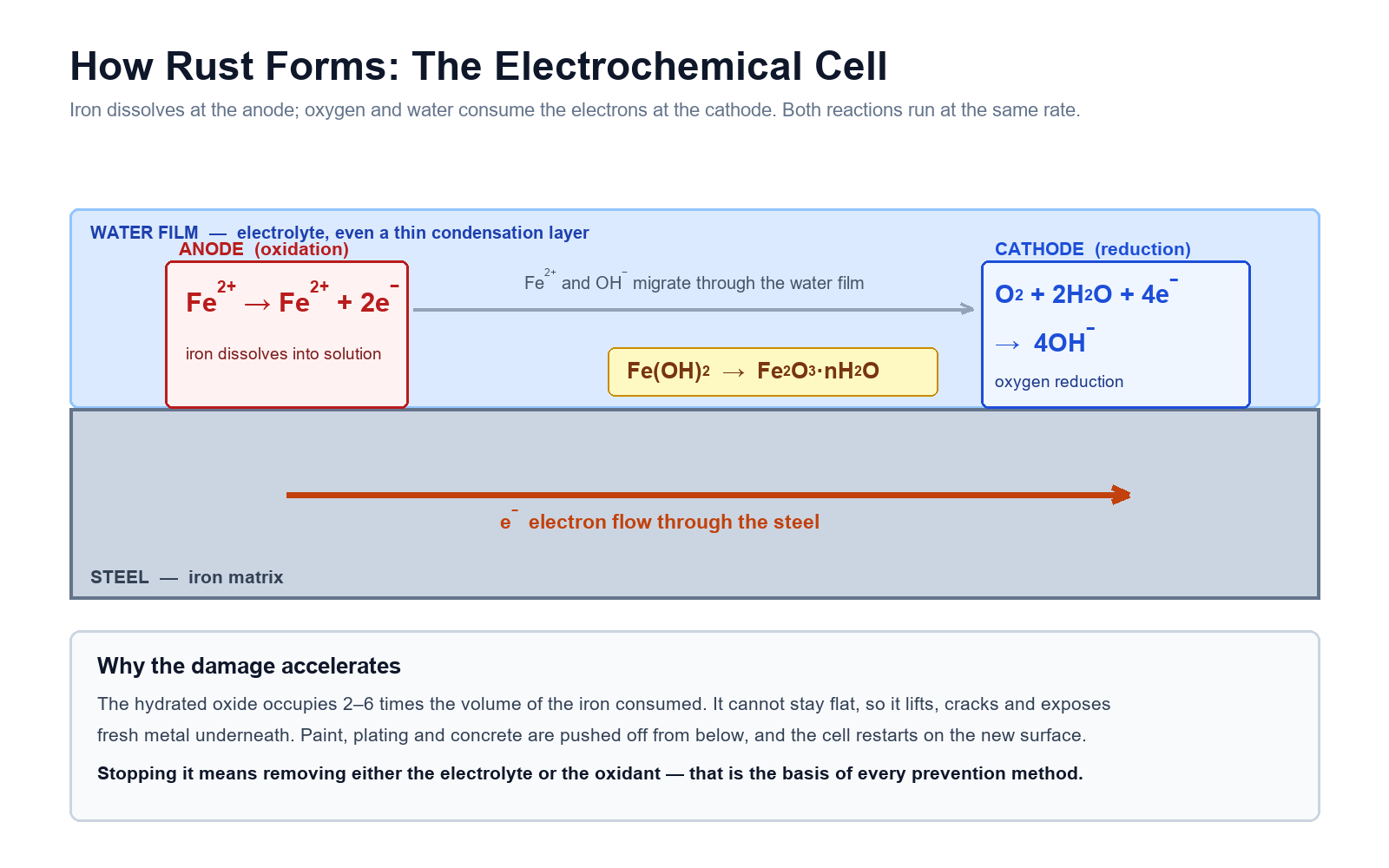
Iron is thermodynamically unstable in the presence of oxygen and water, and rusting is the process by which it returns to a lower-energy state. At the anode, iron gives up electrons and enters solution as Fe2+. At the cathode, dissolved oxygen consumes those electrons in the presence of water. The two half-reactions have to occur at the same rate, which is why rust needs both an electrolyte (water, even a thin condensation film) and an oxidant (air). Remove either one and the reaction stops — the entire logic of rust prevention sits in that sentence.
The first product, iron(II) hydroxide, is not stable in air. It oxidises further into hydrated iron(III) oxide, the reddish-brown material most people call rust, and into iron(III) oxide-hydroxide, which is the darker, tighter layer that forms in sheltered conditions. Neither is protective. Unlike the chromium oxide film on stainless steel, iron oxide is porous and more voluminous than the metal it replaced, so it cracks, lifts and exposes fresh iron to the same cycle.
First, Grade the Rust: Three Levels, Three Different Answers
Before choosing a method, decide what you are looking at. The distinction is not cosmetic. Surface rust is a removal job; pitting is a removal job with a thickness check afterwards; exfoliating rust means the section has already been reduced and the part may no longer be fit for purpose.
| Grade | What it looks like | Metal lost | Treatment |
|---|---|---|---|
| Surface rust | Uniform orange-brown discolouration, wipes off on a cloth, metal underneath still bright | < 10 µm | Any of the five methods below; no dimensional consequence |
| Pitting | Discrete dark craters, rough to the fingernail, often under paint blisters or at weld toes | 0.05–1 mm, locally deeper | Acid or chelant removal, then measure remaining wall; grind out if depth exceeds allowance |
| Exfoliating / scale | Layered flakes, laminated edges, sections visibly thinner, holes through sheet | 0.2–2 mm and continuing | Mechanical blasting and thickness survey; replace if below minimum wall |
Table 1 — Rust grades and the decision each one drives. Depth values are indicative; the acceptance limit always comes from the applicable standard or drawing.
The Five Methods at a Glance
All five rely on the same chemistry: an acid or a chelating agent converts insoluble iron oxide into a soluble iron salt that can be rinsed away, or a mild abrasive lifts it mechanically. They differ in strength, contact time, and how much they attack the healthy metal underneath.
| Method | Active agent | Contact time | Best for | Risk to base metal |
|---|---|---|---|---|
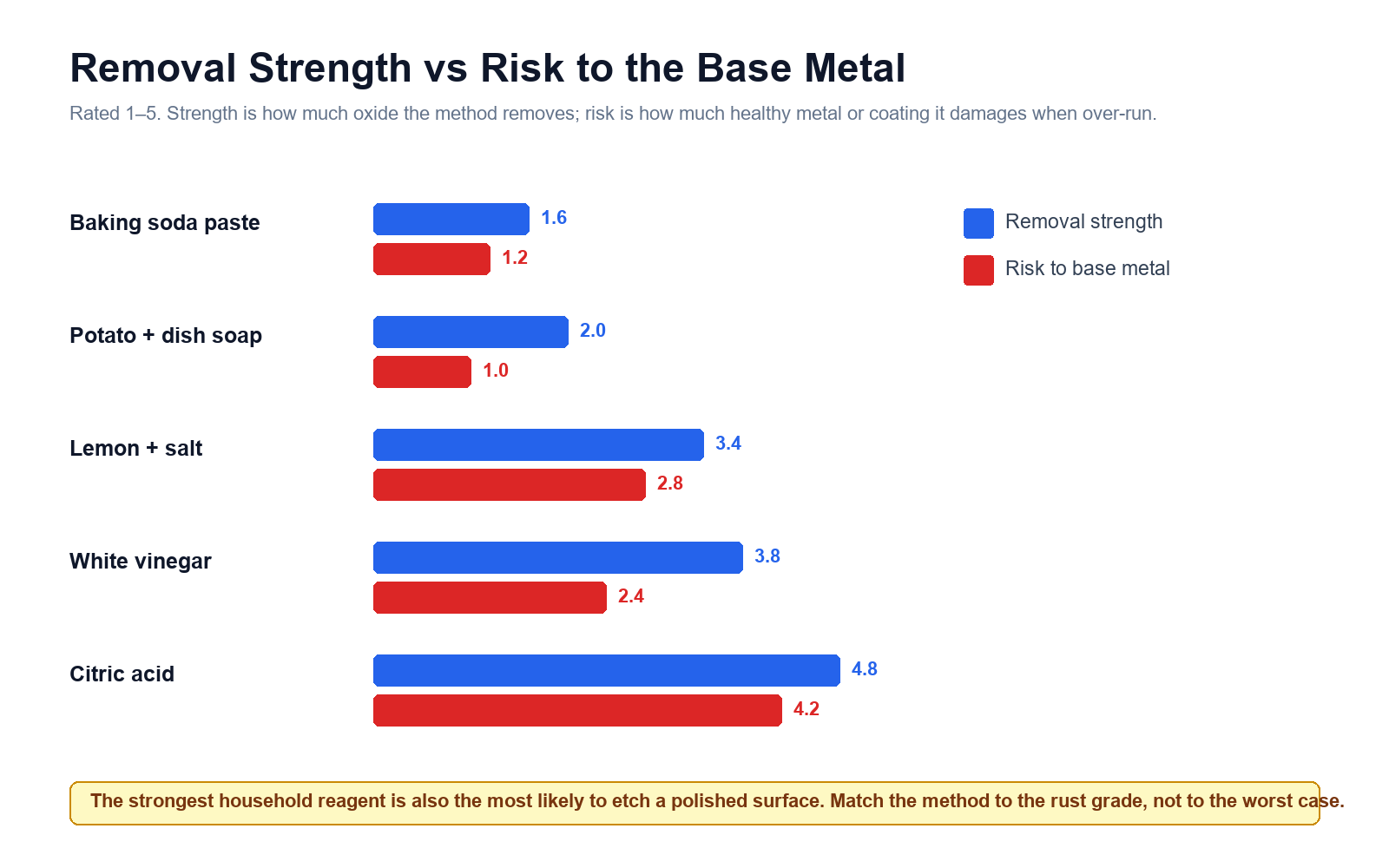
| White vinegar | 5 % acetic acid | 8–24 h soak | Fully submerged small parts, hand tools, bolts | Low; can dull polished finishes and attack zinc plating |
| Potato + dish soap | Oxalic acid in potato flesh, surfactant | 2–5 min scrub | Light film rust on flat, reachable surfaces | Very low; abrasive action is minimal |
| Lemon + salt | Citric acid, chloride-assisted | 30–120 min | Knives, cutlery, small stains on sheet | Moderate; salt promotes pitting if left on stainless |
| Baking soda | Sodium bicarbonate, mild abrasive | 30–60 min paste | Pans, thin sheet, decorative parts | Low; will not remove heavy scale |
| Citric acid | 5–10 % solution, 60–80 °C | 2–12 h | Tools, larger parts, parts with complex geometry | Moderate; strips paint and zinc, etches if over-run |
Table 2 — The five household methods compared. Contact times assume ambient temperature unless stated.
1. White Vinegar Bath
Acetic acid at household concentration is a weak acid, which is exactly why it is safe on steel. It attacks the hydrated oxide preferentially and leaves the underlying metal largely intact, provided the soak does not run for days. It is the default choice for anything that can be fully submerged and forgotten overnight.
Method: submerge the part completely in undiluted white vinegar and leave it 8–24 hours, depending on rust thickness. Lift it out, scrub with a wire brush or steel wool, then rinse in clean water and dry immediately — flash rust appears within minutes on a wet, bare surface. For parts too large to submerge, soak a rag in vinegar and wrap it around the affected area, re-wetting every few hours.
What goes wrong: vinegar attacks zinc, so galvanised hardware should not be soaked. It also dulls polished or brushed finishes, and on high-carbon steel a long soak can leave a grey smut that has to be polished out. Do not use it on aluminium or on anything with a painted or powder-coated surface you intend to keep.
2. Potato and Dish Soap
The potato method sounds like folklore and works for a defensible reason: potato flesh contains oxalic acid, which forms soluble iron oxalate with rust, and the cut surface acts as a mild abrasive carrier. Dish soap supplies the surfactant that lifts the loosened oxide so it does not simply re-deposit.
Method: cut a potato in half, score the cut face lightly, and press it into dish soap. Work the face over the rusted area in small circles, re-loading with soap as needed. Expect two to five minutes for a light film. Rinse and dry.
Where it fits: this is a light-film method. It will not touch pitting, and it is not worth the effort on anything larger than a hand tool. Its real advantage is that it introduces no chloride and no strong acid to a polished surface, so it is a reasonable first attempt on decorative stainless before moving to something more aggressive.
3. Lemon and Salt
Citric acid from the fruit does the chelating; the salt adds chloride, which accelerates the attack on the oxide but also raises the risk of initiating pits on stainless steel. That trade-off is why this method is fast and effective on carbon steel knives and marginal on 304 or 316.
Method: coat the rusted area with a layer of table salt, squeeze lemon or lime juice over it, and leave 30–120 minutes. Scrub with the fruit rind, re-applying salt and juice until the discolouration lifts, then rinse thoroughly and dry. Rinse longer than feels necessary — residual chloride left in a crevice is the starting condition for pitting corrosion.
What goes wrong: leaving the paste on overnight, especially on stainless, is a bad idea. Chloride concentrates as the liquid evaporates and can produce a ring of pits that is far more damaging than the rust you started with. Keep it under two hours and rinse with plenty of water.
4. Baking Soda Paste
Sodium bicarbonate is a mild alkali, not an acid, so it does not dissolve rust chemically to any useful degree. What it does is provide a fine, friable abrasive in a paste that stays where you put it. On thin sheet and cooking pans, that is often enough — and it is far gentler than steel wool.
Method: mix three parts baking soda to one part water to a thick paste, spread it over the rusted area, and leave 30–60 minutes. Scrub with a nylon pad or an old toothbrush, rinse, and dry. For heavier areas, add a drop of dish soap to the paste to help the oxide stay in suspension.
Where it fits: cast-iron pans, baking trays, thin decorative sheet, and any surface where you cannot afford to remove material. It is the weakest of the five, and on anything beyond surface film it will simply polish the rust rather than remove it.
5. Citric Acid
Citric acid is the strongest household option and the closest to an industrial process. It chelates iron ions, forming a soluble complex that lifts the oxide off the surface without the hydrogen embrittlement risk that comes with strong mineral acids. Warm solution works several times faster than cold.
Method: dissolve two to three tablespoons of citric acid powder per litre of hot water (60–80 °C), immerse the part fully, and leave 2–12 hours depending on scale thickness. Check every hour after the second — the moment the oxide is gone, the acid starts working on the base metal. Scrub any remaining patches with a brush, rinse, and dry immediately.
What goes wrong: citric acid strips paint, zinc and cadmium plating, and it will etch a polished surface if left too long. It also removes the passivation layer on stainless steel, so any stainless part treated this way should be re-passivated afterwards — a topic covered in our stainless steel surface finish guide.
Which Method Suits Which Metal
The same method behaves differently across base metals, and two of the five can do real damage if applied to the wrong one. The table below is the short version of that mapping.
| Base metal | Safe methods | Avoid | Reason |
|---|---|---|---|
| Carbon steel | All five; citric acid for heavy scale | Long soaks without re-oiling | Flash rust returns within minutes |
| Stainless steel 304 / 316 | Vinegar, citric acid, baking soda | Lemon and salt | Chloride from salt initiates pitting |
| Cast iron | Baking soda, vinegar, mechanical | Prolonged acid soak | Graphite flakes leave an acid path into the matrix |
| Galvanised steel | Baking soda, light mechanical | Vinegar and citric acid | Both dissolve the zinc layer that protects the steel |
| Aluminium | Mechanical only; no acid | Vinegar, citric acid, lemon | Acid attacks the metal itself, not just the oxide |
Table 3 — Method suitability by base metal. The two exclusions that matter most are chloride on stainless and acid on galvanised or aluminium.
Mechanical and Industrial Removal: Where Household Methods Stop
The five methods above are surface treatments. Once rust has formed a laminated scale, or has pit depths measured in tenths of a millimetre, chemical removal in a bucket stops being practical and the process moves to mechanical means.
Wire brushing and abrasive paper remove the oxide but cannot reach into pits, and they leave abrasive residue embedded in the surface that becomes a corrosion initiation site if not cleaned out. Grit blasting to Sa 2½ is the standard preparation before coating and is the only method that reliably cleans a pitted surface; it also introduces a profile that improves coating adhesion. Pickling — nitric–hydrofluoric acid for stainless, hydrochloric or sulphuric for carbon steel — removes mill scale and heat tint at production scale, and is followed by passivation on stainless. Electrolytic derusting, with the part as the cathode in a sodium carbonate bath, is the shop-floor method for precision parts because it removes oxide without removing base metal.
The choice between them is driven by what happens next. If the part is going back into service bare, mechanical cleaning followed by immediate protection is enough. If it is going for painting, blasting to the specified Sa grade is not optional — a coating applied over residual oxide will fail from underneath within a season.
How to Keep It From Coming Back
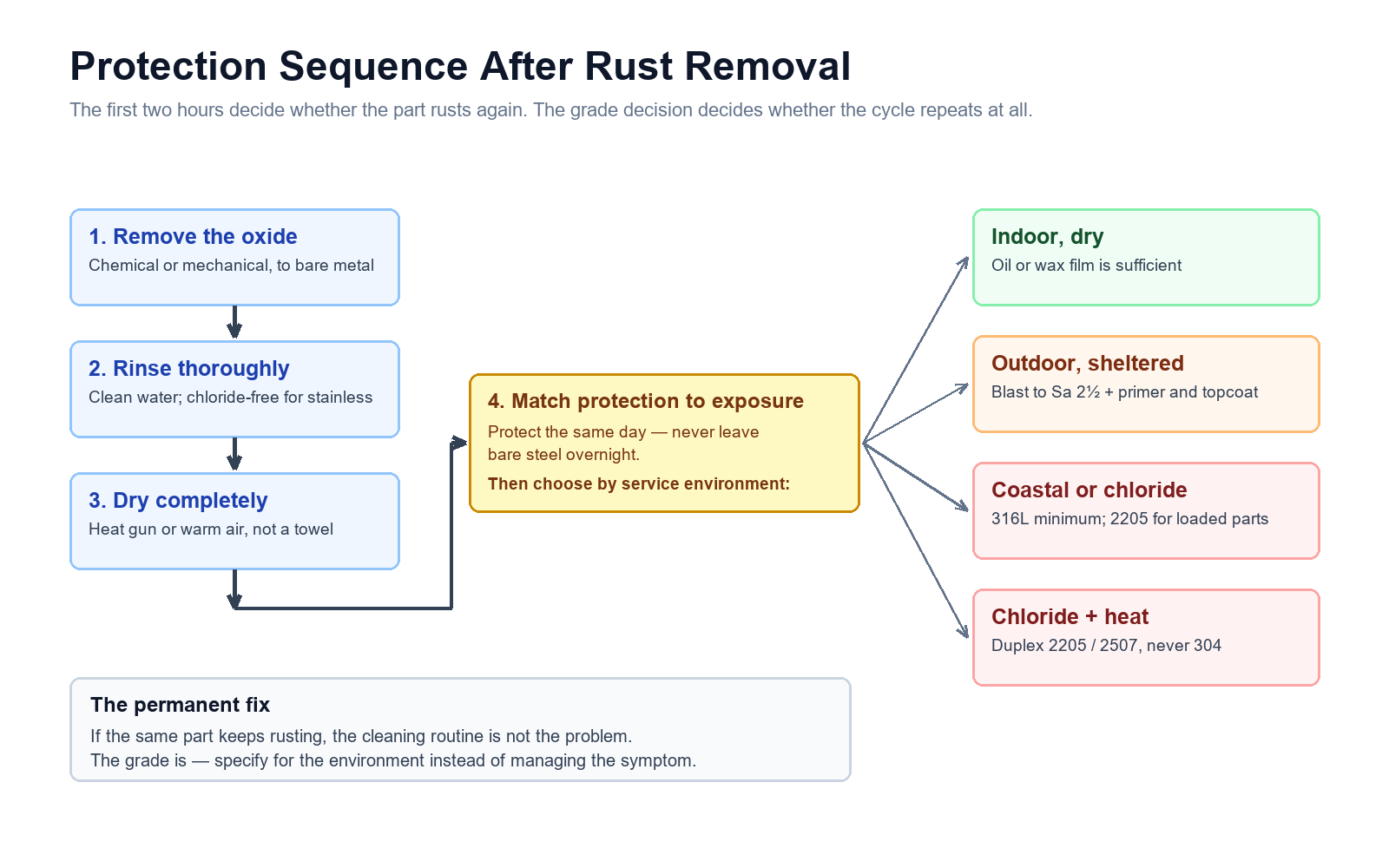
Every removal method ends with the same vulnerability: a clean, oxide-free, microscopically rough surface that is more reactive than the one you started with. Flash rust on a bare steel surface appears in humid air within minutes. Protection has to be applied before that happens, not the next day.
Dry first, then protect. A heat gun or a lint-free cloth followed by ten minutes in warm air is more effective than a towel, because residual water sits in pits and crevices that a cloth cannot reach. For shop use, a water-displacing oil applied immediately after drying covers the interval before the next operation. For long-term protection, the options in order of durability are: oil or wax film for indoor parts, zinc or phosphate conversion coating for parts that will be handled, and paint or powder coating over a blasted surface for outdoor service.
Material choice is the more permanent answer, and it is where most household advice stops short. A stainless grade selection based on the actual service environment — 304 for inland indoor, 316L for coastal or chloride exposure, a duplex grade for chloride plus mechanical load — removes the problem rather than managing it. In marine atmospheres, 304 pitting is routine and 316L is the minimum; at elevated chloride and temperature, 2205 or 2507 is the honest starting point.
When Rust Means Replace, Not Repair
For a decorative bracket or a garden tool, the answer is always to clean it. For a structural or pressure-containing part, the answer depends on how much section is left, and that is a measurement rather than a judgement.
Three conditions justify replacement. Wall loss beyond allowance: ultrasonic thickness readings below the minimum wall in the applicable code, or below 87.5 % of nominal for a typical piping allowance. Pitting deeper than the corrosion allowance: a pit is a stress raiser as well as a thickness loss, and at the toe of a weld it is a fatigue crack initiation site. Intergranular or exfoliating attack: where the oxide layer is laminated and the metal beneath is delaminating, the remaining section is not what the caliper says. Parts that have been hot-formed or welded and then rusted in a chloride environment belong in this category more often than expected.
The same logic applies in reverse to specification. If a part rusted in service faster than expected, the useful question is not which removal method to use next time but whether the grade was correct for the environment. Our failure analysis notes on sudden metal breakage set out how corrosion-initiated failures are distinguished from overload and fatigue.
Frequently Asked Questions
Does vinegar damage steel? At household concentration and for soak times under 24 hours, no — it attacks the oxide far faster than the base metal. Beyond that, high-carbon steels can develop surface smut and polished finishes dull.
Can I use these methods on stainless steel? Vinegar and citric acid are acceptable if rinsed thoroughly. Avoid the salt method on stainless, and re-passivate any part that has been pickled or heavily etched.
Why does rust come back within days? Because removal leaves a clean, rough, oxide-free surface and no protection. Dry it fully and oil, paint or passivate it the same day.
Is rusted rebar still usable? Light surface rust on rebar is acceptable and even improves bond. Flaking scale, or section loss visible as a reduced rib profile, is not — the bar should be rejected on dimensional grounds.
What We Supply
Fushun Special Steel supplies stainless steel, tool steel, alloy steel and nickel alloys in bar, plate, sheet and strip, with mill certificates and third-party inspection on request. If a corrosion problem keeps returning, the practical fix is usually in the grade and the surface condition rather than in the cleaning routine — send us the service environment and the failed part, and we will propose a specification that removes the failure mode instead of managing it. Our tool steel range and guide to ferrous metals are useful starting points if the grade itself is the open question.
You get chemical composition, mechanical properties and a price — with inspection certificates to EN 10204 3.1 issued against the heat number.