
K438 Master Alloy for Gas Turbine Blades and Vanes
Built for sulphur and vanadium, not for the highest number on the data sheet. K438 carries 15.7–16.3 % chromium with tungsten, tantalum and niobium, which is why it survives the contaminated fuels and marine air that eat a higher-strength blade in a few thousand hours. We supply ingot and Ø30–250 mm bar, VIM+ESR, with sulphur held to 0.003 % where the specification asks for it.
At a glance
| Item | K438 master alloy |
|---|---|
| Designation | K438 (former K38) · IN-738LC class · UNS N07738 · ЭП741 |
| Form | Cast ingot; round bar Ø30–250 mm; cut-to-length |
| Condition | As cast, shot blasted, turned or ground |
| Melting route | VIM+ESR as standard; VIM+ESR+VAR on request |
| Standards | GB/T 14992 · GJB 5512.1 · AMS 2280 · ASTM B814 |
| Certificate | EN 10204 3.1 with chemistry, gas, trace elements and sulphur |
The grade is chosen for one reason: it keeps its section in a dirty environment. Everything else on this page follows from that — the chromium level, the sulphur limit, the ESR route and the way acceptance is run.
Where the grade belongs, and where it does not
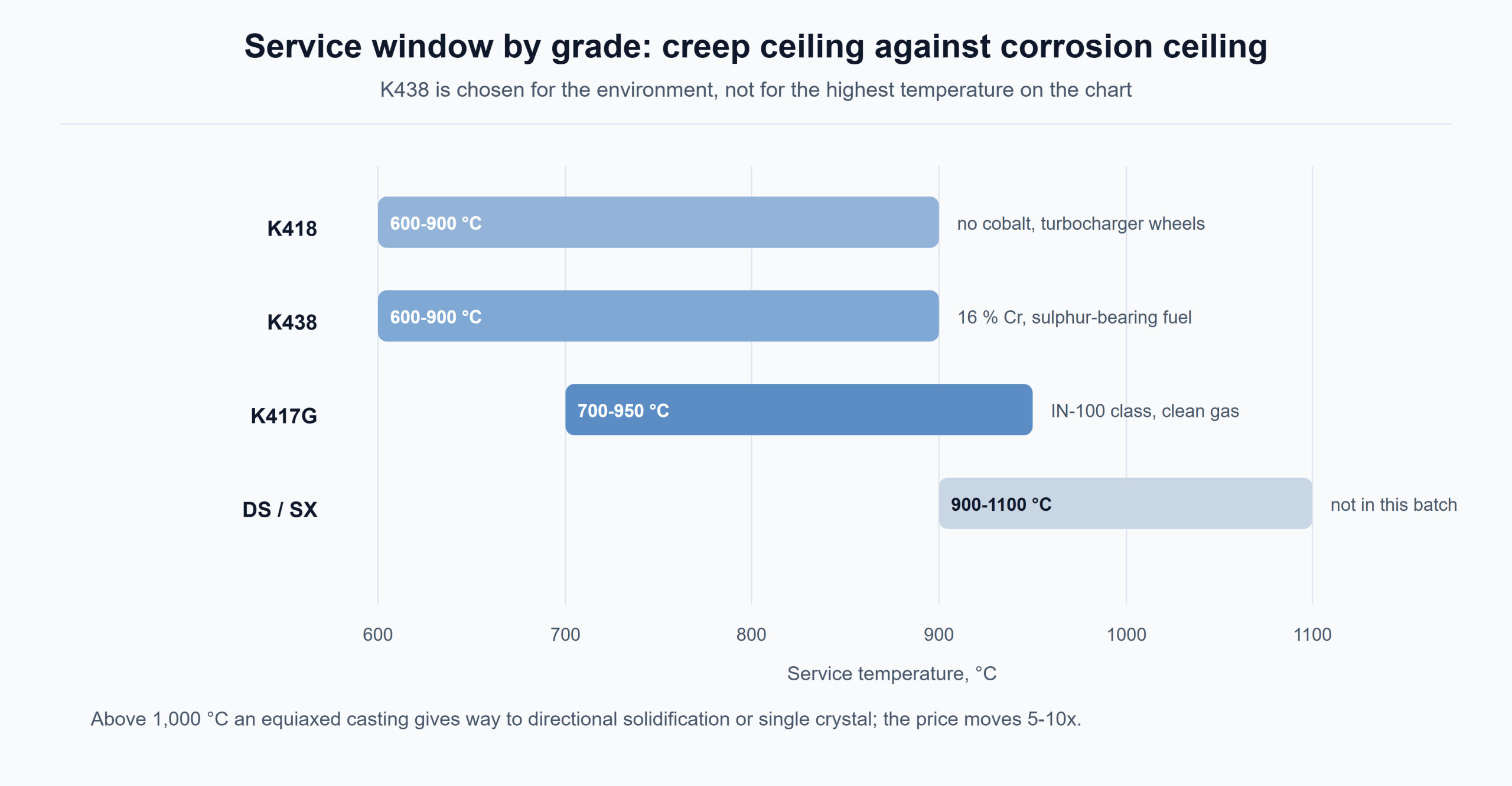
We are asked for K438 most often by gas turbine blade and vane suppliers, and second most often by companies who actually need K417G. The difference is the fuel. K417G is the stronger alloy at 900–950 °C and it is the right answer for clean gas. Put the same blade into a heavy-fuel machine, or onto an offshore platform where the air carries salt, and the chromium level is too low: the sulphidation front moves in from the surface and the blade fails long before its stress-rupture life is used up.
That is not a small correction. A K417 blade run on heavy fuel can lose most of its life, and the failure is not visible in the mechanical test data the buyer approved. It is visible in the deposit analysis and in the metallography of the coating interface. If the fuel specification is not on the enquiry, the first question we ask is what is being burned.
Supply forms and sizes
| Form | Size | Length | Tolerance | Surface | Fits |
|---|---|---|---|---|---|
| Ingot | 5 / 10 / 25 kg | — | Per mould | As cast, blasted | Small crucibles, single castings |
| Round bar | Ø30–250 mm | 200–1,400 mm | ±1 mm dia., ±10 mm length | Black, turned, ground | Blade and vane castings |
| Cut-to-length | From bar | 200–700 mm | ±1 mm | Turned | One charge, one heat |
Charging practice decides the size more often than the casting does: a crucible is filled to 60–80 % of its capacity, so a 50 kg furnace takes a 25–30 kg bar. For thick-section vanes we recommend the larger bar and a cut-to-length piece rather than a stack of small ingots, because every additional piece is another surface carrying oxide into the melt.
Chemical composition
| Element, % | K438 (GB/T 14992) | IN-738LC (typical) |
|---|---|---|
| C | 0.10–0.20 | 0.09–0.13 |
| Cr | 15.7–16.3 | 15.7–16.3 |
| Co | 8.0–9.0 | 8.0–9.0 |
| W | 2.4–2.8 | 2.4–2.8 |
| Mo | 1.5–2.0 | 1.5–2.0 |
| Al | 3.2–3.7 | 3.2–3.7 |
| Ti | 3.0–3.5 | 3.2–3.7 |
| Nb | 0.6–1.1 | 0.6–1.1 |
| Ta | 1.5–2.0 | 1.5–2.0 |
| B | 0.005–0.015 | 0.005–0.015 |
| Zr | 0.05–0.15 | 0.03–0.08 |
| Fe / Si / Mn | ≤0.5 / ≤0.3 / ≤0.2 | ≤0.5 / ≤0.3 / ≤0.2 |
| P / S | ≤0.015 / ≤0.015 | ≤0.015 / ≤0.015 |
Two differences matter when a customer crosses from the Chinese designation to the American one. Carbon: the GB window runs to 0.20 % while the low-carbon 738 grade sits at 0.09–0.13 %, and carbon at the top of the window thickens the grain-boundary carbide network. Titanium: 3.0–3.5 % against 3.2–3.7 % changes the γ′ fraction slightly and the freezing range noticeably. Neither is a reason to refuse a heat; both are reasons to write the actual aim values into the order rather than the grade name.
Gas content, sulphur and inclusions
| Item | Aerospace / IGT grade | Industrial grade |
|---|---|---|
| Oxygen | ≤15 ppm (10 ppm on request) | 30–50 ppm |
| Nitrogen | ≤10 ppm | ≤30 ppm |
| Sulphur | ≤0.003 % (30 ppm) | ≤0.015 % |
| O+N+S total | ≤25 ppm | No combined control |
| Pb, Bi, Sb, Sn, As, Cd | ≤5 ppm each, ≤20 ppm total | Per AMS 2280 |
| Inclusion limit | ≤20 µm, ≤2 per mm² | Metallographic agreement |
Sulphur is the number to argue about. In this alloy it does two jobs at once: it is a trace element that embrittles grain boundaries, and it is the element that reacts first with a sulphur-bearing fuel. A heat at 0.010 % is inside GB/T 14992 and still a poor starting point for a blade that will see fuel with 1 % sulphur. Getting to 30 ppm needs a low-sulphur charge and ESR; it is not a ladle addition.
Test-bar acceptance
| Test | Condition | Requirement | Reported |
|---|---|---|---|
| Tensile | 800 °C | σb ≥784 MPa | δ5 ≥3 % |
| Stress rupture | 815 °C / 421 MPa | ≥70 h | δ5 |
| Stress rupture | 850 °C / 363 MPa | ≥40 h | δ5 |
| Hardness | Room temperature | Typical 32–38 HRC | On request |
As with every cast superalloy, the master alloy is not tested directly. Bars are poured from the heat under the customer’s casting practice, heat treated to the standard cycle (1120 °C solution and 850 °C ageing, for reference) and then tested. Room-temperature tensile values of 900–1,050 MPa circulate in supplier literature; they are typical values, not acceptance limits, and a purchase order should never be written against them.
Melting route and standards
| Route | Oxygen | Relative cost | Fits |
|---|---|---|---|
| VIM only | 30–50 ppm | 1.0 | Industrial castings, short-life parts |
| VIM + ESR | 20–30 ppm, very low S | 1.3–1.5 | Blades and vanes, thick sections |
| VIM + VAR | 20–30 ppm | 1.3–1.6 | Conversion stock |
| VIM + ESR + VAR | ≤10–15 ppm | 1.6–2.0 | Rotating parts, aerospace |
For K438 the default is VIM+ESR, because the same step that drops oxygen also drops sulphur, and sulphur is the reason the grade exists. If the drawing says AMS 2280 the trace-element report comes with the heat; if it says ASTM B814 the casting acceptance route is the one being referenced, not the master alloy.
Packing, marking and traceability
- End face — grade, heat number, melt date, net weight
- MTC — chemistry, gas including sulphur, trace elements, standard applied, inspector and date
- Packing — rust preventive, VCI wrap, crate with desiccant, ISPM 15 for export
- Melt shop — disclosed on request before the order is placed
What to send with an enquiry
- Grade and standard — K438 to GB/T 14992, GJB 5512.1 or an IN-738LC drawing
- Fuel or environment — sulphur, vanadium, salt; it decides whether K438 is the right answer at all
- Form and size — ingot weight or bar diameter, length and single weight
- Sulphur and gas limits — with the sampling position
- Test bar and certificate — who pours, how often, 3.1 or 3.1 plus third-party
Email [email protected] · WhatsApp +86 178 7358 1838 · or use the form below.
FUSHUN METAL · AS9120B · EN 10204 3.1 with the heat number.
Same melting route, different balance of strength and corrosion resistance.
- Master alloy hub — all six grades and three forms
- K418 master alloy — the cobalt-free volume grade — for turbocharger and valve castings
- K417G master alloy — higher strength, lower chromium — clean fuel only
- ESR: principle and function — why the sulphur drops with the oxygen
- PESR: the pressure electroslag route