
CoCrMo Master Alloy for Dental and Orthopaedic Casting
Small volume, long relationship. A dental or orthopaedic casting house that qualifies a CoCrMo heat does not change supplier for a decade, so the sale is decided by documents rather than by cost per kilogram. We supply 3–25 kg ingots to ASTM F75, with nickel held under 0.50 %, full lot traceability and the material-side file that ISO 10993 work starts from.
At a glance
| Item | CoCrMo master alloy |
|---|---|
| Designation | CoCrMo · ASTM F75 · ISO 5832-4 · Stellite 21 family |
| Form | Cast ingot 3 / 5 / 10 / 25 kg; cut pieces on request |
| Condition | As cast, blasted; surface cleaned for casting |
| Melting route | VIM; VIM+ESR for larger orthopaedic lots |
| Standards | ASTM F75 · ISO 5832-4 · ISO 10993 file support |
| Certificate | EN 10204 3.1, chemistry including Ni, Fe, C and trace elements |
Two markets buy this grade and they behave differently. Dental labs cast small batches and care about castability and surface finish. Orthopaedic houses run qualified processes and care about batch consistency, nickel content and paperwork that survives an audit. The ingot is the same; the specification and the file around it are not.
What is different here
CoCrMo is not sold on strength. It is sold on the fact that the material will still be the same material in ten years, and on the fact that the file will satisfy a notified body. Three things follow from that.
- Chemistry stability, not chemistry range — carbon at 0.20 % and at 0.30 % are both inside ASTM F75 and give different carbide structures and different polishability. We hold an aim value and report it heat by heat.
- Nickel under control — the F75 limit is 0.50 % and allergy-sensitive patients are the reason. Every heat is reported, not every batch.
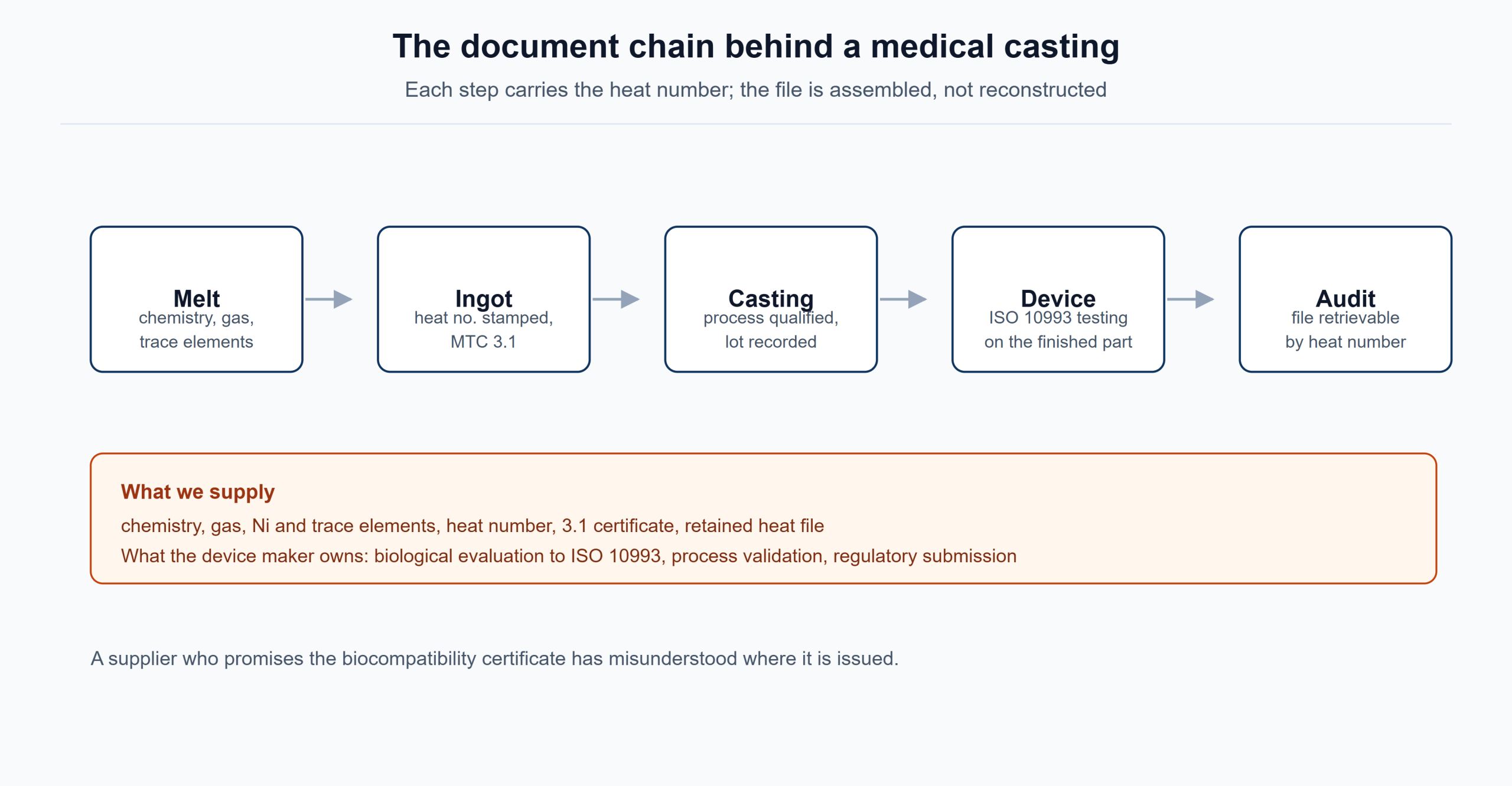
- Documentation as a deliverable — chemistry, gas, trace elements, heat number, and a material file that the customer’s ISO 10993 work can reference.
What we do not do is claim the implant is biocompatible. Biocompatibility is established on the finished device, by the device maker, through ISO 10993 testing. Our job is to make the material side of that file complete and repeatable — and to say so plainly, because a supplier who promises the certificate is a supplier who does not understand it.
Supply forms and sizes
| Form | Size | Length | Tolerance | Surface | Fits |
|---|---|---|---|---|---|
| Ingot | 3 / 5 / 10 / 25 kg | — | Per mould | As cast, blasted | Dental and orthopaedic crucibles |
| Cut ingot | From 10 / 25 kg | Per charge | ±2 mm | Sawn, cleaned | One charge per lot |
| Round bar | Ø30–100 mm | 200–1,000 mm | ±1 mm | Turned | Remelt and machining stock |
For a dental lab the 3 kg ingot is the practical unit: it matches a small crucible and it keeps the heat number intact across a week of casting. For an orthopaedic lot the 25 kg ingot is cut to charge weight and the cut face is cleaned, because a saw-cut face with coolant residue is the most common source of porosity in the first casting of a lot.
Chemical composition
| Element, % | ASTM F75 | ISO 5832-4 |
|---|---|---|
| Co | Balance | Balance |
| Cr | 27.0–30.0 | 26.5–30.0 |
| Mo | 5.0–7.0 | 4.5–7.0 |
| Ni | ≤0.50 | ≤0.50 |
| Fe | ≤0.75 | ≤0.75 |
| C | ≤0.35 | ≤0.35 |
| Si | ≤1.00 | ≤1.00 |
| Mn | ≤1.00 | ≤1.00 |
| P / S | ≤0.020 / ≤0.010 | ≤0.020 / ≤0.010 |
| N | ≤0.25 | ≤0.25 |
The two standards are close but not identical, and the differences sit at the edges of the window rather than in the middle. If the drawing cites ISO 5832-4, quote against it: chromium from 26.5 %, molybdenum from 4.5 %, and the castability changes with both.
Gas content and cleanliness
| Item | Medical casting grade | Industrial grade |
|---|---|---|
| Oxygen | ≤50 ppm | ≤80 ppm |
| Nitrogen | ≤80 ppm | ≤120 ppm |
| Carbon | Aim value held, 0.20–0.30 % typical | Within F75 range |
| Trace elements | Reported per heat, Cd and Be not intentionally added | On request |
| Inclusion | Metallographic report, agreed scale | Visual |
Oxygen in a cobalt-chrome melt comes from the crucible and the charge, and it shows up as oxide inclusions that blunt a burr and spoil a polished surface. For dental work that is the defect the lab notices first, before any mechanical property.
Mechanical acceptance
| Property | ASTM F75 requirement | Measured on |
|---|---|---|
| Tensile strength | ≥655 MPa | Cast-to-shape test bar |
| 0.2 % yield | ≥450 MPa | Cast-to-shape test bar |
| Elongation | ≥8 % | In 50 mm |
| Hardness | 25–35 HRC typical | Cast and polished section |
| Elastic modulus | 210–253 GPa | Reference value |
F75 properties are casting properties. They are demonstrated on bars cast from the same heat under the qualified process, not on the ingot, and the carbon level is what moves hardness and elongation in opposite directions. A heat that meets the chemistry and misses the elongation is almost always a carbon or a cooling-rate story.
Standards and the documentation file
- ASTM F75 — cast CoCrMo for surgical implants, chemistry and properties
- ISO 5832-4 — the ISO counterpart, used across Europe
- ISO 10993 — biocompatibility of the finished device; we supply the material-side data, the device maker runs the tests
- EN 10204 3.1 — inspection certificate with the heat number
- Stellite 21 — the wear-grade trade name customers often quote; same family, different carbon and application
If a customer asks whether F75 and Stellite 21 can be used interchangeably, the answer is no, and the reason is carbon. F75 caps carbon at 0.35 % for implant castings; the wear-grade cobalt alloys run higher carbon for hardness. Quoting one against the other is how a supplier loses a medical account in the first order.
Packing, marking and traceability
- Ingot — grade, heat number, weight and melt date stamped or tagged
- MTC — chemistry including Ni, Fe, C and trace elements, standard applied, inspector and date
- Packing — individual wrap, crate, desiccant; no wooden contact with the ingot face
- Retention — heat file retained so a repeat order can be matched to the original heat
What to send with an enquiry
- Standard — ASTM F75 or ISO 5832-4, and the drawing that cites it
- Application — dental, orthopaedic, or wear part; it decides the carbon aim
- Ingot weight and quantity per lot
- Nickel and trace-element limits, plus the documentation package required
- Certificate and delivery terms — 3.1 as standard, third-party testing at cost
Email [email protected] · WhatsApp +86 178 7358 1838 · or use the form below.
FUSHUN METAL · AS9120B · EN 10204 3.1 with the heat number.
Cobalt-base and nickel-base alloys used in the same casting shops.