
Both are case-hardening steels at about 0.2 % carbon, and on a drawing they look interchangeable. The difference is carbon and manganese: 20MnCr5 carries slightly more of both, so the core hardens to a higher strength after the same quench.
At a glance
Table 1 — 20MnCr5 at a glance
| Item | Detail |
|---|---|
| Designations | 20MnCr5 |
| Standards | EN / ASTM — named on the certificate |
| Delivery condition | Annealed or quenched and tempered |
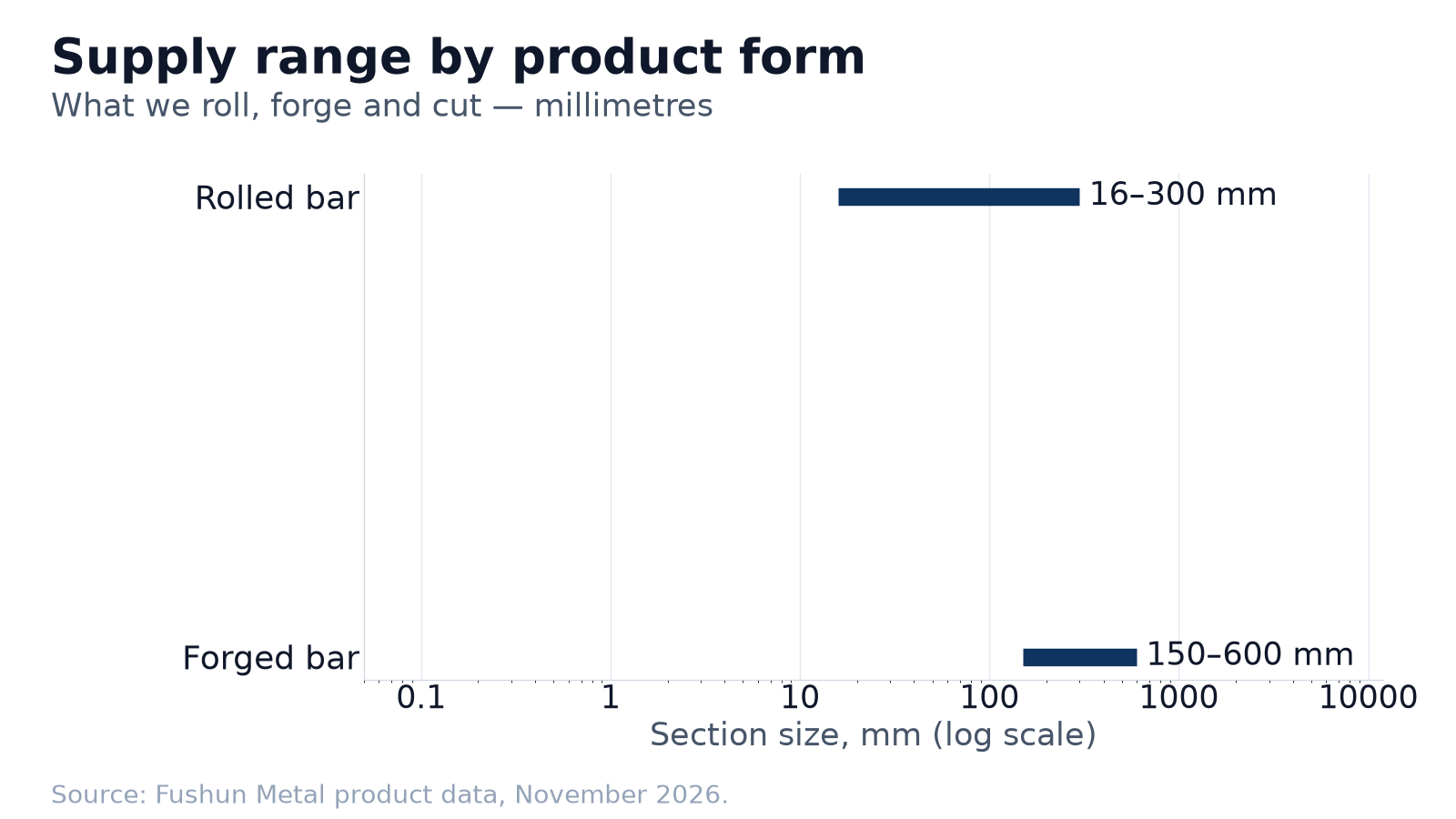
| Supply range | rolled bar 16–300 mm; forged bar 150–600 mm |
| Typical use | Engineering components |
| Certificate | EN 10204 3.1 with chemistry and mechanical properties |
Why 20MnCr5 is the higher-hardenability 16MnCr5
That matters when the tooth root is the failure mode. A gear that pits is a surface problem and 16MnCr5 will do; a gear that breaks at the root is a core strength problem, and 20MnCr5 is the cheaper answer than moving to a nickel grade.
20MnCr5 is a quenched-and-tempered engineering steel: the properties are bought by heat treatment, not by the chemistry alone. Carbon sets the achievable hardness, chromium and molybdenum set how deep that hardness goes, and the tempering temperature trades strength for toughness.
Where 20MnCr5 orders go wrong
- Interchanging the EN and ASTM windows; chromium, phosphorus and copper limits differ, and the difference shows up after quenching.
- Specifying a hardness at the quarter point of a section thicker than the grade can through-harden.
- Welding a quenched-and-tempered part without preheat and a post-weld temper; the HAZ cracks or softens.
- Plating high-strength parts without a baking step; hydrogen embrittlement appears as delayed fracture days after assembly.
When 20MnCr5 is the wrong grade
Above the hardenability limit, step up to a Ni-Mo grade such as 34CrNiMo6 or 4340 rather than increasing the temper. For corrosion, use stainless; for service above 400 °C, the temper backs off and a hot-work or heat-resistant grade is needed.
Supply range and delivery condition
Table 2 — Supply range by form and delivery condition
| Form | Size range | Condition |
|---|---|---|
| Rolled bar | 16–300 mm | Soft annealed |
| Forged bar | 150–600 mm | Soft annealed |
Chemical composition
Table 3 — Chemical composition (wt. %), balance Fe
| C | Mn | Si | P | S | Cr |
|---|---|---|---|---|---|
| 0.17–0.22 | 1.10–1.40 | 0.40 max | 0.035 max | 0.035 max | 1.00–1.30 |
Mechanical properties
Table 4 — Mechanical properties
| Heat treatment state | Diameter(mm) | Rm (Mpa) |
|---|---|---|
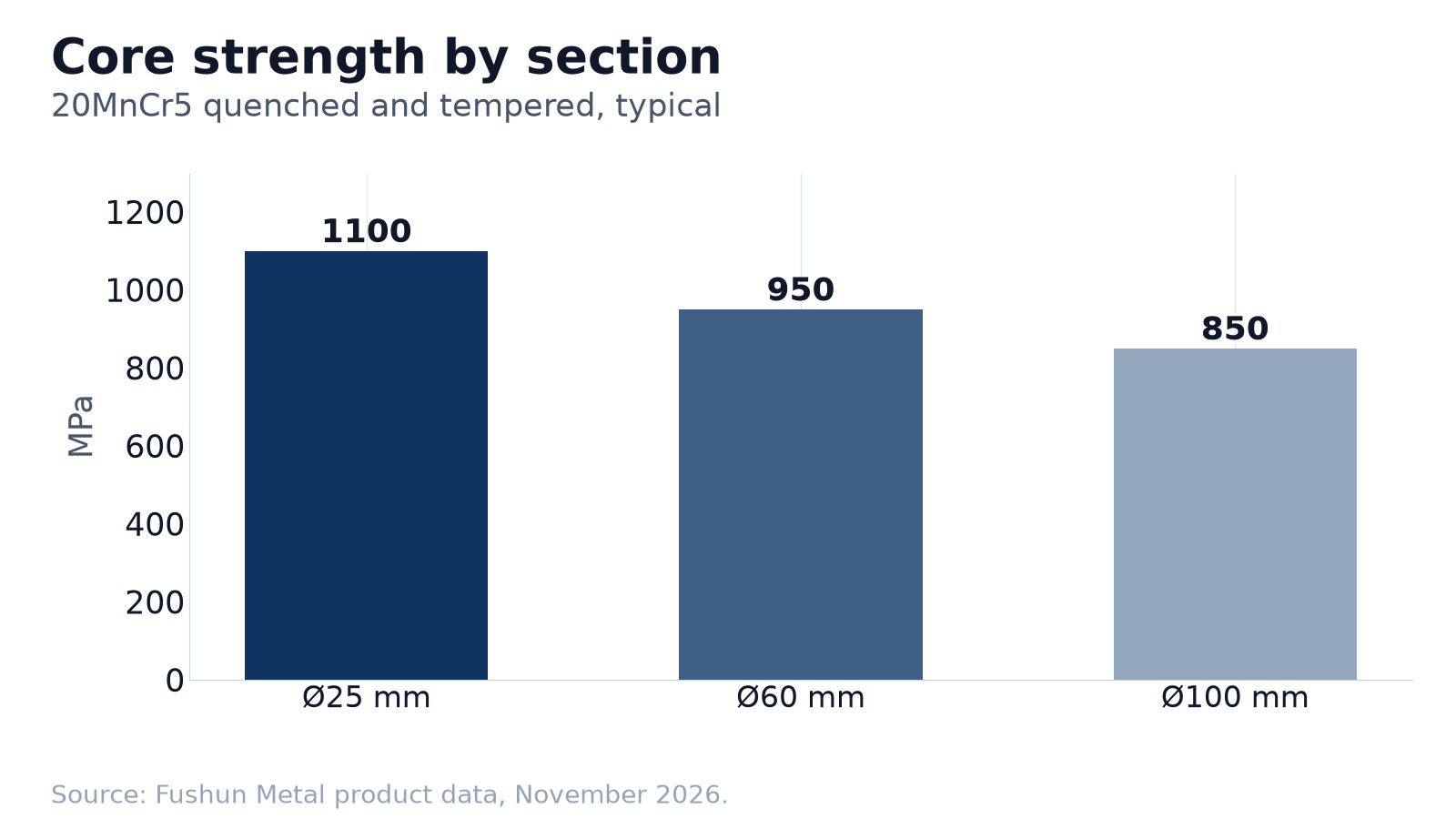
| QUENCHED AND TEMPERED | 16 max | 1200 min |
| QUENCHED AND TEMPERED | 16-40 | 1000 min |
| QUENCHED AND TEMPERED | 40-100 | 800 min |
Heat treatment
Table 5 — Heat treatment schedule
| Process | TEMPERATURE ° C | Cooling Medium |
|---|---|---|
| Forging or hot rolling | 850-1100 | air |
| Normalizing | 840-870 | air |
| Soft Annealing | 650-700 | furnace 217HB max |
| Carburising | 880-980 | / |
| Core hardening | 860-900 | oil |
| Intermediate annealing | 650-700 | / |
| Case hardening | 780-820 | oil |
| Tempering | 150-200 | / |
What ships with every lot
- EN 10204 3.1 mill certificate with chemistry and mechanical properties
- Heat number and melt route recorded on the certificate
- Hardness survey and dimensional report on request
- Ultrasonic inspection to ASTM A388 / SEP 1921 on request
- Third-party inspection (SGS, BV, TUV) arranged before dispatch
Packing and delivery
Material is packed for sea freight, marked with grade, heat number, size and net weight; typical lead time 20–30 days from order confirmation.
Table 6 — Trade terms, packing and documents
| Item | Standard terms |
|---|---|
| Trade terms | FOB Shanghai, Qingdao or Shenzhen; CIF and CFR quoted against the destination port. |
| Minimum order | One bundle or one plate for stock sizes; mill runs and special sections are quoted individually |
| Lead time | 20–30 days from order confirmation for stock sizes; 30–45 days where forging, heat treatment or machining is included |
| Payment | T/T 30 % advance with the order, 70 % against the bill of lading copy; irrevocable L/C at sight accepted for orders above 20 t |
| Packing | Seaworthy export packing — oiled, wrapped, crated or strapped on skids, marked with grade, heat number, size and net weight |
| Documents | 3.1 certificate, packing list, commercial invoice, bill of lading, certificate of origin; legalisation or chamber attestation on request |
Frequently asked questions
What is 20MnCr5 equivalent to?
1.7147 in DIN and SAE 5120 in the American system. It carries more manganese and chromium than 16MnCr5, which is what gives it the extra core strength.
Why choose 20MnCr5 instead of 16MnCr5?
Section and load. Above roughly 40 mm, or where the tooth root sees higher stress, the extra hardenability of 20MnCr5 keeps the core strong after carburising.
What case depth does it take?
0.6–1.2 mm in a normal carburising cycle at 900–930 °C. Deeper cases need longer cycles and a coarser grain, which is where 17CrNiMo6 becomes the better choice.
What lead time applies to 20MnCr5?
20–30 days from order confirmation for stock sizes, 30–45 days where forging, heat treatment or machining is included. Loading from Shanghai, Qingdao or Shenzhen.
Can 20MnCr5 be combined with other grades in one shipment?
Yes. Grades that share a heat-treatment and certification route are consolidated into one export package, which is usually what keeps a mixed order economical.
Request a quote
Send these five lines and we quote within one working day
- Grade and standard
- Form, size and quantity
- Delivery condition
- Certificate and testing requirements
- Destination port
Email [email protected] or use the form below. Drawings in DXF, STEP or PDF are all fine.