
1.6510 (39NiCrMo3) Quenched & Tempered Steel
1.6510 — 39NiCrMo3 — is a 0.39 % carbon nickel-chromium-molybdenum steel for shafts, gears and bolts that need 900–1,200 MPa after quenching and tempering. The nickel gives it a tougher core than 42CrMo4 at the same strength, which is why it is specified for parts that see shock as well as load.
Where 39NiCrMo3 Fails — and Why
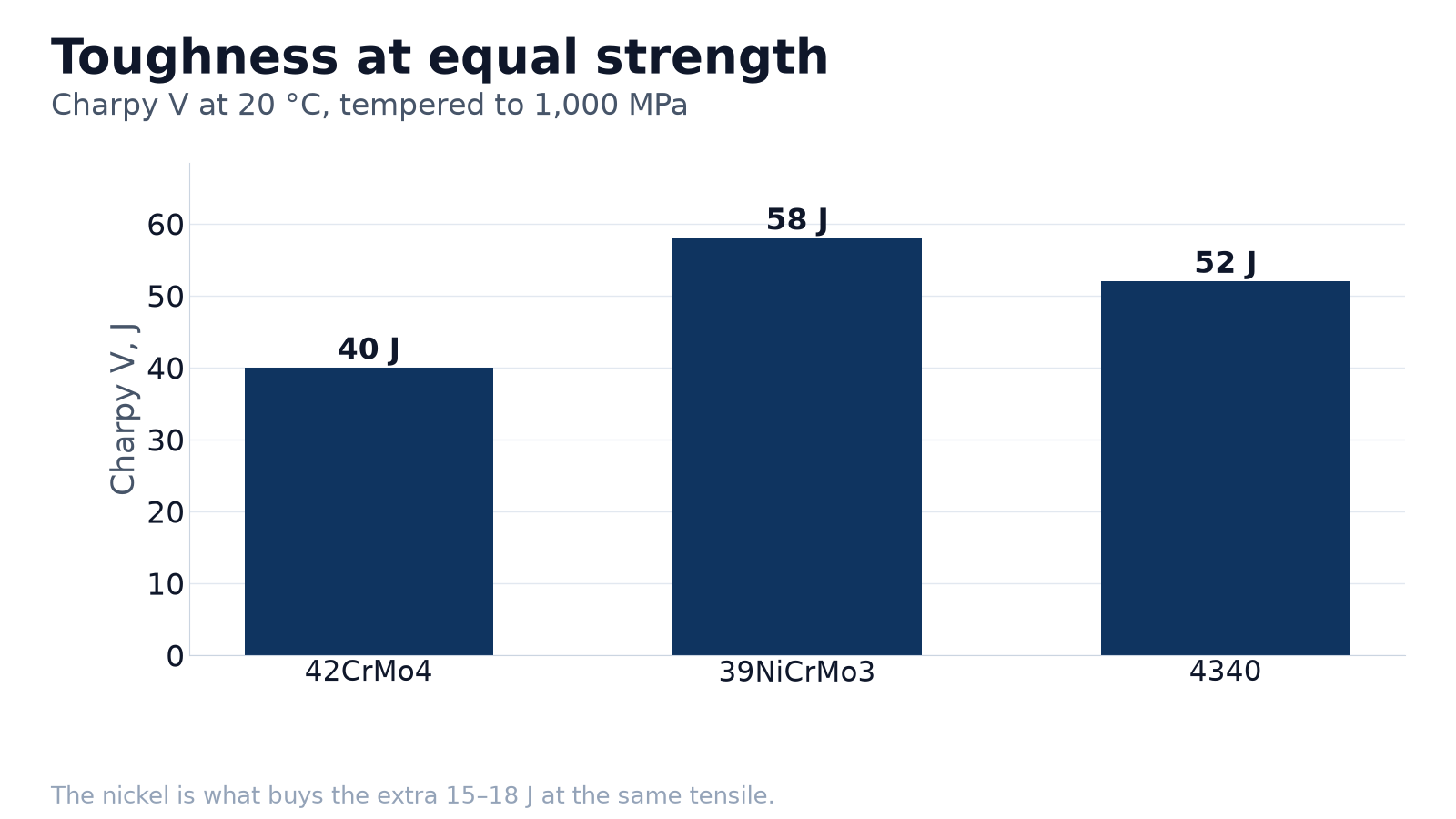
The grade is the European answer to AISI 9840, and it occupies the same place: a through-hardening steel with enough nickel to keep the centre tough after a 1,000 MPa temper. Against 42CrMo4 it gives up about 100 MPa of tensile at the same temper and returns a Charpy value 15–20 J higher.
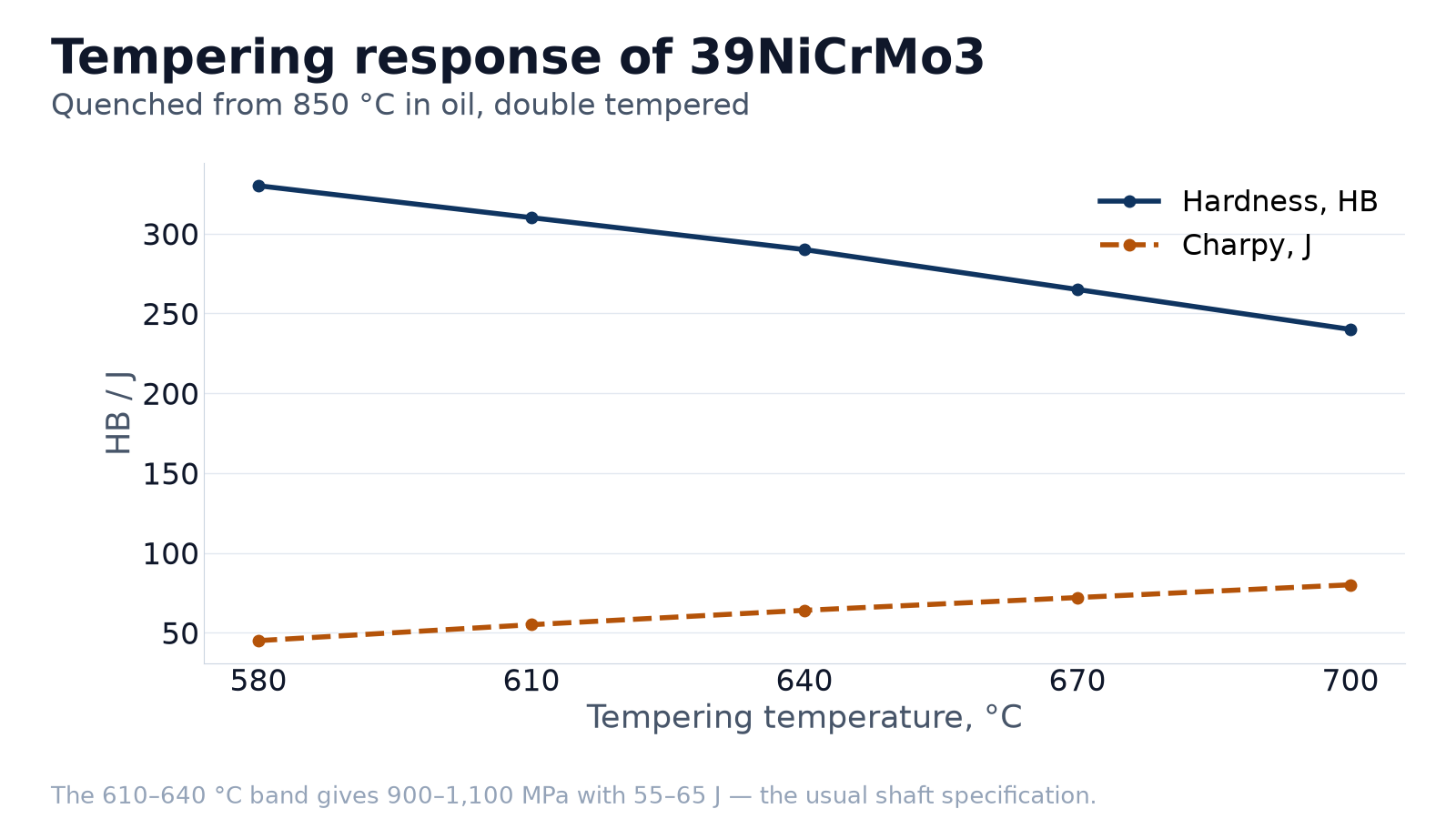
The heat treatment is conventional — austenitise at 830–860 °C, oil quench, temper twice — but the tempering window is narrow. Below 600 °C the toughness falls away; above 660 °C the strength drops below the drawing. The 610–640 °C band is where the grade is usually specified.
39NiCrMo3 is a quenched-and-tempered engineering steel: the properties are bought by heat treatment, not by chemistry alone. Carbon sets the achievable hardness, chromium and molybdenum set how deep that hardness goes, and the tempering temperature trades strength for toughness.
The practical limit is section size. Oil quenching carries full hardness to a depth that depends on the alloy content — roughly 40–60 mm for a 1 % Cr grade, more for a nickel-molybdenum grade. Above that depth the core comes out softer than the skin, and a tensile taken at the quarter point will not match the surface.
That is why the same grade is bought with a class rather than a hardness range: +QT700 or +QT800 fixes a minimum tensile on a stated test piece. On a drawing that only says 28–32 HRC, the hardenability of the section decides whether the part actually meets it.
- Interchanging the EN and ASTM windows; chromium, phosphorus and copper limits differ, and the difference shows up after quenching.
- Specifying a hardness at the quarter point of a section thicker than the grade can through-harden.
- Welding a quenched and tempered part without preheat and a post-weld temper; the heat-affected zone cracks or softens.
- Plating high-strength parts without a baking step; hydrogen embrittlement appears as a delayed fracture days after assembly.
Supply Range and Delivery Condition
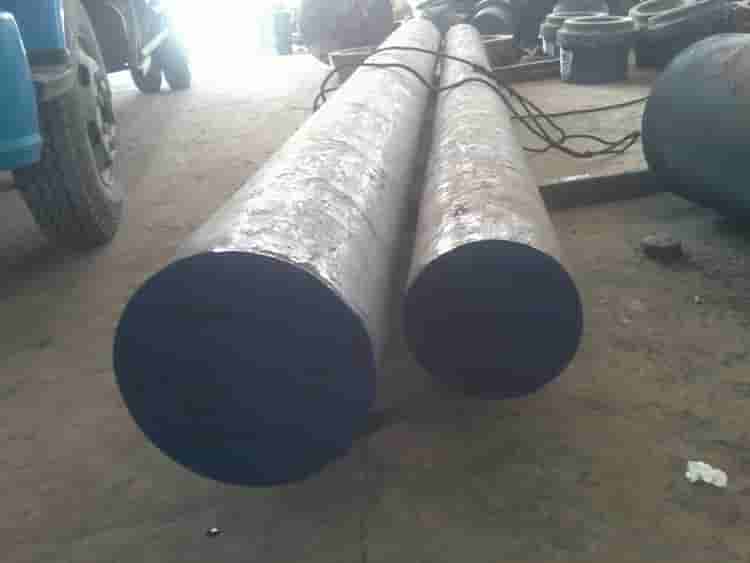
Supply is quoted by form, size and delivery condition — annealed for machining, or quenched and tempered to a stated class.
Table 1 — Supply range by form, size and delivery condition
| Form | Size range | Delivery condition |
|---|---|---|
| Rolled round bar | Ø 20–250 mm | Annealed or +QT |
| Forged round bar | Ø 150–500 mm | Annealed or +QT |
| Forged flat bar | 100–400 × 300–1,200 mm | Annealed |
| Plate | 20–150 mm | Annealed |
Bar is supplied +QT with a tensile from the same heat; for sections above 100 mm a hardness map is added, because the quarter-point hardness is what the drawing actually calls for.
Chemical Composition
Carbon sets the hardness ceiling, manganese and chromium the depth of hardening, and molybdenum suppresses temper embrittlement in thick sections.
Table 2 — Chemical composition, wt. % (single values are maximums unless stated)
| Element | Min | Max | Typical |
|---|---|---|---|
| C | 0.35 | 0.42 | 0.39 |
| Si | 0.10 | 0.40 | 0.25 |
| Mn | 0.50 | 0.80 | 0.65 |
| P | — | 0.025 | 0.015 |
| S | — | 0.035 | 0.010 |
| Cr | 0.60 | 0.90 | 0.75 |
| Ni | 0.70 | 1.00 | 0.85 |
| Mo | 0.15 | 0.25 | 0.20 |
Mechanical Properties
Every row names its condition and its test piece. A tensile from a 25 mm test bar is not the same claim as a tensile from the quarter point of a 300 mm forging.
Table 3 — Mechanical properties by condition
| Condition | Rp0.2 (MPa) | Rm (MPa) | A (%) | KV2 (J) | HB |
|---|---|---|---|---|---|
| +QT, Ø ≤ 16 mm | ≥800 | 1,000–1,200 | ≥11 | ≥40 | 300–340 |
| +QT, Ø 17–40 mm | ≥700 | 900–1,100 | ≥12 | ≥45 | 280–320 |
| +QT, Ø 41–100 mm | ≥550 | 800–950 | ≥14 | ≥45 | 240–280 |
| Annealed | — | — | — | — | ≤250 |
Heat Treatment
Austenitise, quench in oil or water according to section, then temper immediately. A delay between quench and temper is where cracking starts.
Table 4 — Heat treatment schedule
| Step | Temperature | Time / atmosphere | Cooling |
|---|---|---|---|
| Austenitising | 830–860 °C | 30 min per 25 mm | Oil |
| Tempering | 610–640 °C | 2 h per 25 mm, twice | Air |
| Stress relief | 600–650 °C | 1 h per 25 mm | Furnace cool |
Equivalent Grades and Standards
The nearest equivalent is not always a legal substitution: the phosphorus and sulphur limits, and sometimes the chromium range, differ between the EN and ASTM versions.
Table 5 — Equivalent grades and governing standards
| System | Designation |
|---|---|
| EN | 39NiCrMo3 / 1.6510 |
| AISI / SAE | 9840 |
| DIN | 36CrNiMo4 / 1.6511 (close) |
| JIS | SNCM439 (close) |
| GB | 40CrNiMo (close) |
What Ships With Every Lot
- EN 10204 3.1 mill certificate with chemistry and mechanical properties, heat number and melt route.
- Hardness survey and dimensional report on every piece on request.
- Ultrasonic inspection to ASTM A388 or SEP 1921 where the section or the application calls for it.
- Third-party inspection — SGS, BV, TUV — arranged before dispatch, at the customer’s instruction.
- Spectro check on the finished part where a weld or a heat treatment has been added after despatch.
Machining, Welding and Surface Finish
The steel machines at 250–300 HB in the annealed condition and at 300–340 HB after quenching and tempering. Carbide tooling and a rigid set-up are needed for the +QT condition; the nickel makes the chip stringy.
Welding requires preheat at 250–300 °C and a post-weld temper at 600 °C. A quenched and tempered part that is welded without the temper cracks in the heat-affected zone within hours.
Packing, MOQ and Delivery Terms
Bars are supplied black or peeled, with the heat number and the +QT condition stamped on the end. Forgings travel with the test certificate and hardness map.
Table 6 — Trade terms, packing and documents
| Item | Standard terms |
|---|---|
| Trade terms | FOB Shanghai / CIF / CFR / EXW; FOB is the default. |
| Minimum order | One bundle, plate or coil for stock sizes; mill runs quoted individually. |
| Lead time | 20–30 days from order confirmation for stock sizes; 30–45 days where forging or heat treatment is included. |
| Payment | 30 % T/T deposit, 70 % against the bill of lading copy; L/C at sight above 20 t. |
| Packing | Seaworthy export packing — crated or strapped, marked with grade, heat number, size and net weight. |
| Documents | EN 10204 3.1 certificate, packing list, invoice, bill of lading, certificate of origin; legalisation on request. |
Frequently Asked Questions
Is 39NiCrMo3 the same as 42CrMo4?
No. It carries nickel and less carbon, so it is tougher at the same strength and about 100 MPa weaker at the same temper.
What is the tempering window?
610–640 °C for the 900–1,100 MPa range. Below 600 °C the toughness falls; above 660 °C the strength drops below the drawing.
Can it be welded?
Yes, with preheat at 250–300 °C and a post-weld temper at 600 °C.
What is the maximum section?
About 100 mm for 800 MPa; above that the core hardness falls and a higher-alloy grade is needed.
Do you supply +QT bar?
Yes, with a tensile from the same heat and a hardness map for sections above 100 mm.
Related Grades
Browse the full range: alloy structural steel grades.
Request a Quote
- Grade and governing standard
- Form, size and quantity
- Delivery condition and hardness
- Certificate and testing requirements
- Destination port and required date
Email [email protected] or use the form below. Drawings in DXF, STEP or PDF are all fine. Stock sizes ship within 20 days of order confirmation.