
Glass Mould Tool Steel: Grades and How to Choose
A glass mould fails differently from a plastic mould: it sees 500–700 °C at the surface, thermal cycling every few seconds, and abrasive contact with hot glass. That rules out most of the P20 family and points to hot work steels, 12 % chromium mould steels or high-carbon wear grades — depending on which duty the block actually does.
At a glance
| Item | Detail |
|---|---|
| Grades covered | 1.2343 / 1.2344 hot work, 1.2083 / 420 stainless, 1.2080 high-carbon wear, 1.2316 corrosion resistant |
| Standards | EN ISO 4957 (hot work); EN 10088-3 (stainless); ASTM A681 |
| Delivery condition | Soft annealed for machining, or pre-hardened where the grade allows |
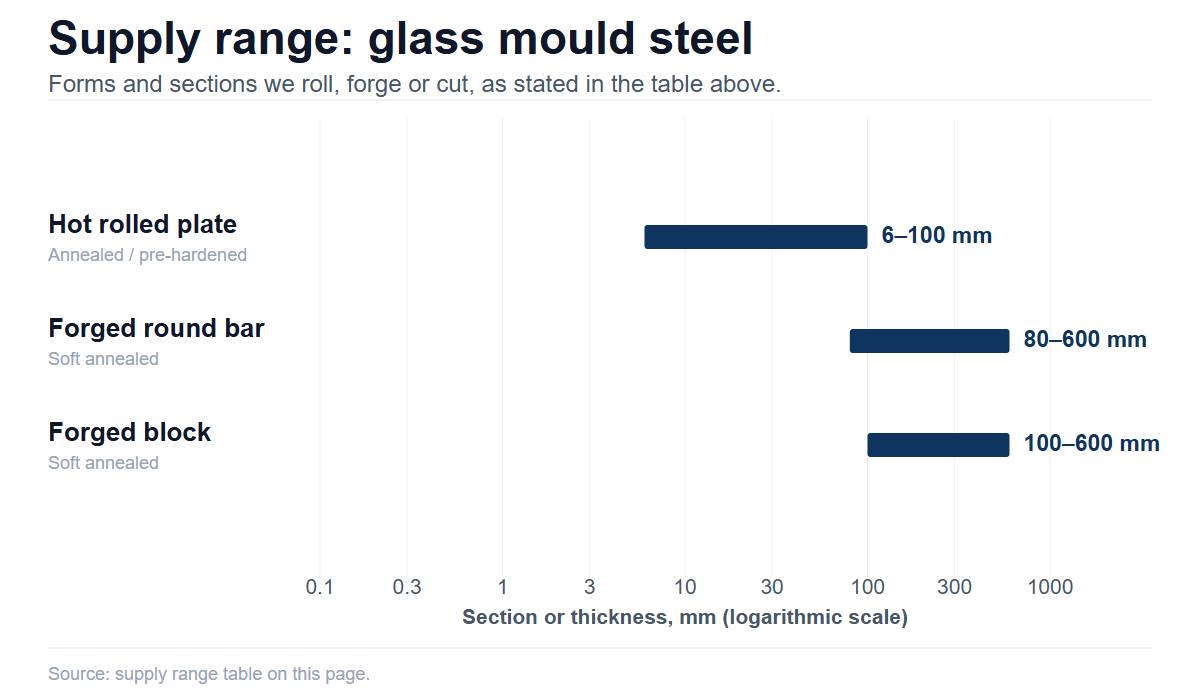
| Supply range | Forged block 100–600 mm, plate 6–100 mm, bar Ø80–600 mm |
| Typical use | Blow moulds, blank moulds, plungers, neck rings, take-out inserts, dead plate tooling |
| Certificate | EN 10204 3.1 with chemistry, hardness and mechanical properties |
What a glass mould actually has to survive
Three loads act at once. Thermal fatigue from the cycle — the surface goes to 600 °C and back every few seconds, and the resulting heat-check network is what ends most glass moulds. Oxidation, because there is no protective atmosphere in a glass shop. And abrasion, because hot glass is hard and moving.
That combination is why 1.2344 and 1.2343 dominate: 5 % chromium, molybdenum for secondary hardening and a structure that resists heat checking. Where the mould is water-cooled or runs with lubricant, a 12 % chromium stainless such as 1.2083 stops the corrosion pitting that starts the cracks. Where wear dominates — neck rings, guides, take-out fingers — a 2 % carbon, 12 % chromium grade such as 1.2080 outlasts both.
Where a P20-type steel goes wrong: it softens above about 400 °C. A block that looks fine after a week is a block with a softened skin after a month, and the mould then fails by erosion rather than by cracking.
Supply range and delivery condition
| Form | Size range | Condition |
|---|---|---|
| Forged block | Thickness 100–600 mm × width 300–2000 mm | Soft annealed |
| Hot rolled plate | Thickness 6–100 mm × width up to 1600 mm | Annealed / pre-hardened |
| Forged round bar | Ø80–600 mm | Soft annealed |
Blocks are sawn and squared to size; larger sections and near-net-shape forgings are quoted individually.
Chemical composition
| Grade | C | Si | Mn | Cr | Mo | V |
|---|---|---|---|---|---|---|
| 1.2344 | 0.37–0.42 | 0.80–1.20 | 0.20–0.50 | 4.80–5.50 | 1.10–1.50 | 0.80–1.20 |
H13 / 1.2344 shown as the reference hot work grade. Chemistry for 1.2343, 1.2083, 1.2080 and 1.2316 is given on their own pages and on the 3.1 certificate.
Mechanical properties
| Grade | Delivery hardness | Working hardness | Duty |
|---|---|---|---|
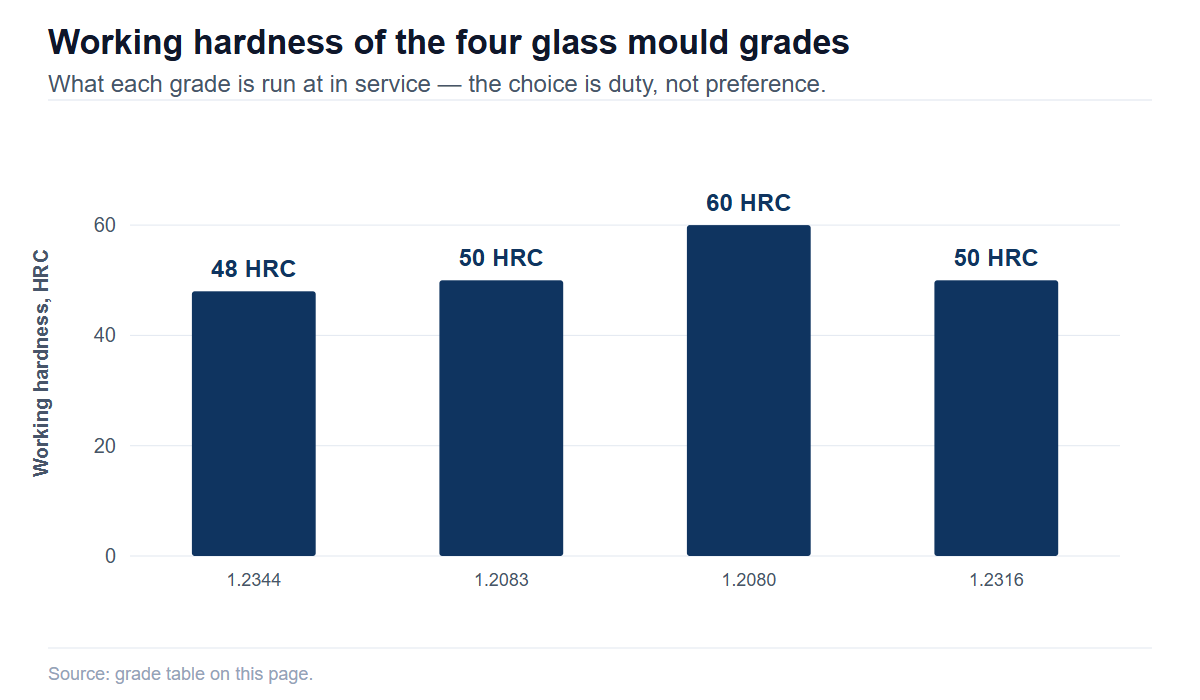
| 1.2343 / 1.2344 | ≤235 HB annealed | 44–52 HRC | Plungers, dies, pressing tools |
| 1.2083 / 420 | ≤235 HB annealed | 48–52 HRC | Blow moulds, wet service |
| 1.2080 / X210Cr12 | ≤248 HB annealed | 58–62 HRC | Neck rings, wear inserts |
| 1.2316 / X38CrMo16 | 30–34 HRC pre-hardened | 48–52 HRC | Large cavities, corrosive cooling |
Hardness values are for the delivered and working condition; the certificate reports the actual heat.
Where orders go wrong
- Specifying P20 because the mould is “only” for glass. P20 softens above 400 °C; the surface erodes within weeks and the mould loses its dimensions rather than cracking.
- Choosing the hardest grade for the hottest job. 1.2080 at 60 HRC wears well but heat-checks early. Hot work steels exist because toughness at temperature beats hardness at temperature.
- Ignoring the cooling water. A water-cooled mould with a plain 5 % chromium grade pits at the cooling channels; a 12 % chromium grade or a corrosion-resistant 1.2316 is the cheaper answer over the mould life.
What ships with every lot
- EN 10204 3.1 mill certificate with chemistry, hardness and mechanical properties
- Hardness map across the block on request — the only way to know the core before the first cut
- Ultrasonic inspection to SEP 1921 or ASTM A388 for blocks over 200 mm
- Grain size and carbide distribution on request
- Sawn faces checked for squareness and flatness
Cutting, machining and surface
| Operation | What we hold |
|---|---|
| Saw cutting | Section up to 1200 mm; square within 1 mm per 100 mm |
| Milling | Six faces squared, bright milled |
| Surface grinding | Thickness tolerance −0 to +0.1 mm; flatness 0.01/100 mm |
| Rough machining | Cavity roughing from drawing, allowance held to your specification |
Rough machine before hardening and leave the allowance you want; stress relieve after removing more than 30 % of the section.
Trade terms and how an order runs
The terms below apply unless the enquiry states otherwise, and they can be adjusted in the quotation.
| Item | Standard terms |
|---|---|
| Incoterms 2020 | FOB Shanghai, Qingdao or Shenzhen; CIF and CFR quoted against the destination port |
| Payment | T/T 30 % advance, 70 % against the bill of lading copy; irrevocable L/C at sight above 20 t |
| Minimum quantity | One bundle or one plate for stock sizes; mill runs quoted individually |
| Lead time | A glass mould fails differently from a plastic mould: it sees 500–700 °C at the surface, thermal cycling every few seconds, and abrasive contact with hot glass. That rules out most of the P20 family and points to hot work steels, 12 % chromium mould steels or high-carbon wear grades — depending on which duty the block actually does. |
| Documents | 3.1 certificate, packing list, invoice, bill of lading, certificate of origin |
| Inspection | Third-party inspection (SGS, BV, TUV) arranged before dispatch on request |
Packing and delivery
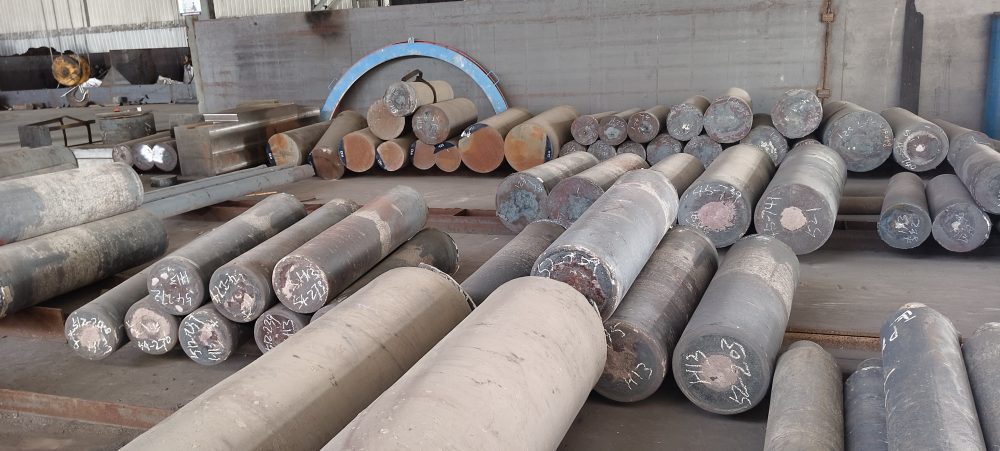
Blocks are oiled, wrapped and crated with grade, heat number, size and net weight stencilled on the outside, matching the certificate inside.
Typical lead time is 20–30 days for stock sizes, 30–45 days where rough machining or hardening is included.
Request a quote
- Duty — blow mould, blank mould, plunger or wear insert
- Block size — finished thickness × width × length, plus the allowance you want left
- Quantity in pieces
- Grade — tell us the duty and we will propose the grade, or specify 1.2344 / 1.2083 / 1.2080
- Certificate and inspection — 3.1 as standard, UT or hardness map on request
Email [email protected] or use the form below. Drawings in DXF, STEP or PDF are all fine.
Related grades
One heat-treatment route, one certification route — grades can be combined in a single shipment.
- 1.2367 / X38CrMoV5-3 — hot work grade with higher molybdenum
- 1.2083 / S136 — corrosion-resistant mould steel
- 1.2316 / X38CrMo16 — pre-hardened corrosion-resistant grade
- Rubber mould tool steel — the other high-temperature mould family
Browse all mould steel grades →
Governing standard: ASTM A681 (PDF)
Frequently asked questions
A 12 % chromium stainless such as 1.2083 / 420 is the common choice for blow moulds, because the mould is water-cooled and lubricated and corrosion pitting starts the heat-check cracks. Hot work steels are used where the surface runs hotter.
P20 softens above about 400 °C. A glass mould sees 500–700 °C at the surface, so the cavity erodes and loses its shape instead of wearing out gradually.
Vanadium and molybdenum content. 1.2344 carries more vanadium, which gives better resistance to heat checking and is why it dominates die casting; 1.2343 is slightly tougher and easier to machine.
Hot work grades weld well with a matching filler and a preheat, and the repair is normally dressed and re-polished. Stainless mould grades weld less predictably and should be avoided on a cavity surface.
Soft annealed for a block that will be fully machined and then hardened; pre-hardened where the grade allows and the cavity only needs finishing. Tell us the finished size and we leave the allowance you specify.