
IN718 / GH4169 Atomization Rod, Built to Your Atomizer
An electrode, not a length of bar. GH4169 rod for powder production is judged by whether it fits the clamp, whether the nose seats, whether the surface is clean enough to keep oxygen out of the melt, and whether the heat number can still be read after the first run. We machine it to Ø30–130 mm, Ra ≤1.6 µm, with the EIGA 70° nose and the end-face marking the standards require.
At a glance
| Item | GH4169 atomization rod |
|---|---|
| Designation | GH4169 · IN718 · UNS N07718 · W.Nr 2.4668 |
| Form | Round rod, straight lengths, ends machined; centre hole or thread on request |
| Size | Ø30–130 mm, length 120–700 mm or cut to the clamp length |
| Condition | Black, turned, ground, or mirror polished; Ra ≤1.6 µm for PREP and EIGA |
| Melting route | VIM+VAR or VIM+ESR+VAR; single VIM only below 30 ppm by agreement |
| Standards | GB/T 38941 (PREP sizes) · AMS 5383 chemistry · customer drawing |
| Marking | Grade, final melt heat number and melt date stamped on the end face |
This page covers the rod. It does not cover the powder: we sell the electrode, and the atomizer turns it into powder. That boundary is worth keeping in mind, because most arguments about “powder quality” start with an electrode that was ordered without a drawing.
Why a rod is not a bar
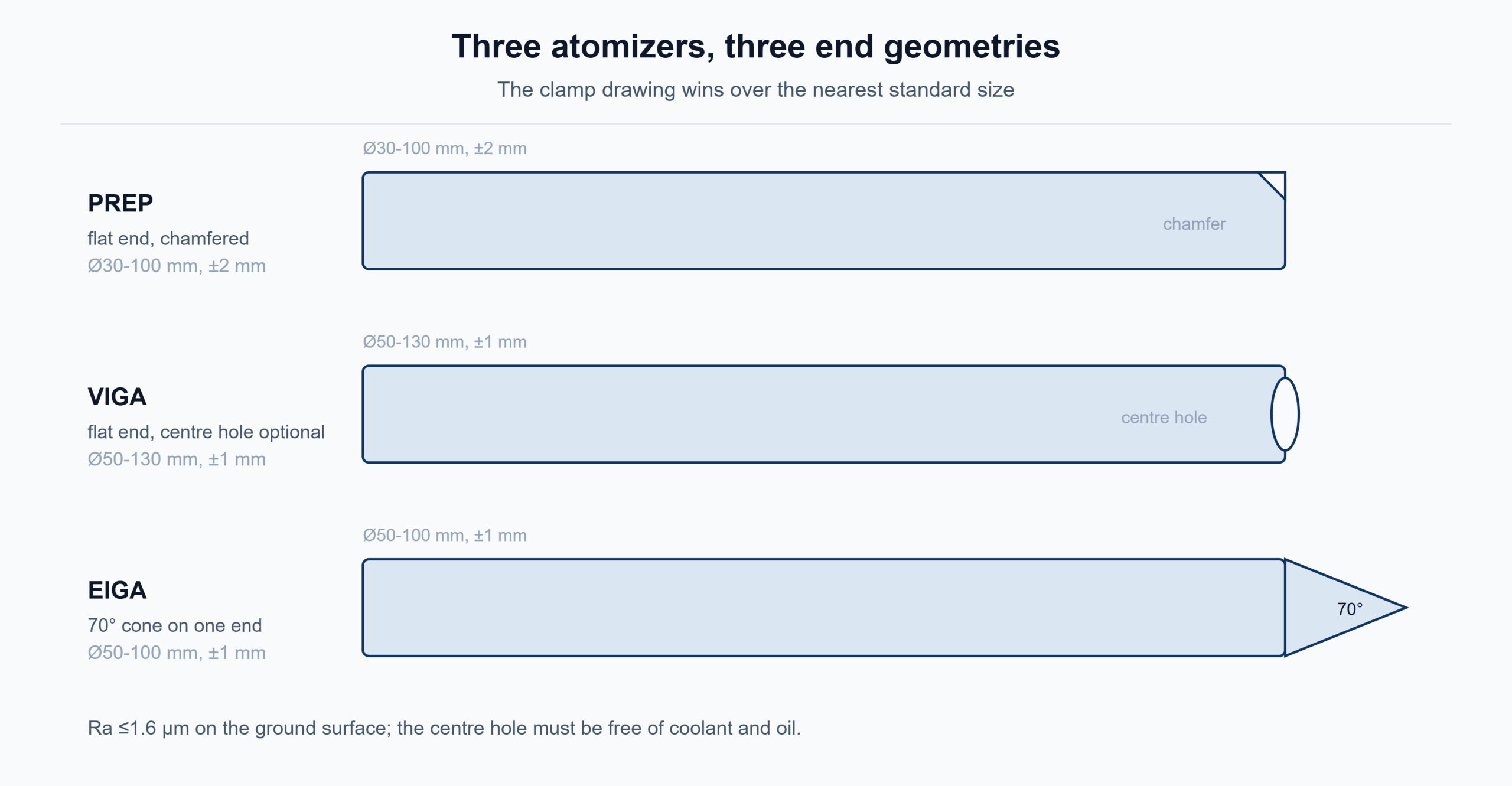
A bar is ordered by diameter and grade. A rod is ordered against a machine. The same Ø80 mm section can be wrong for three different atomizers because the clamp length, the nose angle and the surface finish all come from the equipment, not from the alloy.
| Atomizer | Diameter | Diameter tolerance | Length | End geometry | Surface |
|---|---|---|---|---|---|
| PREP | Ø30–100 mm | ±2 mm | Per clamp | Flat, chamfered | Ra ≤1.6 µm |
| VIGA | Ø50–130 mm | ±1 mm | Per clamp | Flat, centre hole optional | Turned or ground |
| EIGA | Ø50–100 mm | ±1 mm | Per clamp | 70° cone on one end | Ra ≤1.6 µm |
Two details decide whether the first run works. The centre hole, if there is one, must be free of coolant and oil — a drilled hole that is never cleaned is a virtual leak in the chamber. And the straightness has to survive the clamp: a rod that is straight on the bench but spring-loaded in the fixture will run out of concentricity and spray unevenly.
Chemical composition
| Element, % | GH4169 (GB/T 14992) | IN718 (AMS 5383) |
|---|---|---|
| C | ≤0.08 | ≤0.08 |
| Cr | 17.0–21.0 | 17.0–21.0 |
| Ni | 50.0–55.0 | 50.0–55.0 |
| Mo | 2.8–3.3 | 2.8–3.3 |
| Nb+Ta | 4.75–5.50 | 4.75–5.50 |
| Ti | 0.65–1.15 | 0.65–1.15 |
| Al | 0.20–0.80 | 0.20–0.80 |
| Co | ≤1.00 | ≤1.00 |
| B | ≤0.006 | ≤0.006 |
| Si / Mn | ≤0.35 / ≤0.35 | ≤0.35 / ≤0.35 |
| P / S | ≤0.015 / ≤0.015 | ≤0.015 / ≤0.015 |
| Fe | Balance | Balance |
The two windows are the same. What differs is the sampling and retest discipline behind them, and for atomization the more useful conversation is about Nb: it segregates in the ingot, and a rod cut from the segregated end will not atomize into the same powder as one cut from the middle. If the powder is for a rotating part, ask where along the ingot the rod was taken.
Gas and inclusion limits
| Item | Atomization grade | General bar grade |
|---|---|---|
| Oxygen | ≤30 ppm (20 ppm on request) | 30–50 ppm |
| Nitrogen | ≤30 ppm | ≤50 ppm |
| Sulphur | ≤15 ppm | ≤15 ppm |
| Trace elements | Per AMS 2280, report per heat | On request |
| Inclusion rating | Metallographic report, agreed scale | Not normally specified |
| Surface contamination | No oil, no coolant residue, no grinding burn | — |
Oxygen in the rod is the floor for oxygen in the powder; atomization only adds to it. A heat at 40 ppm will not produce a 15 ppm powder no matter how good the atomizer is, which is why the rod specification should be written backwards from the powder specification.
What the consolidated powder has to hit
| Property | 20 °C | 650 °C |
|---|---|---|
| Tensile strength, MPa | ≥1276 | ≥1000 |
| 0.2 % yield, MPa | ≥1034 | ≥862 |
| Elongation, % | ≥12 | ≥12 |
| Reduction of area, % | ≥15 | ≥15 |
These are the AMS 5662 values for wrought IN718, quoted as the reference the customer’s part is usually judged against after HIP and heat treatment. They are not properties of the rod and we do not test them on the rod: the acceptance route for an electrode is chemistry, gas, density, geometry and surface. Anyone offering you tensile data measured on an atomization rod is selling something else.
Melting route and standards
| Route | Oxygen | Relative cost | Fits |
|---|---|---|---|
| VIM only | 30–50 ppm | 1.0 | Industrial powder, cladding, non-rotating parts |
| VIM + VAR | 20–30 ppm | 1.3–1.6 | LPBF and EIGA stock for structural parts |
| VIM + ESR + VAR | ≤10–15 ppm | 1.6–2.0 | Rotating parts, aerospace powder |
For a rotating part the route is normally triple melt and the drawing says so. For a laser-cladding or cold-spray grade, single VIM at a controlled oxygen level is the economic answer. The mistake is to buy the triple-melt route for a part that will never be audited, or to buy single melt for one that will.
Sizes follow GB/T 38941 for PREP, and the VIGA and EIGA geometries in the revision now in circulation. Where the two disagree, the customer’s clamp drawing wins — and we machine to it rather than to the nearest standard size.
End-face marking, packing and traceability
- Stamped on the end face — grade, final melt heat number, melt date; a fourth line for the rod serial if the customer asks
- Marking method — low-stress stamp or laser, clear of the seat and the clamp zone
- Packing — individual sleeve, VCI paper, crate with desiccant; ends protected against nicks
- Documents — EN 10204 3.1 with chemistry and gas, dimensional report, surface roughness record
The marking requirement is not decorative. If the heat number cannot be read when the rod comes back out of the atomizer, the powder lot loses its link to the melt, and that link is the whole point of buying master alloy rather than scrap.
What to send with an enquiry
- Atomizer make and model, or the clamp drawing
- Rod diameter, length and single weight, with tolerance
- End geometry — flat, centre hole, 70° cone, thread
- Surface requirement — turned, ground, Ra value
- Oxygen limit and acceptance standard, plus the powder specification it has to serve
Email [email protected] · WhatsApp +86 178 7358 1838 · or use the form below.
FUSHUN METAL · AS9120B · EN 10204 3.1 with the heat number.
The same heat, in the form the next operation needs.
- Master alloy hub — all six grades and three forms
- IN625 / GH3625 atomization rod — the corrosion-resistant twin — same discipline, different alloy
- IN718 wrought bar to AMS 5662 — the other form — for machined parts, not for atomizing
- IN718 wire — for welding and additive wire processes
- VIM inclusion control in N07718 — what the rod inherits from the melt