
4140 vs 4130: The Carbon Difference and Where It Stops Mattering
Ten points of carbon separate these two chromoly grades. That is enough to double the hardenability, lift the achievable strength by 50 ksi, and make one of them a welding problem instead of a welding job.
Both grades share the same chromium and molybdenum addition, the same 0.15–0.25 % Mo, the same corrosion behaviour and, at low stress, the same machined finish. On a drawing they are one substitution apart. In a heat-treat furnace they are two different materials. The 4130 grade on its own is covered separately; this page is about the gap between the two.
The choice comes down to three questions, in this order: how thick is the section, how hard does it have to be in the middle of that section, and is anything welded to it. If the answer to the third is yes, the carbon content stops being a strength decision and becomes a procedure decision.
The chemistry that matters
The “40” and “30” in the designation are the carbon points, and the specification ranges barely overlap: 4130 runs 0.28–0.33 % C, 4140 runs 0.38–0.43 % C. The manganese is the second difference and it is often overlooked — 4140 carries roughly twice the manganese of 4130.
Table 1. Composition limits, AISI/SAE 4130 and 4140, mass %.
| Element | 4130 | 4140 | Effect of the difference |
|---|---|---|---|
| C | 0.28–0.33 | 0.38–0.43 | Hardenability, achievable strength, weldability |
| Mn | 0.40–0.60 | 0.75–1.00 | Hardenability, sulphur control, toughness |
| Cr | 0.80–1.10 | 0.80–1.10 | Same — oxidation resistance, hardenability |
| Mo | 0.15–0.25 | 0.15–0.25 | Same — suppresses temper embrittlement |
| Si | 0.15–0.35 | 0.15–0.35 | Same |
| P / S | ≤ 0.035 | ≤ 0.035 | Same — both available at 0.025 max on request |
The chromium and molybdenum are what make the grade “chromoly”. Chromium raises hardenability and gives moderate oxidation resistance; molybdenum in this range does two jobs — it keeps the steel from temper embrittlement when a large part cools slowly through 400–550 °C, and it suppresses the grain growth that would otherwise follow a high austenitising temperature.
Hardenability is the real divider
Tensile strength is quoted as a single number, but only the surface of a quenched bar reaches it. What the middle of the bar reaches is decided by hardenability, and that is where the carbon and manganese difference turns into a design limit.
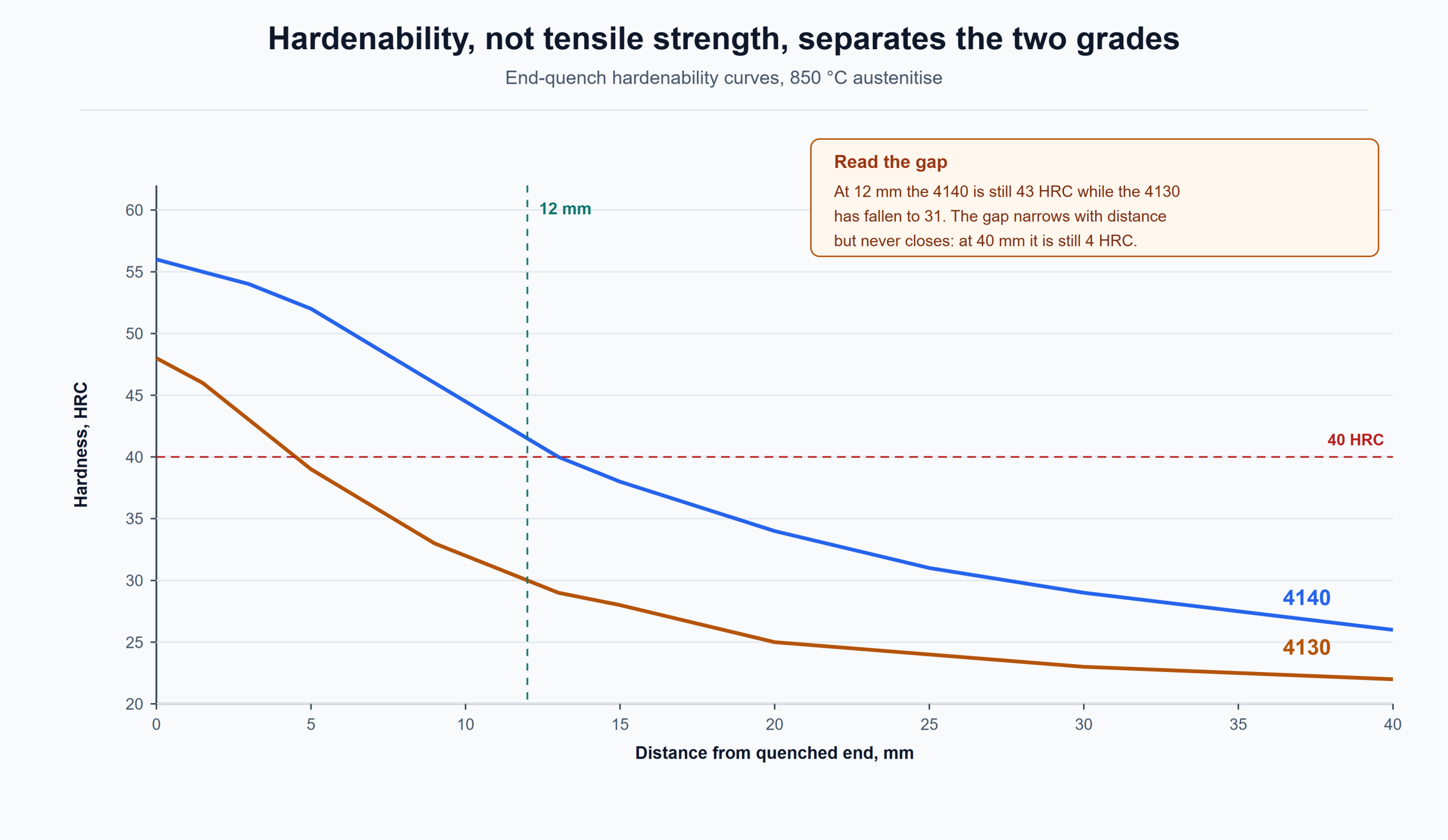
End-quench testing puts a number on it. At the quenched end both grades are martensitic; 12 mm down the specimen the 4140 is still above 40 HRC while the 4130 has already fallen below 32 HRC. Translated to a round bar quenched in oil, that is the difference between full hardness through 60 mm and full hardness through 25 mm.
Table 2. Practical section capability, oil quench, 850 °C austenitise.
| Section | 4130 | 4140 | Comment |
|---|---|---|---|
| ≤ 20 mm | Through-hardened | Through-hardened | Both reach 95 % martensite at the centre |
| 20–40 mm | Mixed structure | Through-hardened | 4130 centre falls to bainite and ferrite |
| 40–70 mm | Surface only | Through-hardened | 4130 needs a polymer quench and still misses |
| 70–120 mm | Surface only | Surface hardened | 4140 needs water or polymer, risk of cracking |
| > 120 mm | Not suitable | Limited | Consider 4340 or a higher-hardenability grade |
What each grade delivers
In the normalized condition the gap is narrower than most people expect; after quenching and tempering it opens up. The table gives the properties a purchase order should be written against.
Table 3. Typical mechanical properties, bar and plate.
| Condition | Grade | Yield, MPa | Tensile, MPa | Hardness |
|---|---|---|---|---|
| Normalized | 4130 | 415–520 | 620–760 | 170–200 HBW |
| Normalized | 4140 | 655–725 | 900–1,035 | 215–250 HBW |
| Annealed | 4130 | 360–430 | 560–670 | 156–197 HBW |
| Annealed | 4140 | 415–500 | 655–760 | 197–229 HBW |
| Q&T 540 °C | 4140 | 1,035–1,170 | 1,170–1,310 | 32–36 HRC |
| Q&T 425 °C | 4140 | 1,310–1,450 | 1,450–1,600 | 42–46 HRC |
Two points in that table are worth a second look. First, 4140 normalized already yields at about 690 MPa, which is why fabricators who never heat treat still specify it — the as-supplied part is stronger than an annealed 4130 part. Second, the Q&T rows only exist for 4140: 4130 is rarely quenched and tempered because at 0.30 % C the hardness ceiling is around 45 HRC, and above 40 HRC the toughness falls away faster than the strength rises.
The aerospace route uses 4130 in the normalized or normalized-and-tempered condition, not in the quenched condition. AMS 6345 covers the tube, AMS 6346 the sheet and strip, and AMS 6350 the bar — three product forms of the same grade, each with its own allowance on mechanical properties.
Welding: where 4130 earns its place
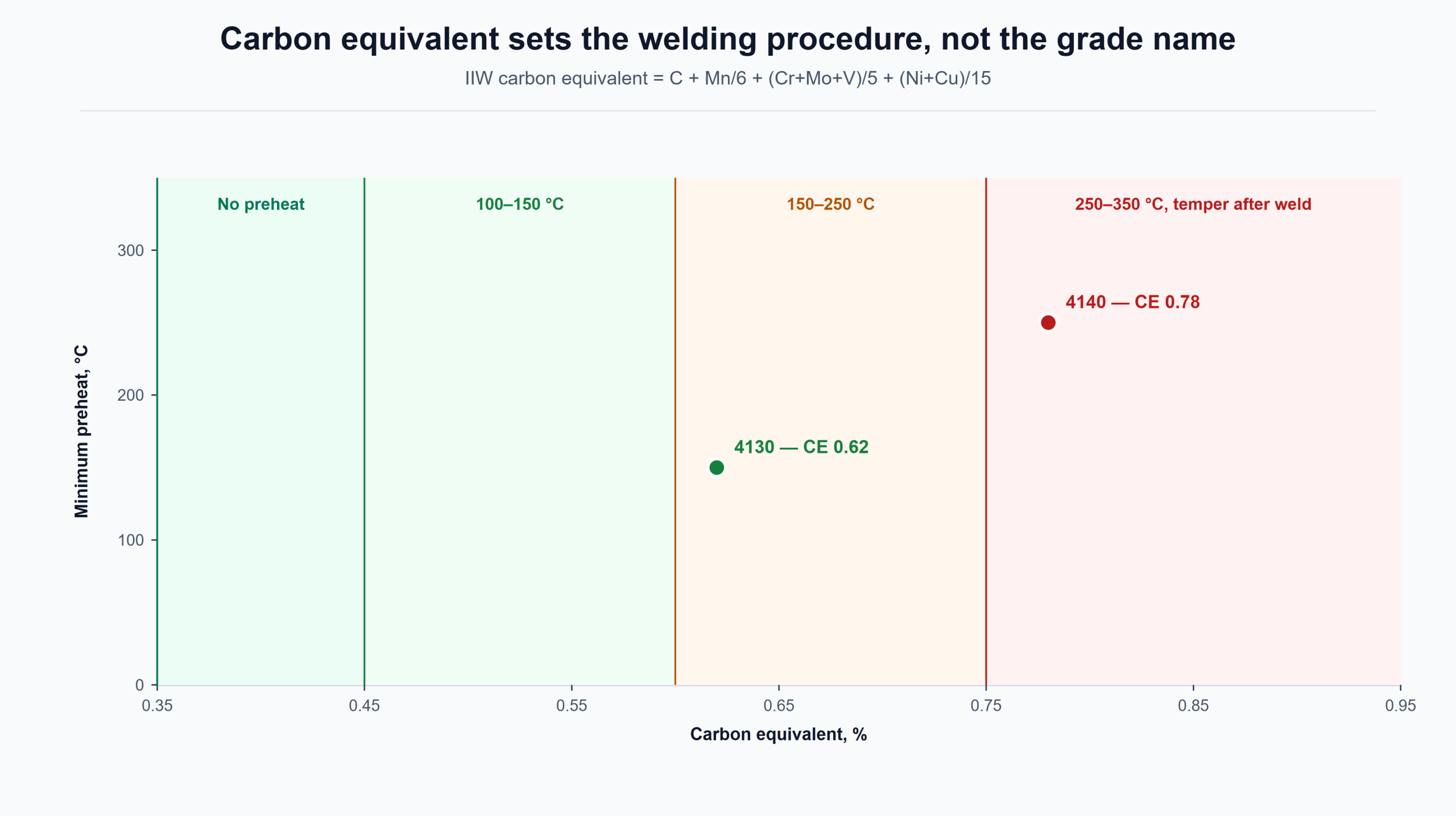
Carbon equivalent is the number a welding engineer needs, not the tensile strength. On the IIW formula, 4130 sits near 0.62 and 4140 near 0.78 — a step that moves the job from “preheat if the section is thick” to “preheat, control interpass, and temper immediately”.
In practice:
- 4130 tube — 150 °C preheat, ER80S-D2 or ER70S-6 filler, no post-weld heat treatment for wall thickness under about 6 mm. This is the combination behind aircraft fuselage clusters, race-car space frames and bicycle frames.
- 4140 bar — 200–260 °C preheat, interpass held at that temperature, low-hydrogen practice, and a temper at 550–620 °C as soon as the weld cools. Left un-tempered, the heat-affected zone forms untempered martensite and cracks within hours, not months.
Welding 4130 to 4140 in the same assembly is common and does not require a special filler. The weld takes the lower-carbon grade as its reference, and the strength of the joint is limited by the weaker of the two heat-affected zones. What it does require is that the preheat is set by the higher-carbon side.
Machining and cost
4140 in the normalized or annealed condition machines better than 4130, despite being harder. The difference is “gumminess”: low-carbon chromoly tears rather than cuts, produces a built-up edge on carbide and gives a poor surface at high feed. 4140 at 200–250 HBW breaks the chip cleanly.
The cost picture is decided by availability, not by alloy content. 4140 is a stock grade in bar and plate at almost every service centre; 4130 is a stock grade in tube and sheet. A part designed in 4130 bar or 4140 tube is a part with a lead time, and usually a minimum order quantity attached.
How to choose
Work through four questions and the grade follows:
- Is the section over 40 mm and does it need to be hard in the centre? Then 4140, or a higher-hardenability grade if it is over 120 mm.
- Is anything welded to it? If the answer is yes and the wall is thin, 4130. If the answer is yes and the part is a heavy forging, 4140 with a written procedure.
- Does the part need to hold 1,200 MPa or more? 4140, quenched and tempered, with 4130 excluded by its carbon ceiling.
- Is the part a tube or a sheet? 4130, because that is the form the mills roll.
Above 120 mm there is no answer inside this pair. The next step is a nickel-bearing grade such as 4340, which buys hardenability with nickel rather than with carbon and keeps the weldability problem from getting worse.
Substitution caution
Replacing 4130 with 4140 in a welded assembly raises the carbon equivalent of the joint from 0.62 to 0.78 and can double the preheat requirement. Replacing 4140 with 4130 in a thick section drops the centre hardness below the drawing. Neither substitution is “the same steel, cheaper”.
Frequently asked questions
Is 4140 stronger than 4130?
Yes, in every condition. The margin is about 200 MPa in the normalized condition and 400 MPa or more after quenching and tempering, because 4140 can be hardened to 45 HRC while 4130 tops out near 45 HRC only at the surface of a thin section.
Can 4130 be quenched and tempered?
It can, and it is, but the useful window is narrow. Above about 40 HRC the toughness drops steeply and the grade no longer offers an advantage over 4140. Most 4130 is supplied normalized or normalized and tempered.
Which grade is better for a shaft?
4140, unless the shaft is under about 25 mm diameter and lightly loaded. A shaft needs hardness at the bearing seat and strength through the section, and that is a hardenability requirement rather than a chemistry one.
Does 4130 need post-weld heat treatment?
For thin-wall tube with 150 °C preheat, no. For sections above roughly 10 mm, or where the part sees fatigue loading, a stress relief at 600 °C is normal practice even though the specification does not demand it.
Related reading
- All About 4130 Steel — the full property set, heat treatment and aerospace specification map
- 4130 AMS 6345 / 6346 / 6350 — tube, sheet and bar specifications for aircraft use
- 4140 vs 4150 — what another ten points of carbon changes
- AISI 4140 L80 — the oil-and-gas condition of the same grade
- Quenching and Tempering Large Forgings — why section size decides the tempering cycle
You get chemical composition, mechanical properties and a price — with inspection certificates to EN 10204 3.1 issued against the heat number.