
AISI 4130 is a chromium-molybdenum steel with 0.28–0.33 % carbon and about 1 % chromium. It is weldable in all commercial processes, through-hardening, and normally supplied as tube or bar for airframe structures, bicycle frames and high-pressure equipment. The combination of moderate carbon with 1 % Cr and 0.2 % Mo is what gives it strength well above plain carbon steel without losing weldability.
Chemical composition
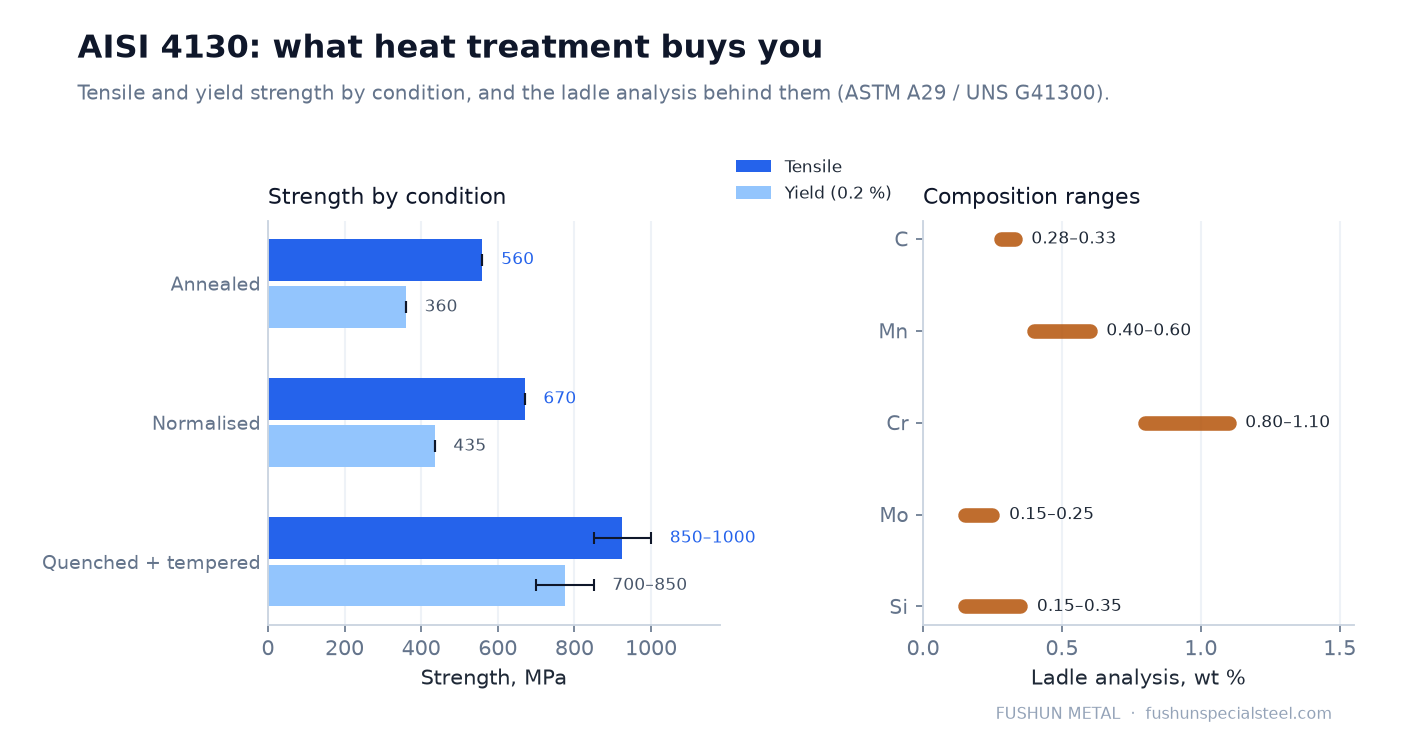
Typical ladle analysis to ASTM A29 / AISI 4130 (UNS G41300):
| Element | Range (%) |
|---|---|
| Carbon, C | 0.28 – 0.33 |
| Manganese, Mn | 0.40 – 0.60 |
| Chromium, Cr | 0.80 – 1.10 |
| Molybdenum, Mo | 0.15 – 0.25 |
| Silicon, Si | 0.15 – 0.35 |
| Phosphorus, P | 0.035 max |
| Sulphur, S | 0.040 max |
Equivalent grades
| System | Designation |
|---|---|
| AISI / SAE | 4130 — UNS G41300 |
| DIN / EN | 25CrMo4 — 1.7218 |
| JIS | SCM430 (JIS G4105) |
| AFNOR | 25CD4 |
Mechanical properties
Typical values. Section size and the exact heat treatment move these numbers, so treat them as a guide and confirm against the mill certificate for a specific order.
| Condition | Tensile (MPa) | Yield (MPa) | Elongation | Hardness |
|---|---|---|---|---|
| Annealed | about 560 | about 360 | about 28 % | about 170 HB |
| Normalised | about 670 | about 435 | about 25 % | about 197 HB |
| Quenched and tempered | 850 – 1000 | 700 – 850 | 12 – 18 % | 28 – 35 HRC |
Heat treatment
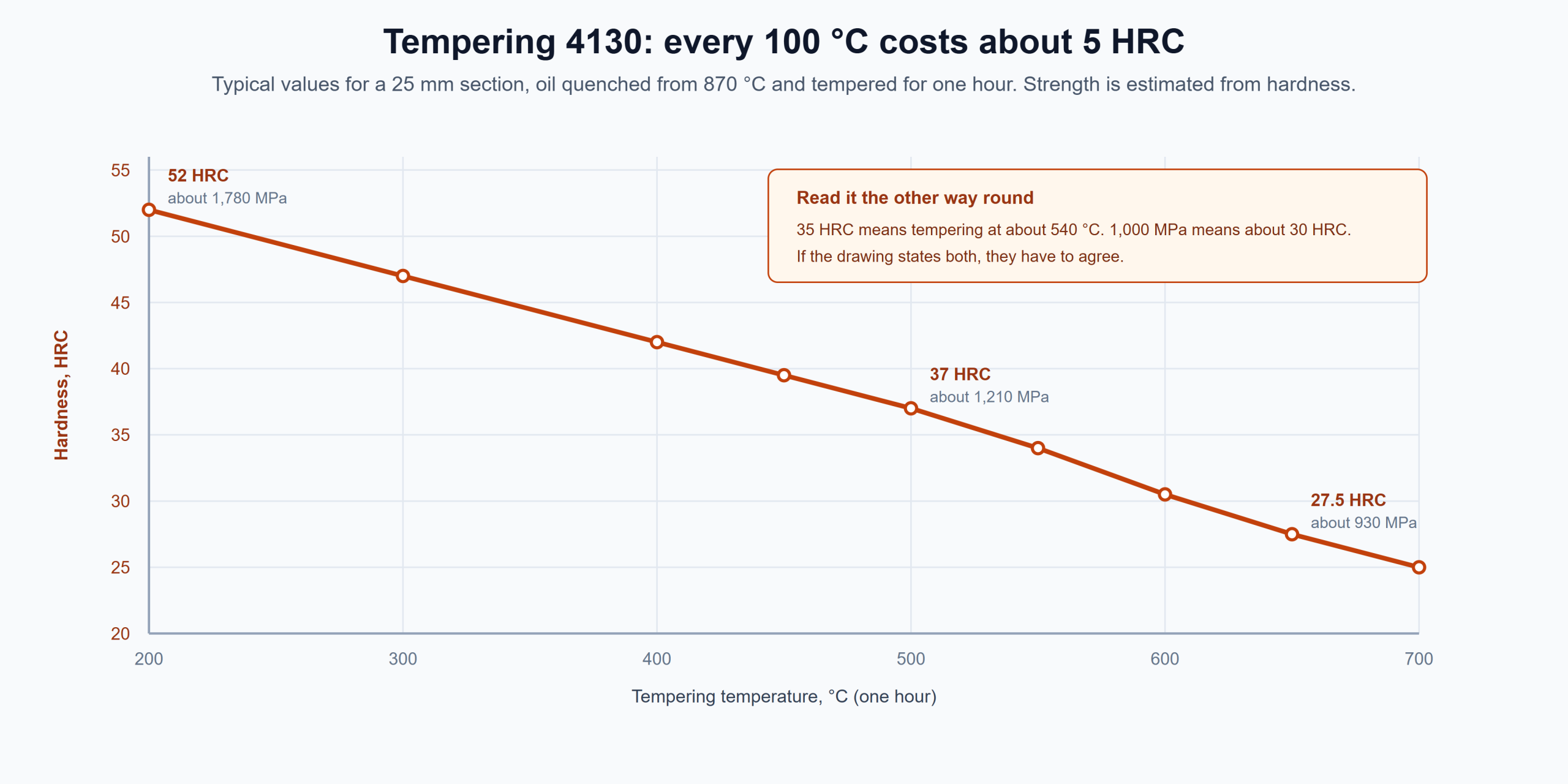
Annealing is done at 845–900 °C followed by slow furnace cooling. For hardening, austenitise at 855–880 °C, quench in oil (water is used only on heavy sections), then temper immediately at 400–650 °C depending on the strength required. 4130 is through-hardening, but the ruling section matters: above roughly 25 mm the centre will not reach the same hardness as the surface.
The cooling side of the same story is covered under what quenching does, and the direct grade comparison under 4140 against 4130.
Welding is the other reason this grade gets specified. Preheating at 150–200 °C and a post-weld stress relief are normal on sections over about 6 mm, and the weld zone hardness should be checked after stress relief.
What the 4130 designation means
4130 steel gets its name from specific rules outlined by the AISI and SAE. The first digit of the alloy designates the class of the steel, including its major alloying component(s). The second digit represents the relative percentage of this alloying element and/or other important secondary elements. The last two digits represent the carbon concentration in 0.01% increments. Knowing these rules, 4130 steel is, therefore, part of the 4xxx and 41xx series (the chromium-molybdenum steels) with around 1% molybdenum/chromium by mass with an included 0.30% carbon. To learn more about the differences between steels, feel free to browse our article on the types of steels.
Below is an exact chemical breakdown of 4130 steel, with tolerances:
0.28 – 0.33% Carbon
0.8 – 1.1% Chromium
0.7 – 0.9% Manganese
0.15 – 0.25% Molybdenum
≤ 0.035% Phosphorus
0.15 – 0.35% Silicon
≤ 0.04% Sulphur
4130 steel is a chromium-molybdenum alloy steel and is considered a low carbon steel. It has a density of 7.85 g/cm3 (0.284 lb/in3) and benefits from heat-treatment hardening. It is an exceptional welding steel, being weldable in all commercial methods, and is readily machined in its normalized/tempered condition. 4130 steel is easily cold worked, hot worked, and forged, but cannot be aged. It has excellent ductility when annealed and is a through-hardening alloy. 4130 steel performs best as a structural steel, and is most often found as round tube or bar stock in structural applications for aircraft and buildings.
Mechanical Properties
The elastic modulus is a measure of a material’s elasticity, as well as its resistance to elastic deformation. It is a common mechanical value that is often used to show a material’s stiffness and is especially useful when comparing engineering metals. Type 4130 steel has a modulus of elasticity of 205 GPa (29700 ksi), which is higher than some high strength spring steels such a 9260 steel (read more in our article on 9260 steel). This means that 4130 steel does not easily bend and can withstand large stresses and still return to its original form. This is a great characteristic in structural steel, as its main goal is to remain rigidly in place.
The ultimate and yield tensile strengths provide the maximum stress a material can withstand before permanent changes in geometry occur. Yield stress describes the onset of permanent (or plastic) deformation, and the ultimate strength is the stress value before fracture. Both are important measures for designers, but yield strength is a vital component in structural applications where this value can never be exceeded. 4130 steel’s tensile yield strength is 435 MPa (63100 psi), which is surprisingly low when compared to other steels. This is not to say that 4130 steel is weak; in fact, it far surpasses most aluminum alloys.
Hardness is a qualitative, comparative parameter that describes the response of a material to local surface deformation. There are many hardness scales that depend on standard hardness testing machines; for most alloys, the Rockwell indenter machine is used and each material is graded on the Rockwell hardness scales. There are three main scales (A, B, & C), where the Rockwell B hardness scale value is depicted in Table 1. For reference, the Rockwell B hardness of copper, a relatively soft metal, is 51. Type 4130 steel has a Rockwell hardness of 92, which is high for steel and shows why this material is so tough. A high hardness usually indicates increased stiffness, which is an ideal property for materials in compression.
Elongation at break is a measure of a material’s ability to resist plastic deformation before its fracture point. It is found by pulling a test specimen apart and measuring the ratio of its initial length to its final length before fracture. Elongation at break is generally used to show how bendable a material is, and/or how it withstands plastic deformation. This parameter is quite high in 4130 steel (25.5%), which shows the great workability of this alloy steel.
Applications of 4130 Steel
Type 4130 steel is an exceptionally tough metal vital to manufacturing, welding, cutting, and other high-stress applications in industry. Its great heat treatment characteristics impart a high toughness and, combined with its great workability and machinability, allows 4130 steel to be widely useful. Though most often implemented as structural steel, there are some other notable applications, such as:
Manufacturing equipment for bearings, vehicle parts, and gears
Rock crushing machinery
Resistance welding products
Drill bits and taps
Mills and cutters
and more.
4130 steel is a popular, easily sourced material for projects of all kinds. If you think 4130 steel might be useful in your designs, feel free to contact your supplier and ask if they have it in stock. They most likely will have plenty, and if they don’t, they will be the best source of information for alternatives to consider.
Fushun Special Steel LTD CO
Fushun Metal is a large special steel manufacturer and supplier. We are metal experts and have been providing quality customer service and products since 1998.
At Fushun Metal, we supply a wide range of metals for a variety of applications. Our products/stock includes: stainless steel, alloy steel, spring steel, tool steel, high speed steel, mould steel, nickel alloy.
Our hot rolled and cold rolled steel is available in a wide range of shapes including: bars, tubes, sheets and plates. We can cut metal to your exact specifications.
Send your inquiry information to us and get a free quotation today!
Related reading
- 4140 vs 4130 — 0.1 % more carbon, a different steel.
- AISI 4140 — the grade most often substituted for 4130.
- AISI 4340 — the nickel-bearing step up for thick sections.
- What is quenching — cooling rate and the hardness it produces.
You get chemical composition, mechanical properties and a price — with inspection certificates to EN 10204 3.1 issued against the heat number.
Higher-carbon neighbours in the same family are covered under AISI 4140 and AISI 4340.

