
K418 Master Alloy for Investment Casting and Remelting
The cobalt-free cast nickel superalloy. K418 (IN-713C, UNS N07713) is the grade behind a large share of the world’s turbocharger wheels and a long list of industrial valve bodies, precisely because it does without cobalt and still holds 900 °C. We supply it as 5, 10 and 25 kg ingots and as Ø30–250 mm bar, VIM or VIM+ESR, with the gas and trace-element limits written into the order.
At a glance
| Item | K418 master alloy |
|---|---|
| Designation | K418 (former K18) · IN-713C · UNS N07713 · W.Nr 2.4671 |
| Form | Cast ingot 5 / 10 / 25 kg; round bar Ø30–250 mm; cut-to-length pieces |
| Condition | As cast, shot blasted, turned or ground; stress relief on request |
| Melting route | VIM, VIM+ESR or VIM+ESR+VAR, selected against the gas limit |
| Standards | GB/T 14992 · GJB 5512.1 · AMS 5391 · HB 7763 |
| Certificate | EN 10204 3.1, chemistry including O/N/S and trace elements, hardness on request |
| Traceability | Heat number stamped on the end face, repeated on the MTC and the crate |
The short answer for a buyer: we can hold the GB/T 14992 window, tighten Al and Ti to an agreed band, and report oxygen, nitrogen and sulphur by heat. What we cannot do is quote a number before the melting route and the sampling position are fixed — those two decide whether the heat lands at 15 ppm or 45 ppm.
Supply forms and sizes
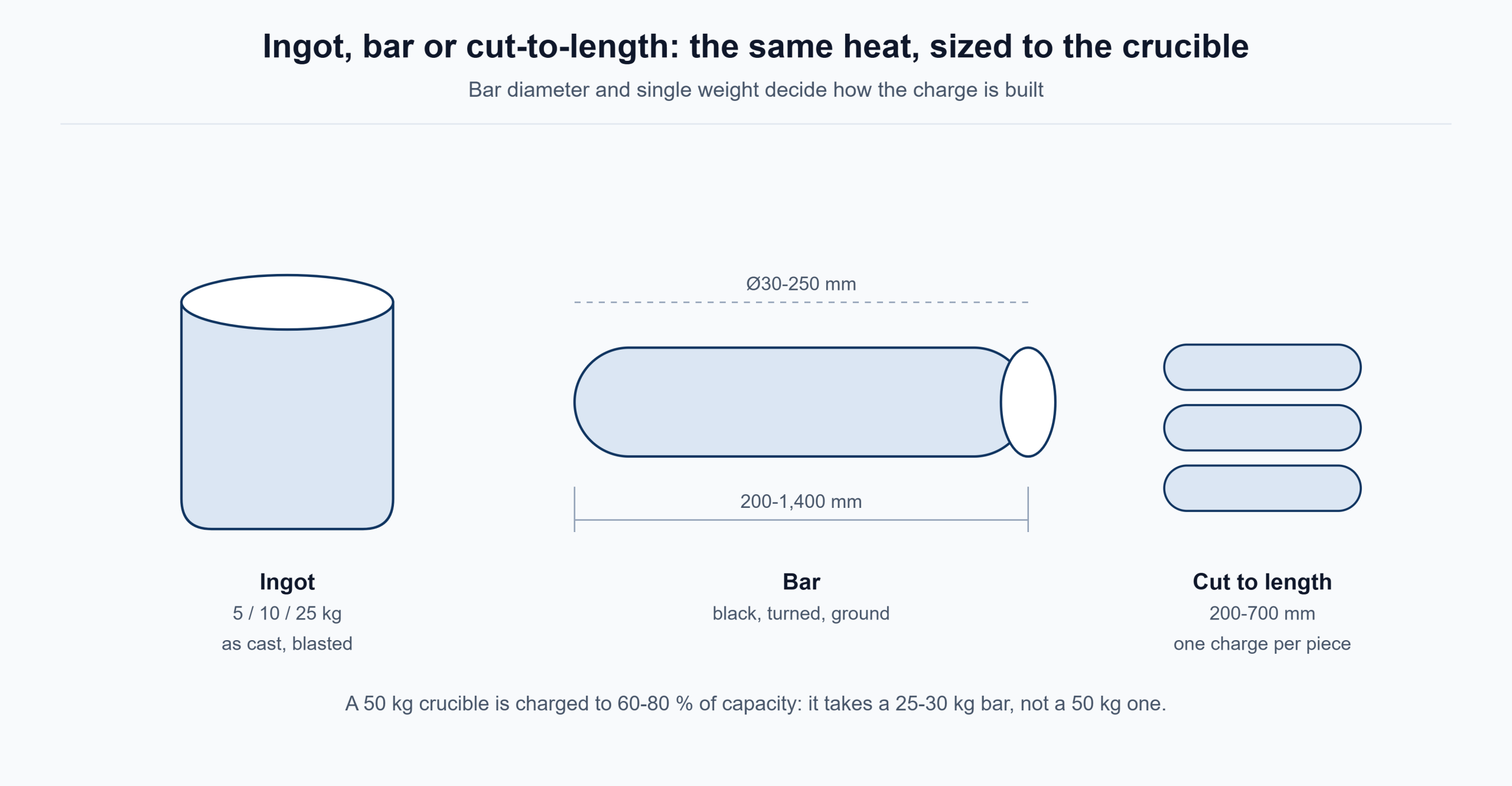
| Form | Size | Length | Tolerance | Surface | Fits |
|---|---|---|---|---|---|
| Ingot | 5 / 10 / 25 kg | — | Per ingot mould | As cast, shot blasted | Crucibles of 25–50 kg |
| Round bar | Ø30–250 mm | 200–1,400 mm | ±1 mm dia., ±10 mm length | Black, shot blasted, turned, ground | Remelt shop feeding a casting cell |
| Cut-to-length | From bar stock | 200–700 mm | ±1 mm | Turned or ground | One heat, one charge, no cutting loss |
A furnace is normally charged to 60–80 % of crucible capacity, so a 50 kg crucible takes a 25–30 kg bar, not a 50 kg one. That single line decides the size you should order, and it is the most common correction we make to an enquiry. Cut-to-length pieces cost more per kilogram and save it back in remelting loss and in saw time at the customer’s shop.
Bars are straightened to 1 mm/m; ingot weight is set by the mould, so a 12 kg ingot is a mould change.
Chemical composition
| Element, % | GB/T 14992 | AMS 5391 |
|---|---|---|
| C | 0.08–0.16 | 0.08–0.20 |
| Cr | 11.5–13.5 | 12.0–14.0 |
| Mo | 3.8–4.8 | 3.8–5.2 |
| Al | 5.5–6.4 | 5.5–6.5 |
| Ti | 0.5–1.0 | 0.5–1.0 |
| Nb | 1.8–2.5 | 1.8–2.8 |
| B | 0.008–0.020 | 0.005–0.015 |
| Zr | 0.06–0.15 | 0.05–0.15 |
| Fe | ≤1.0 | ≤1.00 |
| Si / Mn | ≤0.50 / ≤0.50 | ≤0.50 / ≤0.25 |
| P / S | ≤0.015 / ≤0.010 | ≤0.015 / ≤0.015 |
| Ni | Balance | Balance |
Aluminium at 5.5–6.4 % with titanium at 0.5–1.0 % is the window that makes this grade work: aluminium forms the γ′ volume fraction that carries the strength, titanium tunes it, and together they set the freezing range. Push aluminium to the top of the window and the alloy pours badly and drops primary γ′; pull it low and the 800 °C strength goes with it.
For casting houses running a repeat job we hold an internal band narrower than the standard — typically ±0.2 % on Al and ±0.1 % on Ti — and report the aim values on the certificate. It costs nothing at the melt and removes a whole class of casting scrap.
Gas content and inclusions
| Item | Aerospace grade | Industrial grade (normal) |
|---|---|---|
| Oxygen | ≤8 ppm | 30–50 ppm |
| Nitrogen / sulphur | ≤5 ppm / ≤3 ppm | Agreed per grade |
| O+N+S total | ≤15 ppm (12 ppm preferred) | No combined control |
| Pb, Bi, Sb, Sn, As, Cd | ≤5 ppm each, ≤20 ppm total | Per AMS 2280 or customer |
| Maximum inclusion size | ≤20 µm | Metallographic agreement |
| Harmful inclusion | None above 30 µm in any field | — |
Oxygen does not come from the alloy; it comes from the crucible lining, the surface of the charge and the leak rate of the furnace. That is why 30–50 ppm is a normal industrial result from a single VIM heat and 8 ppm needs a clean charge, a tight furnace and usually a second melting step. If a purchase order asks for 15 ppm without naming the route, it is asking for the triple-melt route.
Mechanical acceptance: the test bar, not the bar
| Test | Temperature | σb, MPa | σp0.2, MPa | δ5, % | &psi, % |
|---|---|---|---|---|---|
| Tensile | 20 °C | ≥755 | ≥686 | ≥3.0 | — |
| Tensile | 800 °C | ≥755 | — | ≥4.0 | ≥6.0 |
| Stress rupture | 750 °C / 608 MPa | — | — | ≥40 h | ≥3.0 |
| Stress rupture | 800 °C / 490 MPa | — | — | ≥45 h | ≥3.0 |
Master alloy is a cast, coarse-grained product, so testing the bar itself tells you very little. Acceptance is done on a remelt test bar poured from the master alloy under the customer’s casting practice — GJB 5515.1 and HB 7763 both work this way. The bar can be poured by us against an agreed procedure, or by the customer and reported back; the second route is cheaper and is what most foundries prefer.
Two rules in the standard are worth knowing before the contract is signed. Tensile and stress rupture may be tested at one temperature, not both, which halves the testing cost. And rupture is run on one heat in ten, with the elongation and reduction of area after fracture reported but not used as a rejection criterion. Both rules are negotiation levers, and both are routinely missed.
Melting route and standards
Four standards appear on K418 documents and they do different jobs. GB/T 14992 defines what the grade is — the composition window above. GJB 5512.1 sets what a master alloy heat has to reach in cleanliness and consistency. AMS 5391 governs the investment casting made from it, including sampling and retest rules. AMS 2280 covers the trace elements. A purchase order that says “per AMS 5391” is therefore asking for more testing than one that says “per GB/T 14992”, and the difference is visible in the cost.
| Route | Oxygen | Relative cost | Fits |
|---|---|---|---|
| VIM only | 30–50 ppm | 1.0 | Turbocharger wheels, valve bodies, general castings |
| VIM + ESR | 20–30 ppm, very low S | 1.3–1.5 | Heavy sections, low-sulphur grades |
| VIM + VAR | 20–30 ppm, low gas | 1.3–1.6 | Conversion stock, rotating parts |
| VIM + ESR + VAR | ≤10–15 ppm | 1.6–2.0 | Aerospace rotating parts, powder stock |
The relative cost column is a ratio, not a quotation: the route is a commercial decision as much as a metallurgical one, and it belongs in the enquiry rather than in the catalogue.
Packing, marking and traceability
- End face — grade, heat number, melt date and net weight stamped on every bar or ingot
- MTC — chemistry including gas and trace elements, hardness if requested, standard applied, inspector and date
- Packing — rust preventive, VCI wrap, crate or wooden case with desiccant; ISPM 15 heat treatment for export
- Disclosure — melt shop and heat number available before the order, not only after delivery
The surface state travels on the packing list, because it decides how the bar is handled before charging.
What to send with an enquiry
- Grade and acceptance standard — K418 to GB/T 14992, GJB 5512.1 or AMS
- Form and size — ingot weight, or bar diameter, length and single weight
- Furnace or crucible — capacity and charge weight, so the bar fits
- Gas and trace limits — O, N, S, combined total, and where the sample is taken
- Test bar and certificate — who pours, how often, 3.1 or 3.1 plus third-party
Email [email protected] · WhatsApp +86 178 7358 1838 · or use the form below.
FUSHUN METAL · AS9120B · EN 10204 3.1 with the heat number.
Same supply chain, different balance of cobalt, chromium and gas control.
- Master alloy hub — all six grades and three forms
- K438 master alloy — the hot-corrosion grade — when the fuel contains sulphur and vanadium
- K417G master alloy — IN-100 class blade alloy — for 900–1,000 °C blades
- Vacuum induction melting: where the oxygen comes from
- Nickel-based superalloy melting process