
K417G Master Alloy for Turbine Blades and Nozzle Segments
The 900–1,000 °C blade alloy, with the cobalt pulled back. K417G is the Chinese derivative of the IN-100 family: lower cobalt than IN-100, slightly lower titanium, better structural stability after long exposure. We supply Ø50–200 mm bar, VIM+VAR or triple melt, with oxygen held at 20 ppm and acceptance run on remelt test bars rather than on the bar.
At a glance
| Item | K417G master alloy |
|---|---|
| Designation | K417G · IN-100 class (not a one-for-one equivalent) · Rene 100 family |
| Form | Round bar Ø50–200 mm, cut-to-length; ingot on request |
| Condition | As cast, turned or ground |
| Melting route | VIM+VAR as standard; VIM+ESR+VAR for rotating parts |
| Standards | GB/T 14992 · GJB 5512.1 · GJB 5515.1 · HB 7763 · AMS 2280 |
| Certificate | EN 10204 3.1 with chemistry, gas and trace elements |
The “class” wording is deliberate. K417G is not IN-100 with a different label: cobalt runs 9–11 % instead of 13–16 %, and titanium is held slightly lower. A customer who needs a qualified IN-100 heat for an existing drawing should say so, because substituting one for the other is a re-qualification, not a purchase decision.
Where the temperature goes
Below 900 °C there is a wide choice, and K418 is usually the cheaper one. Between 900 and 1,000 °C the choice narrows quickly: the γ′ fraction has to stay high enough to carry the load, and the alloy has to keep a coherent γ/γ′ structure after hundreds of hours. K417G sits in that band, which is why it appears on turbine blades, nozzle segments and the hotter static parts. Above 1,000 °C the answer is no longer an equiaxed casting at all — it is directionally solidified or single crystal, and the cost moves by a factor of five to ten.
That progression is worth stating plainly to anyone specifying a blade: the alloy is not chosen at the top of its range. It is chosen so that the service temperature sits comfortably inside it, with margin for a hot restart and for the drift that comes with a coated surface.
Supply forms and sizes
| Form | Size | Length | Tolerance | Surface | Fits |
|---|---|---|---|---|---|
| Round bar | Ø50–200 mm | 200–1,200 mm | ±1 mm dia., ±10 mm length | Black, turned, ground | Blade and vane castings |
| Cut-to-length | From bar | 200–600 mm | ±1 mm | Turned | One charge per casting |
| Ingot | 5 / 10 kg | — | Per mould | As cast | Trial heats, small lots |
For blade work the cut-to-length piece is worth the premium: a bar that has been cut to the charge weight enters the crucible once, with one clean surface, instead of being sawn in the customer’s shop where the saw coolant becomes the contamination source.
Chemical composition
| Element, % | K417G (GB/T 14992) | IN-100 (typical) |
|---|---|---|
| C | 0.13–0.22 | 0.15–0.19 |
| Cr | 8.5–9.5 | 9.0–10.0 |
| Co | 9.0–11.0 | 13.0–16.0 |
| Mo | 2.5–3.5 | 2.8–3.2 |
| Al | 4.8–5.7 | 5.4–5.7 |
| Ti | 4.1–4.7 | 4.5–4.8 |
| V | 0.60–0.90 | 0.80–1.10 |
| B | 0.012–0.024 | 0.014–0.020 |
| Zr | 0.05–0.09 | 0.03–0.09 |
| Fe / Si / Mn | ≤1.0 / ≤0.5 / ≤0.5 | ≤0.5 / ≤0.2 / ≤0.2 |
| P / S | ≤0.015 / ≤0.010 | ≤0.015 / ≤0.015 |
The cobalt line is the one to read twice. Cobalt raises the solvus and the γ′ fraction, and it is also the element whose cost moves most; the Chinese grade takes out three to five points of it and recovers the stability with a tighter carbon and boron window. The result is a blade alloy that is cheaper to melt and slightly less strong at the very top of the range — a trade that suits industrial turbine work and does not suit every aero drawing.
Gas content and inclusions
| Item | Aerospace grade | Industrial grade |
|---|---|---|
| Oxygen | ≤20 ppm (12 ppm on request) | 30–50 ppm |
| Nitrogen | ≤15 ppm | ≤30 ppm |
| Sulphur | ≤10 ppm | ≤0.010 % |
| O+N+S total | ≤30 ppm | No combined control |
| Trace elements | ≤5 ppm each, ≤20 ppm total | Per AMS 2280 |
| Inclusion limit | ≤20 µm, ≤2 per mm² | Agreed |
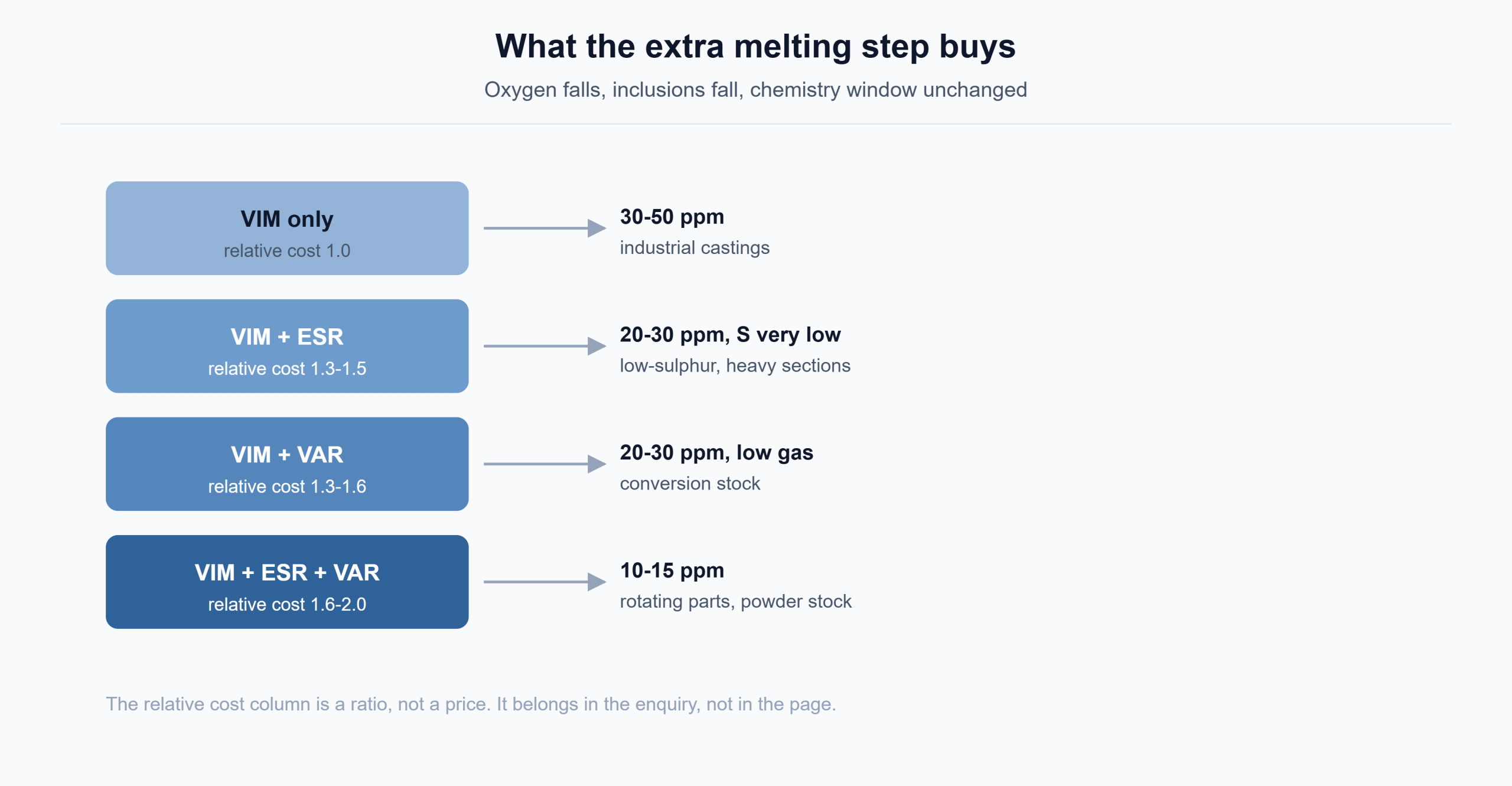
For a blade alloy the inclusion limit is not a formality. A 40 µm oxide film in a section that later sees low-cycle fatigue is a crack starter, and it will not appear in the chemistry report. If the part is a rotating blade, ask for the metallographic report by heat, not by batch.
Test-bar acceptance, and why it is done this way
| Test | Temperature | Typical value | Reported |
|---|---|---|---|
| Tensile | 20 °C | σb 880–920 MPa, σp0.2 700–750 MPa | δ5 4–8 % |
| Tensile | 900 °C | σb 600–650 MPa | δ5 ≥5 % |
| Stress rupture | 900 °C / 315 MPa | ≥70 h | δ5 |
| Hardness | 20 °C | 30–38 HRC | On request |
The master alloy is a cast, coarse-grained bar. Measuring tensile strength on it measures the casting, not the material, so the standard route is to remelt a sample under the customer’s process, pour a test bar, heat treat it and test that. GJB 5515.1 and HB 7763 describe the bar and the sampling; the values above are typical for the grade, and the contractual limits belong in the purchase order.
Melting route and standards
VIM+VAR is the normal route for this grade: VAR is what removes the last of the nitrogen and closes the centre porosity that a Ø200 mm VIM ingot carries. For rotating parts the drawing usually asks for the triple route, and the incremental cost is real but smaller than the cost of a rejected blade casting.
- GB/T 14992 — composition window
- GJB 5512.1 — master alloy specification for cast superalloys
- GJB 5515.1 / HB 7763 — remelt test bar and mechanical acceptance
- AMS 2280 — trace elements
- ASTM B637 — where a wrought reference is quoted for comparison
Packing, marking and traceability
- End face — grade, heat number, melt date, net weight
- MTC — chemistry, gas, trace elements, test-bar results when poured, inspector and date
- Packing — VCI wrap, crate, desiccant, ISPM 15
- Records — melt route and melt shop retained with the heat file for the life of the order
What to send with an enquiry
- Grade and drawing — K417G to GB/T 14992, or an IN-100 drawing that must not be substituted
- Service temperature and part — blade, vane or nozzle segment
- Form and size — bar diameter, length, single weight
- Oxygen and trace limits, with the sampling position
- Test bar — who pours, how often, and which standard governs
Email [email protected] · WhatsApp +86 178 7358 1838 · or use the form below.
FUSHUN METAL · AS9120B · EN 10204 3.1 with the heat number.
The alloys either side of K417G on the temperature ladder.
- Master alloy hub — all six grades and three forms
- K418 master alloy — below 900 °C — the volume grade
- K438 master alloy — when the fuel is dirty — chromium over strength
- VIM furnace design and trends
- Nickel-based superalloy melting process