
IN625 / GH3625 Atomization Rod for Corrosion-Resistant Powders
Same rod discipline as IN718, a different reason to buy it. GH3625 powder goes into parts that see seawater, acid and combustion condensate — valve bodies, pump components, liners, cladding layers. The electrode is machined to your clamp, ground to Ra ≤1.6 µm and marked so the powder lot can be traced back to the heat.
At a glance
| Item | GH3625 atomization rod |
|---|---|
| Designation | GH3625 · IN625 · UNS N06625 · W.Nr 2.4856 |
| Form | Round rod, straight lengths, ends machined |
| Size | Ø50–130 mm, length 120–700 mm or cut to clamp length |
| Condition | Turned, ground or mirror polished; Ra ≤1.6 µm |
| Melting route | VIM+VAR or VIM+ESR+VAR |
| Standards | GB/T 38941 (PREP sizes) · ASTM B446 chemistry · customer drawing |
| Marking | Grade, final melt heat number, melt date on the end face |
625 is the alloy customers come back for. The first order is a trial, the second is a production order and the third is a standing one, because once a corrosion-resistant part is qualified nobody wants to requalify it. That is the reason this page exists alongside the IN718 rod page rather than as a line item on it.
Why 625, and where the rod goes
The molybdenum and niobium in 625 give it resistance to chloride pitting and to a wide range of acids, and the alloy keeps useful strength to about 650 °C without a strengthening heat treatment. In powder form that turns into three demand streams: additive manufacturing of corrosion-resistant components, laser cladding of sealing surfaces and valve seats, and cold spray repair. Each stream wants a different powder size cut, but they start from the same electrode.
| Process | Powder cut | Typical part | What the rod has to be |
|---|---|---|---|
| LPBF | 15–45 µm | Valve bodies, pump housings, filters | Low oxygen, spherical, tight PSD |
| Laser cladding | 45–106 µm | Sealing faces, shaft repair, valve seats | Consistent feed, low porosity |
| EIGA / VIGA | 0–150 µm | Powder for HIP and MIM | Clean electrode, controlled O |
| Cold spray | 5–25 µm | Conductive and corrosion coatings | Very low oxygen, no satellites |
Rod sizes and end geometry
| Form | Size | Length | Tolerance | Surface | Fits |
|---|---|---|---|---|---|
| Ground rod | Ø50–130 mm | 120–700 mm | ±1 mm | Ra ≤1.6 µm | PREP, EIGA, LPBF stock |
| Turned rod | Ø50–130 mm | 120–700 mm | ±1 mm | Ra 3.2 µm | VIGA, cladding powder |
| Cut to clamp length | From bar | Per drawing | ±1 mm | As machined | One clamp, one heat |
Two machining details come up on almost every 625 enquiry. A centre hole, if the clamp uses one, has to be drilled before the final grind so the hole does not interrupt the surface the clamp grips. And a thread, where the machine pulls the rod from the end, is cut after grinding rather than before, because a threaded end in the chuck is a run-out problem waiting to happen. Both are quoted from the drawing, not from a standard size list.
Where 625 is the wrong answer: a part that has to carry load above about 650 °C belongs in 718, and a part exposed to reducing acids or chlorides at the aggressive end belongs in a C-family alloy. 625 sits between them and is chosen when one material has to do both jobs reasonably, which is most of the time.
Chemical composition
| Element, % | GH3625 (GB/T 14992) | IN625 (ASTM B446) |
|---|---|---|
| C | ≤0.10 | ≤0.10 |
| Cr | 20.0–23.0 | 20.0–23.0 |
| Ni | ≥58.0 | ≥58.0 |
| Mo | 8.0–10.0 | 8.0–10.0 |
| Nb+Ta | 3.15–4.15 | 3.15–4.15 |
| Fe | ≤5.0 | ≤5.0 |
| Ti / Al | ≤0.40 / ≤0.40 | ≤0.40 / ≤0.40 |
| Co | ≤1.0 | ≤1.0 |
| Si / Mn | ≤0.50 / ≤0.50 | ≤0.50 / ≤0.50 |
| P / S | ≤0.015 / ≤0.015 | ≤0.015 / ≤0.015 |
Niobium is the element that decides whether the powder behaves. It segregates during solidification, it forms Laves phases if the cooling is slow, and in powder form that shows up as a wider scatter in flowability and in the as-built microstructure. A homogeneous electrode is the most reliable route to a homogeneous powder.
Gas and inclusion limits
| Item | Atomization grade | General bar grade |
|---|---|---|
| Oxygen | ≤30 ppm (20 ppm on request) | 30–50 ppm |
| Nitrogen | ≤30 ppm | ≤50 ppm |
| Sulphur | ≤15 ppm | ≤15 ppm |
| Trace elements | Per AMS 2280, report per heat | On request |
| Surface | No oil, coolant or grinding burn | — |
| Density | No shrinkage cavity at the ends | Visual |
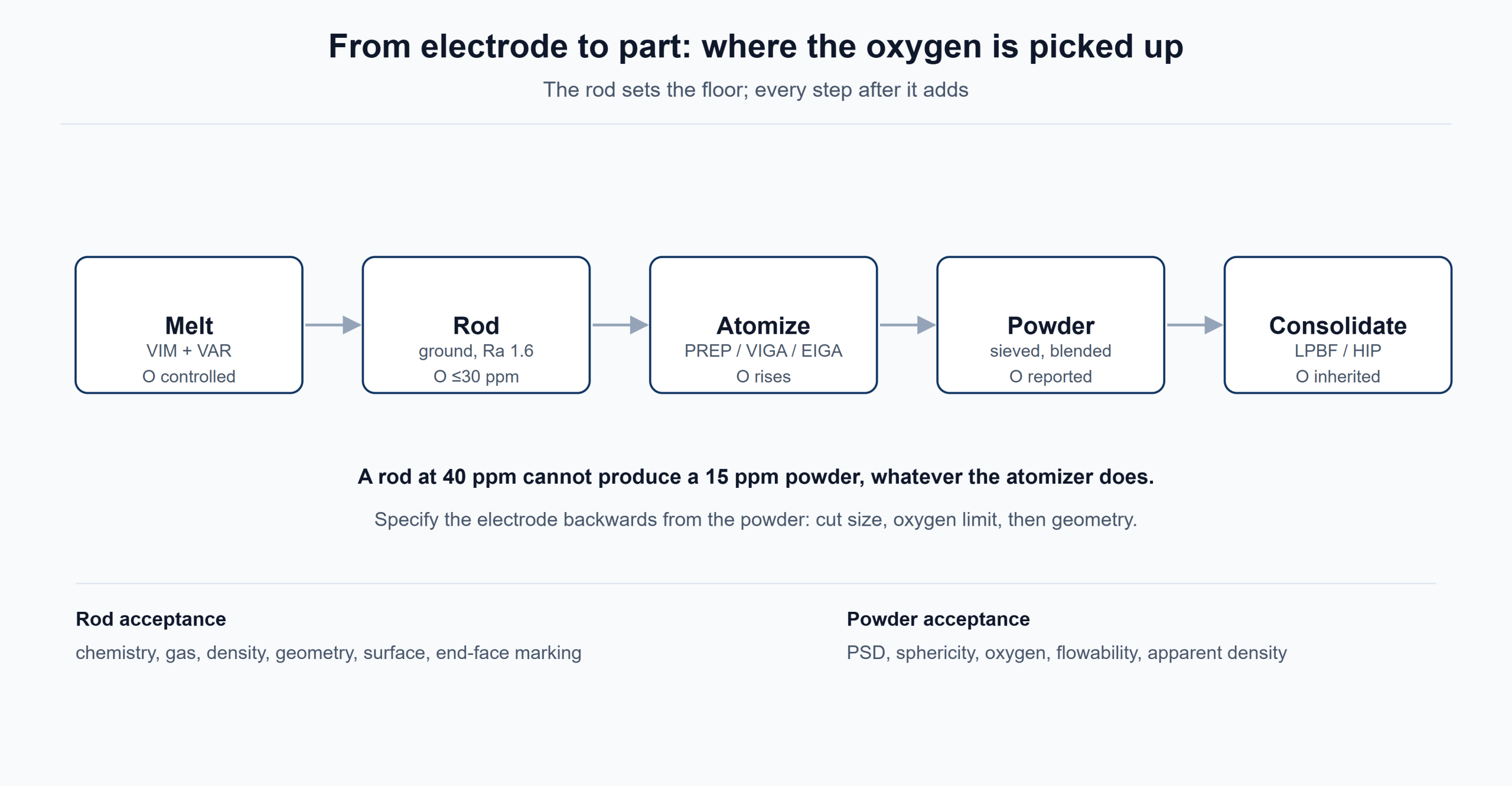
A pipe or a shrinkage cavity that runs into the rod end is not a cosmetic defect: it becomes a gas pocket in the atomizer and a porosity band in the powder. Rods are inspected at both ends before packing for this reason, and the requirement is written into the dimensional report.
What the consolidated material has to hit
| Property | Room temperature | Note |
|---|---|---|
| Tensile strength | ≥827 MPa | AMS 5666 reference |
| 0.2 % yield | ≥414 MPa | Annealed condition |
| Elongation | ≥30 % | In 50 mm |
| Hardness | ≤95 HRB | Typical for annealed bar |
These are the reference values for wrought 625, quoted so a customer can see what the powder is expected to deliver after consolidation. The rod itself is accepted on chemistry, gas, geometry and surface — the same split as the IN718 page, for the same reason.
Melting route and standards
| Route | Oxygen | Relative cost | Fits |
|---|---|---|---|
| VIM only | 30–50 ppm | 1.0 | Cladding powder, industrial parts |
| VIM + VAR | 20–30 ppm | 1.3–1.6 | LPBF and EIGA stock |
| VIM + ESR + VAR | ≤15–20 ppm | 1.6–2.0 | Aerospace and medical powder |
The 625 decision is usually made on oxygen and on the end use, not on strength. A cladding electrode at 40 ppm is fine; an LPBF electrode for a pressure-retaining part at 40 ppm is not, because the oxygen carries straight through the powder into the built part.
Marking, packing and traceability
- End face — grade, heat number, melt date
- Packing — sleeve, VCI paper, crate with desiccant; ends protected
- Documents — 3.1 with chemistry and gas, dimensional report, roughness record
- Link — heat number carried through to the powder lot by the customer’s own system
What to send with an enquiry
- Atomizer make and model, or the clamp drawing
- Rod diameter, length and single weight
- Surface and end geometry — turned, ground, Ra, centre hole
- Oxygen limit and the powder cut it has to serve
- Certificate and delivery terms
Email [email protected] · WhatsApp +86 178 7358 1838 · or use the form below.
FUSHUN METAL · AS9120B · EN 10204 3.1 with the heat number.
The 625 family, split by form so the pages do not compete for the same query.