
Master Alloy: Ingot, Bar and Atomization Rod
Six grades, three forms, one supply point. Master alloy is the heat that has not become a part yet: cast into ingots for a crucible, drawn into bar for a remelt shop, or machined into an electrode for a powder atomizer. The pages below are organised by what you are going to do with the metal, not by trade name.
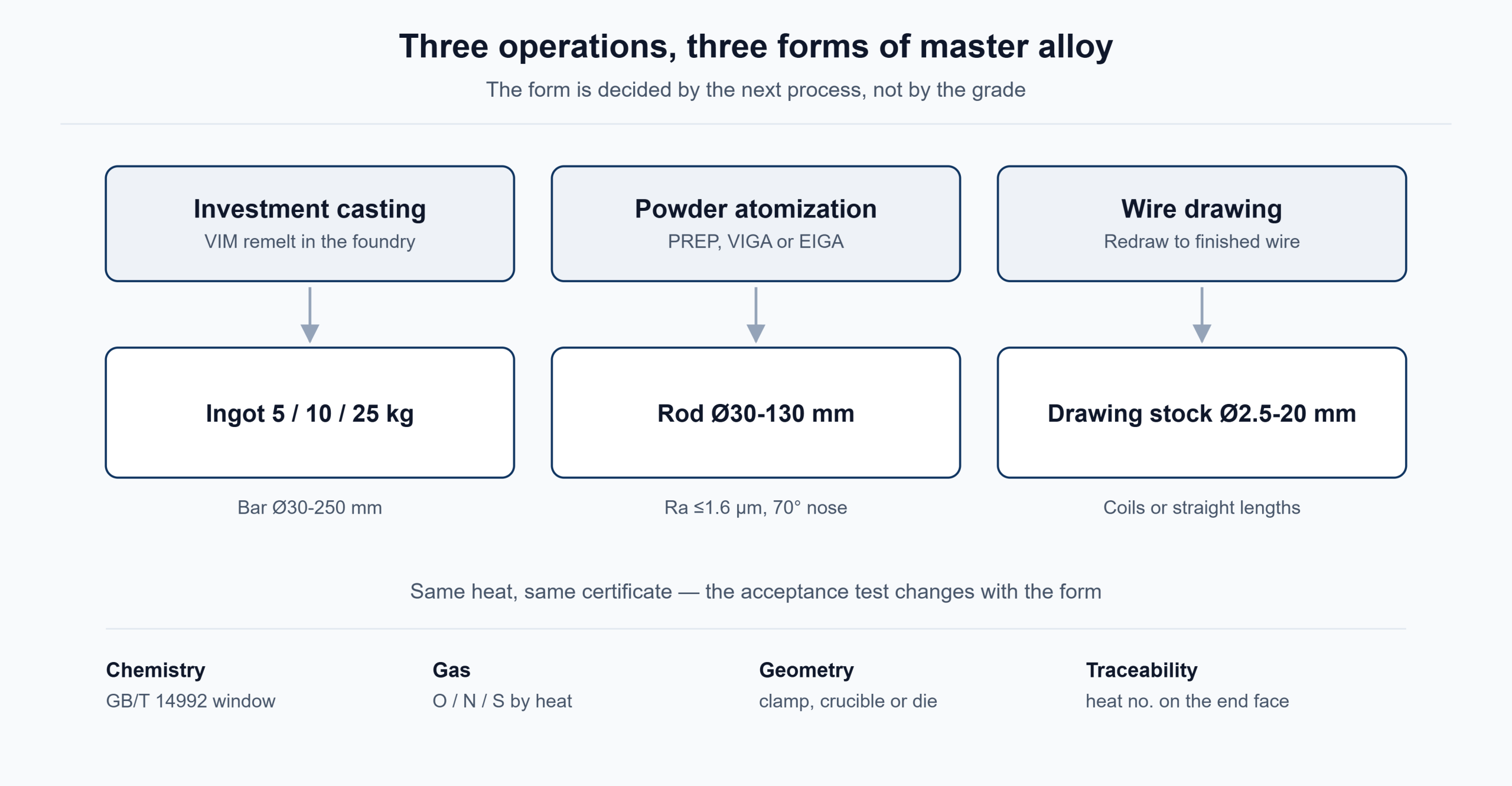
Start from the operation, not the grade
Most enquiries we receive open with a grade name and a weight. The form is decided later, usually after one exchange that could have been avoided. The three routes below cover what master alloy is actually used for; each one carries different size tolerances, different surface requirements and a different set of acceptance tests.
| If you are going to | You need | What decides the specification |
|---|---|---|
| Investment casting or remelting in a VIM furnace | Ingot (5/10/25 kg) or cut-to-length bar | Crucible capacity, charge weight per heat, whether the furnace can take a 1 m bar |
| Atomising powder (PREP, VIGA, EIGA) | Atomization rod, machined and end-faced | Clamp geometry, rod diameter and length, nose angle, surface roughness, oxygen limit |
| Drawing wire or re-melting for a weld consumable | Drawing stock or fine bar | Diameter tolerance, coil or straight length, surface condition, drawing reduction |
If the operation is not on this list — for example a casting house that remelts in an open induction furnace — say so in the enquiry. The recommendation changes, and so does the grade of cleanliness you actually need to pay for.
The six grades in this batch
| Grade | Equivalent | Where it is used | Form |
|---|---|---|---|
| K418 | IN-713C / N07713 / 2.4671 | Turbocharger wheels, valve bodies, industrial castings | Ingot, bar |
| K438 | IN-738LC class / N07738 | Gas turbine blades and vanes, hot-corrosion service | Ingot, bar |
| K417G | IN-100 class (lower Co) | Aero and industrial turbine blades, nozzle segments | Bar |
| IN718 / GH4169 | N07718 / 2.4668 | Atomization rod for LPBF, EIGA, VIGA, PREP powder | Rod |
| IN625 / GH3625 | N06625 / 2.4856 | Atomization rod for corrosion-resistant powder | Rod |
| CoCrMo | ASTM F75 / Stellite 21 | Dental and orthopaedic casting | Ingot |
Each product page gives the size matrix, the chemistry window, the gas and inclusion limits, the test-bar acceptance values and the melting routes we can quote. None of the pages carries a figure: master alloy is quoted against a grade, a size, a melting route and an inspection scope, and those four answers change the number by a factor of two.
What sits behind the pages
We supply under our AS9120B distribution quality system. Melting is done by qualified VIM, ESR and VAR shops in China; the mill and the heat number are disclosed on the certificate, and on request before the order is placed. That distinction matters to aerospace customers, who audit the melt shop and the distributor separately, and it is the reason we do not describe ourselves as a melting house.
- Routes — VIM only, VIM+ESR, VIM+VAR, VIM+ESR+VAR, quoted against the gas limit you write
- Certification — EN 10204 3.1 as standard, with gas analysis and trace-element report; third-party testing (SGS, BV) arranged at cost when the end customer asks for it
- Traceability — heat number stamped on the end face, repeated on the MTC and on the crate
- Packing — rust preventive, VCI wrap, crate or wooden case, ISPM 15 heat treatment for export
- Lead time — confirmed per order against the melt schedule, not published as a fixed number
Read this before you write the purchase order
Three of the eight technical articles already on the site explain why master alloy enquiries go wrong, and they are worth ten minutes before a specification is fixed:
- Vacuum induction melting: purity mechanics — where the oxygen in a VIM heat actually comes from.
- Nickel-based superalloy melting process — why a triple-melt route is specified for rotating parts.
- Superalloy revert recycling: recovery rates — how much revert is inside the bar you are buying.
Enquiry
- Operation — casting, atomising or drawing
- Grade and acceptance standard — GB/T 14992, GJB 5512.1, AMS or your drawing
- Form, size and single weight — including the crucible or clamp it has to fit
- Gas and trace-element limits, with the sampling position
- Certificate, test-bar arrangement and delivery port
Email [email protected] · WhatsApp +86 178 7358 1838 · or use the form below.
FUSHUN METAL · AS9120B · EN 10204 3.1 with the heat number.
Form, chemistry, gas limits and test-bar acceptance for each grade.
- K418 master alloy — cobalt-free, the volume grade — ingot 5–25 kg, bar Ø30–250 mm
- K438 master alloy — hot-corrosion cast superalloy — S ≤0.003 %, gas turbine blades
- K417G master alloy — vacuum cast blade alloy — IN-100 class, test-bar acceptance
- IN718 / GH4169 atomization rod — PREP, VIGA and EIGA geometry
- IN625 / GH3625 atomization rod — corrosion-resistant powder
- CoCrMo master alloy — ASTM F75 — dental and orthopaedic casting