
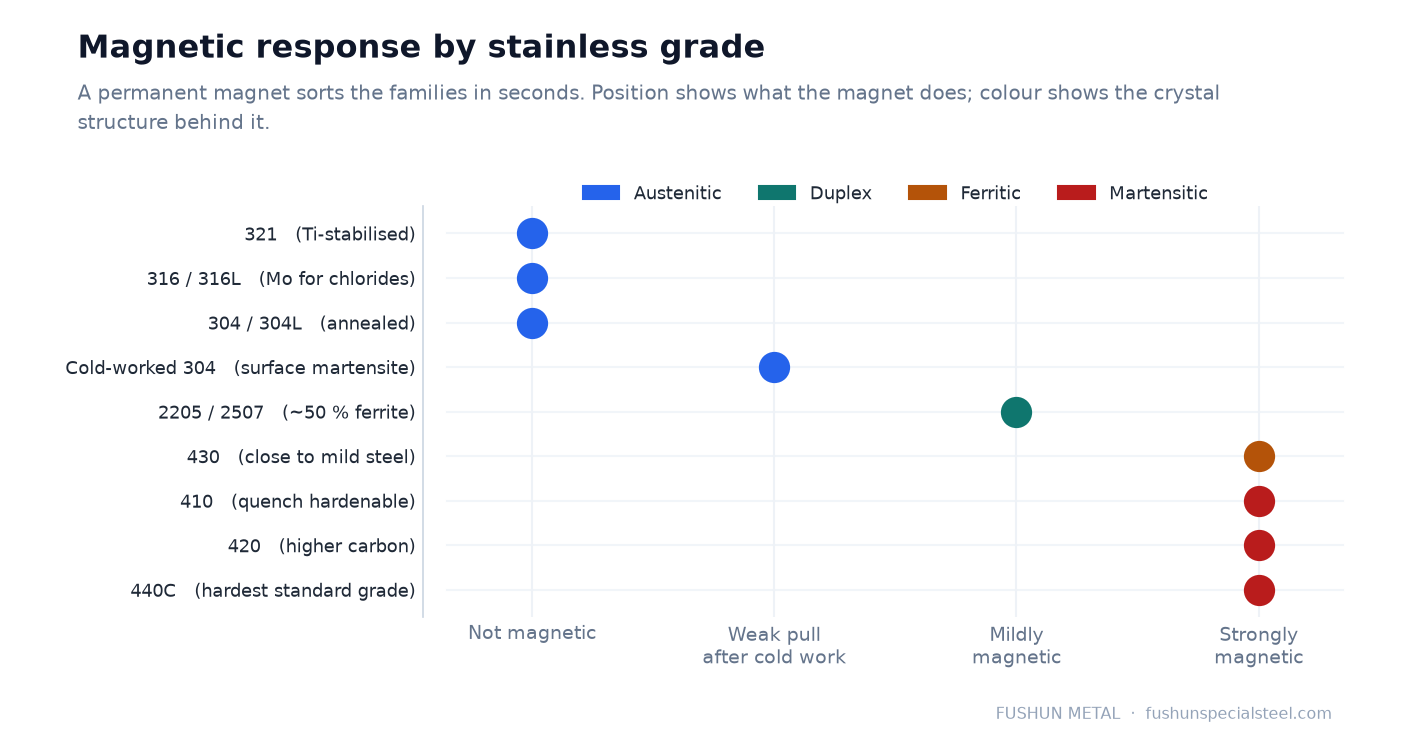
Short answer: austenitic grades — 304, 316 and 321 — are not magnetic. Ferritic grades such as 430 and 409 are, and so are the martensitic grades 410, 420 and 440C. Duplex grades are mildly magnetic because roughly half their structure is ferrite, but the pull is weaker than on plain carbon steel.
Magnetic behaviour by grade
| Grade | Structure | Magnetic | Note |
|---|---|---|---|
| 304 / 304L | Austenitic | No | Weakly magnetic after cold working |
| 316 / 316L | Austenitic | No | Molybdenum added for chloride service |
| 321 | Austenitic | No | Titanium stabilised against carbide precipitation |
| 430 | Ferritic | Yes | Strong pull, close to mild steel |
| 410 | Martensitic | Yes | Hardenable by quenching |
| 420 | Martensitic | Yes | Higher carbon than 410, harder after treatment |
| 440C | Martensitic | Yes | Highest hardness of the standard grades |
| 2205 / 2507 | Duplex | Mildly | About half ferrite, so a weaker pull |
Why the crystal structure decides it
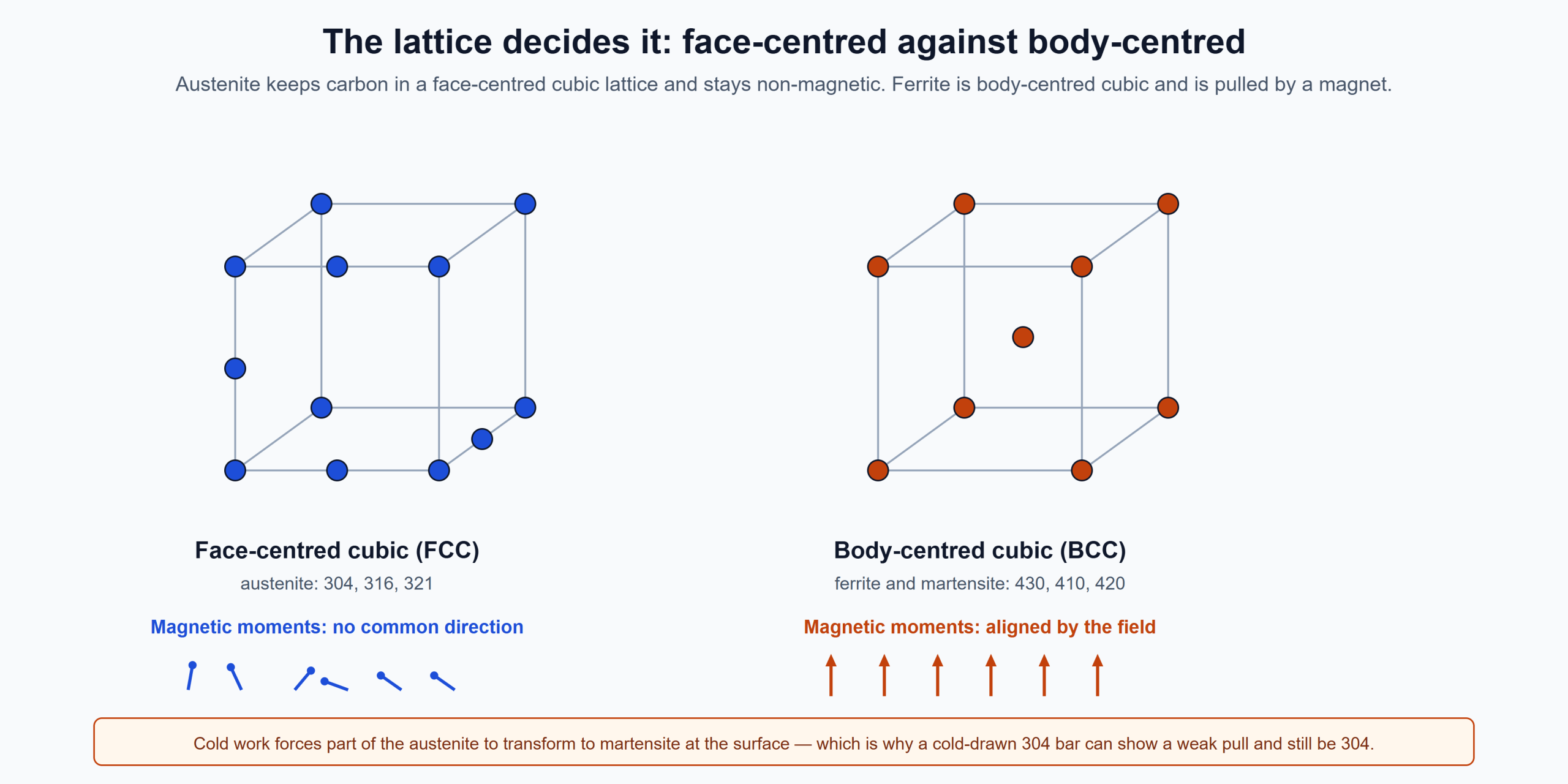
Every stainless steel contains iron, but iron on its own does not make a grade magnetic. What matters is the crystal lattice the iron sits in. Ferritic and martensitic steels keep a body-centred cubic lattice, which aligns in a magnetic field and is pulled towards a magnet. Austenitic steels — the whole 300 series — are face-centred cubic, and in the fully annealed condition they are not magnetic at all.
Why cold-worked 304 still sticks to a magnet
Cold working partly transforms austenite into martensite at the surface. Drawing, rolling, bending and machining all do it, which is why a cold-drawn 304 bar or a deep-drawn 316 part can show a weak magnetic pull even though the grade is classified as non-magnetic. It is a surface effect, not a change of grade, and it disappears on annealing.
301 stainless is the extreme case: it work-hardens faster than any other austenitic grade, so it develops a magnetic response sooner and more strongly.
How to test a part in ten seconds
A small permanent magnet separates the families reliably. It holds firmly to 430, 410 and 420, and falls away from annealed 304 and 316. A weak, patchy pull usually means cold-worked austenitic steel or a duplex grade. What a magnet cannot do is tell grades apart inside a family — for that you need PMI or chemical analysis.
Where this matters in purchasing
Magnetic response is a sorting aid on the shop floor and in scrap segregation, not an acceptance test. If a drawing calls for 304 and the part attracts a magnet, the question to ask is whether it was cold worked or annealed — not whether it is the wrong grade.
For the grades behind the table, see 317L, the 400 series and the hardness conversion chart.
What the magnet does not tell you
A magnet sorts families; it does not identify grades. 304 and 316 both fall away from it, and the two are indistinguishable on the shop floor even though 316 costs roughly a third more and is the grade specified for chloride service. Likewise 410, 420 and 440C all pull hard, and what separates them is carbon content, which no magnet can see.
The same limitation applies to scrap and to incoming mixed stock. A bin labelled “300 series” can hold 304, 316, 321 and 201, and the price gap between them is wider than the cost of sorting. Hand-held X-ray fluorescence or a chemical spot test is the only reliable separation; a magnet is at best a first pass that removes the 400-series and any carbon steel that has been mixed in.
There is one case where the magnetic response is genuinely diagnostic: a 304 part that should be non-magnetic and is not. That almost always means cold work — drawing, bending, thread rolling — and it is not a defect. If the part was annealed after forming and still pulls strongly, it is worth asking whether the grade on the certificate is the grade in the box.
Related reading
- 317L stainless steel — when the higher molybdenum grade is worth the cost.
- 400 series stainless — the martensitic and ferritic families in one place.
- 301 stainless steel — the austenitic grade that work-hardens fastest.
- Hardness conversion chart — HBW, HV and HRC in one table.
You get chemical composition, mechanical properties and a price — with inspection certificates to EN 10204 3.1 issued against the heat number.