
34CrMo4 / 1.7220 Alloy Steel (AISI 4135)
The lower-carbon member of the Cr-Mo family — 0.35 % carbon instead of 0.42. That difference is why 34CrMo4 welds without preheat in thin sections and still reaches 900 MPa after quench and temper, which is what pressure parts and seamless tube stock need.
34CrMo4, 42CrMo4 and SCM435 are not the same
All three are chromium-molybdenum steels and the names get used loosely. The carbon decides which one you want: 34CrMo4 runs 0.30–0.37 %, 42CrMo4 runs 0.38–0.45 %, and SCM435 runs 0.33–0.38 % to a Japanese specification. Same family, different weldability and different strength ceiling.
Choose 34CrMo4 when the part has to be welded and then heat treated: pressure vessels, tube sheets, gas cylinders, seamless tube stock. Choose 42CrMo4 when it has to be machined to 30 HRC and never welded. For JIS drawings calling SCM435, the SCM435 page governs.
Where the lower carbon pays off
Carbon equivalent for 34CrMo4 sits around 0.65 against 0.75 for 42CrMo4. That gap is what lets a 20 mm section be welded with a modest preheat instead of a full 250 °C soak. On a vessel that has to be fabricated and then stress relieved, the lower carbon also reduces the risk of cold cracking in the HAZ.
The cost is strength. Quenched and tempered, 34CrMo4 tops out around 900–1000 MPa where 42CrMo4 reaches 1100–1250 MPa. If the design needs 10.9 bolts or a 35 HRC shaft, this is the wrong grade and we will say so.
Supply range and delivery condition
| Form | Size range | Condition |
|---|---|---|
| Rolled round bar | Ø16–200 mm | Annealed / Q+T |
| Forged round bar | Ø200–600 mm | Annealed / Q+T |
| Seamless tube stock | Ø60–350 mm | Annealed |
| Plate | Thickness 6–100 mm | Normalised / Q+T |
Chemical composition
| C | Si | Mn | P | S | Cr | Mo |
|---|---|---|---|---|---|---|
| 0.30–0.37 | ≤0.40 | 0.60–0.90 | ≤0.025 | ≤0.035 | 0.90–1.20 | 0.15–0.30 |
EN 10083-3. The ASTM 4135 window is close but allows P to 0.035 and does not control residual Cu.
Mechanical properties
| Condition | Tensile MPa | 0.2 % proof MPa | Elongation % | Hardness |
|---|---|---|---|---|
| Annealed | ≤650 | ≥380 | ≥20 | ≤217 HB |
| Q+T, 24–28 HRC | 800–950 | ≥650 | ≥15 | 250–280 HB |
| Q+T, 30 HRC | 900–1000 | ≥750 | ≥13 | 285–320 HB |
Heat treatment
Normalise 870–900 °C, air cool. Harden 850–880 °C, oil quench. Temper 600–650 °C for 24–28 HRC, 540 °C for 30 HRC.
For welded fabrications, stress relieve at 600–620 °C after welding and before the final machining. Do not skip it on thick sections — the residual stress will move the bore.
What ships with every lot
- EN 10204 3.1 with chemistry and mechanicals
- Carbon equivalent calculated and reported for welding qualification
- Hardenability curve on request
- Ultrasonic inspection to SEP 1921 for pressure parts
- Grain size to ASTM E112
Packing and delivery
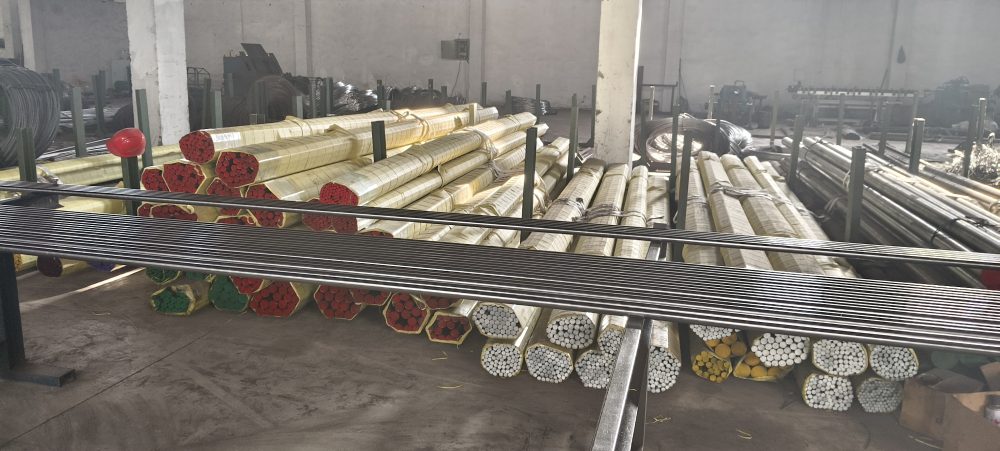
Bar bundled by heat, tube stock capped and bundled. Typical lead time 20–30 days.
Request a quote
- Standard — EN 10083-3 34CrMo4, or ASTM 4135
- Form and size — bar diameter, tube stock OD × wall, or plate thickness
- Quantity in pieces or kilograms
- Condition — annealed or Q+T with the hardness window
- Inspection — 3.1, UT, hardenability
Email [email protected] or use the form below. Drawings in DXF, STEP or PDF are all fine.
Related grades
One heat-treatment route, one certification route — grades can be combined in a single shipment.
